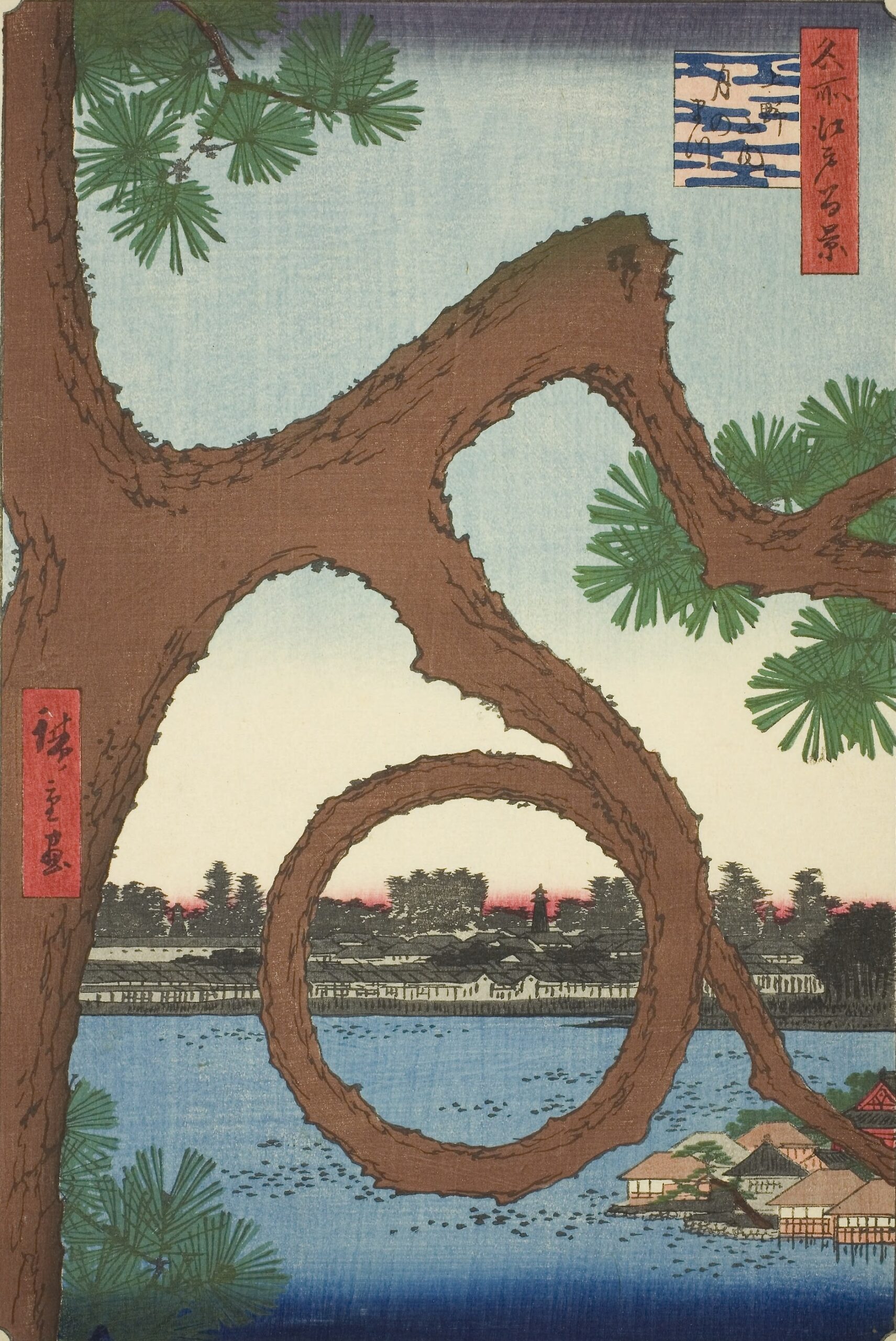
Utagawa Hiroshige-One Hundred Famous Views of Edo-90-Autumn-Moon Festival in Ueno 歌川広重-名所江戸百景-90-秋-上野山内月のまつ
Current Address: Ueno Toshogu Shrine Area, Taito Ward
Latitude and Longitude: Latitude: 35.7156, Longitude: 139.7709
Published: August 1857 Age: 61
Moon Festival in Ueno (Ueno Sannai Tsuki no Matsu) Tourist Guide-Style Commentary: “Moon Festival in Ueno Sannai”
■ Introduction
Utagawa Hiroshige’s “One Hundred Famous Views of Edo” is a masterpiece of 119 paintings, vividly depicting the landscapes symbolizing the four seasons of Edo and the lives of ordinary people.
One of the paintings, “Moon Festival in Ueno Sannai,” depicts the renowned “Moon Pine” tree located in the grounds of Kan’ei-ji Temple in Ueno.
This pine tree was widely known for its unique appearance, and was a famous spot visited by the people of Edo.
Hiroshige places the tree’s unique branches majestically at the center of the composition, adding the Edo cityscape in the background, creating a stunning ukiyo-e that blends the beauty of nature with the urban landscape.
■ What is the Moon Pine?
The “Moon Pine” refers to a pine tree with branches that curve like a bow, as if the moon could be seen hanging between them.
It is located near the Kiyomizu Kannon Hall in the grounds of Kan’ei-ji Temple in Ueno, and was widely known throughout the Edo period.
Moon viewing was an elegant pastime for the people of Edo, and is featured in many haiku and waka poems.
The “Moon Pine” in particular was an especially popular moon-viewing spot, as its branches framed the moon like a picture frame.
In fact, it was lost once after the Meiji period.
It was recently restored, and can still be seen today within the grounds of Kiyomizu Kannon Hall.
If you visit after learning about Hiroshige’s ukiyo-e, you can experience the refined style beloved by the common people of Edo, even today.
■ Highlights of the Painting
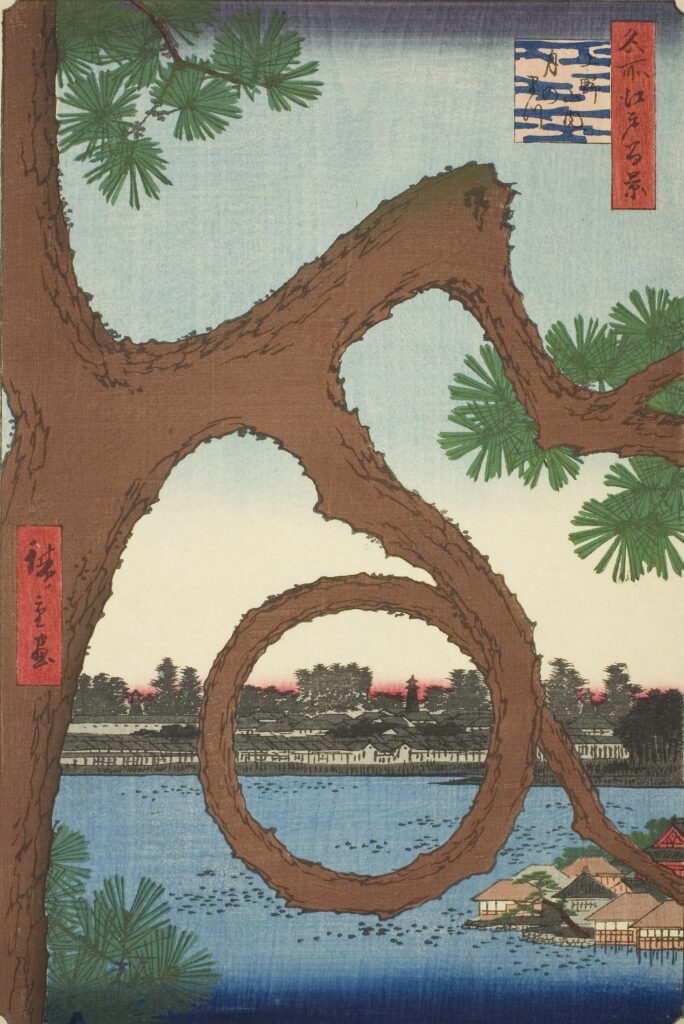
This painting features a rather interesting composition, overlooking Shinobazu Pond through the beautifully swirling branches of a pine tree.
Near the Kiyomizu-do Temple, which was located beside Shinobazu Pond in Ueno, there was a pine tree with oddly curved branches.
People called it the “Moon Pine.”
The image is too enlarged, making the relative positions of the pine trees unclear.
The painting depicts the tree as it grew along the pond’s edge.
On the right side, the vermilion-lacquered Bentensha Shrine on Nakajima Island and the surrounding restaurants are depicted.
Lotus leaves float like specks on the surface of Shinobazu Pond.
Across the pond, three fire watchtowers can be seen.
The numerous feudal lord residences are also evident.
■ Modern-Day “Moon Pine” and Ueno Tourism
The “Moon Pine,” restored at Kiyomizu Kannon-do Temple in Ueno Park, is a valuable piece that conveys the atmosphere of the Edo period to the present day.
Looking from beneath the tree, you can practically see the moon hanging between its branches.
After visiting Tsuki no Matsu, we recommend a stroll through Ueno Park.
■ Tourist Guide Recommendations
① The Different Appearances of the Pine Trees at Day and Night
Enjoy the completely different beauty of the pines at different times of the day: the pines against the blue sky during the day, and the mystical pines draped over the moon at night.
② Visit Kiyomizu Kannon-do Temple
This Kannon-do Temple was modeled after Kiyomizu-dera Temple in Kyoto. The view from the temple grounds is truly spectacular, like an “Edo observation deck.”
③ Stroll through Ueno Park: With Shinobazu
Pond, the statue of Saigo Takamori, and museums and art galleries, Ueno Park is packed with spots where you can enjoy culture and nature.