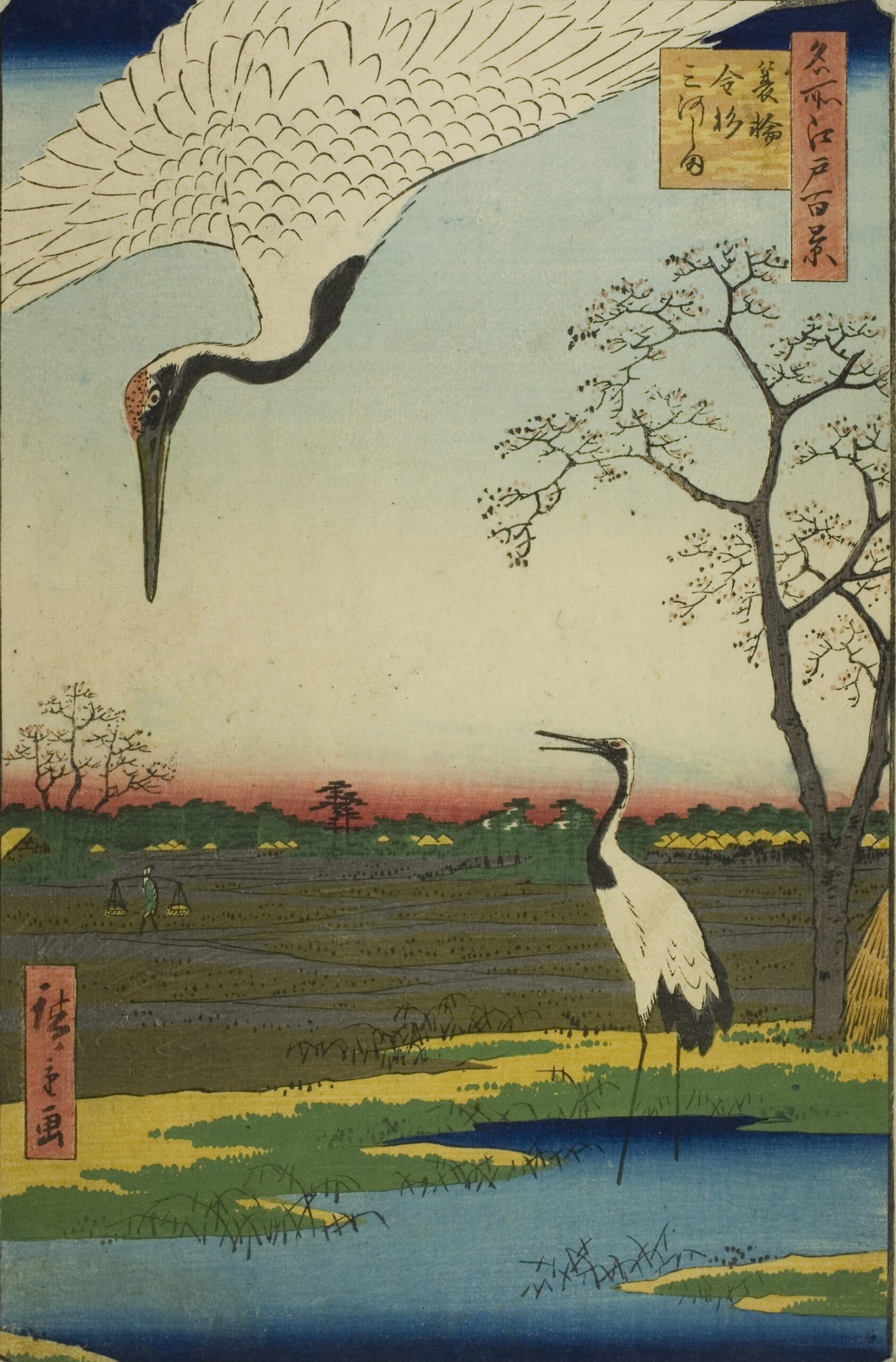

Utagawa Hiroshige – One Hundred Famous Views of Edo – 103 – Winter – Minowa, Kanasugi, and Mikawa Island 歌川広重-名所江戸百景-103-冬-蓑輪金杉三河しま
Current Address: Near Minowa, Arakawa Ward
Latitude and Longitude: Latitude: 35.7370, Longitude: 139.7830
Published: May 1857 Age: 61
Tourist Guide-Style Commentary: “Minowa, Kanasugi, and Mikawa Island”
■ Introduction
Utagawa Hiroshige’s “One Hundred Famous Views of Edo” is a masterpiece of 119 illustrations depicting the city, nature, and everyday life of Edo’s common people throughout the four seasons at the end of the Edo period.
Among these, “Minowa, Kanasugi, and Mikawa Island” depicts the waterfront landscape in the eastern part of Edo, stretching from present-day Taito Ward to Sumida Ward.
The sandbars and islands along the Sumida River, as well as the fishing communities, are woven into the work, vividly conveying the lives of Edo’s common people and their waterfront culture.
■About Minowa, Kanasugi, and Mikawashima
Minowa is the area around Minowa in present-day Taito Ward.
During the Edo period, the area featured a rural landscape, and its proximity to the Sumida River meant it was deeply connected to waterside life.
Kanasugi stretches from Ueno to Asakusa, on the border between Edo’s urban area and downtown.
With numerous docks and lumber yards along the river, it served as a logistics hub.
Mikawashima is in what is now Arakawa Ward.
A sandbar formed in the Sumida River, where fishing, vegetable gardens, and dried sardine production were common.
It was an important location that supported the food culture of the Edo commoners.
All three areas were closely connected to the Sumida River and its tributaries, and were symbolic of the waterfront landscape and lifestyle.
■Highlights of the Art
Minowa Village is located where the Nihonzutsumi and the Nikko Kaido road, which runs from Nihonbashi to Senju, intersect.
To the south is Mikawashima Village, an area of marshes and rice fields.
Red-crowned cranes migrated here every year from October to March and settled there.
Cranes were prized as sacred birds of good fortune and longevity.
At the end of the year, the shogun would personally release his hawk to capture a crane and present it to the Imperial Court as an “Oki no Tsuru.”
This was known as the Shogun’s “Tsuru Onari no Kari.”
In addition, bamboo fences were placed around the feeding area to protect the cranes.
Local farmers were hired as Tsurumi headmen, commonly known as dog watchmen.
The headman provided food and watched over passersby and dogs.
Kites were also regulated to avoid startling the cranes.
■ Modern-day Minowa and Mikawashima Area
The area from present-day Minowa in Taito Ward to Mikawashima in Arakawa Ward has developed into a residential and commercial district.
Walking paths have been constructed along the Sumida River embankment, allowing you to experience the waterfront atmosphere of the past.
The rows of cherry blossom trees are particularly beautiful in spring, allowing you to imagine the scenery of Hiroshige’s “Waterside and Common People” as you walk.
■ Recommended Points from the Tourist Guide
- Stroll along the Sumida River Terrace
Walking along the Sumida River from Minowa toward Mikawashima allows you to reminisce about the history of Edo’s shipping and fishing industries while enjoying the scenery of modern Tokyo. - Arakawa Nature Park
This nature park near Mikawashima is a lush green space, reminiscent of the suburban atmosphere of Edo. - Combine with a visit to Asakusa
Kanasugi’s proximity to Asakusa makes it a recommended sightseeing spot to combine a visit to Sensoji Temple and Nakamise Shopping Street.