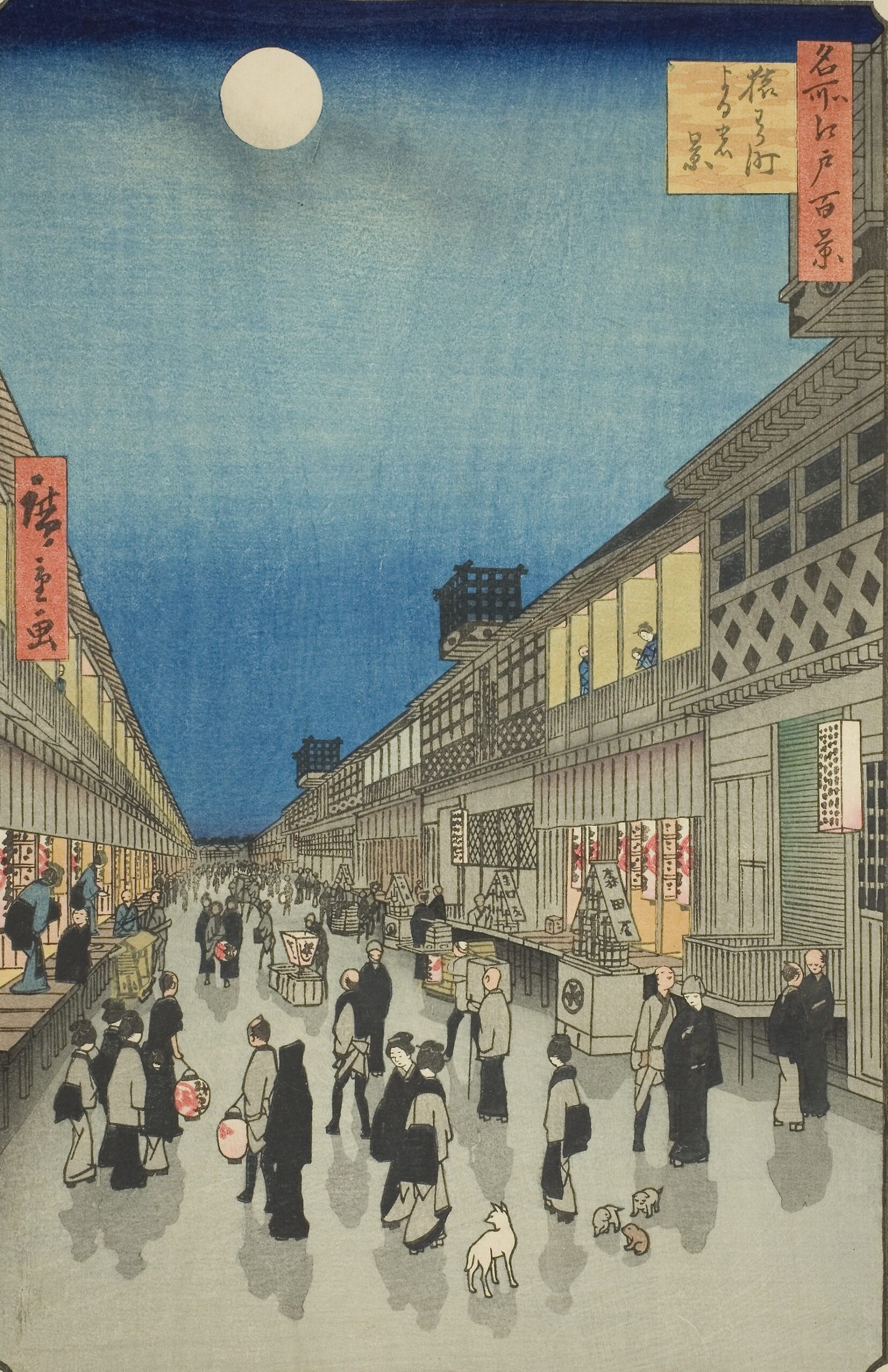
Utagawa Hiroshige-One Hundred Famous Views of Edo-91-Autumn-Saruwakacho Evening View 歌川広重-名所江戸百景-91-秋-猿わか町よるの景
Current Address: Near Saruwakacho, Asakusa, Taito Ward
Latitude and Longitude: Latitude: 35.7140, Longitude: 139.7960
Published: September 1856 Age: 60
Tourist Guide-Style Commentary: “Saruwakacho Evening View”
■ Introduction
Utagawa Hiroshige’s “One Hundred Famous Views of Edo” is a series of ukiyo-e prints that vividly capture the lives and urban culture of Edo’s common people.
Among these, “Saruwakacho Evening View” is particularly noteworthy as one of the few works depicting Edo’s nighttime entertainment.
Saruwakacho (near present-day Asakusa 6-chome, Taito Ward, Tokyo) was a theater district home to Edo’s three theaters.
It was a bustling entertainment district, bustling with theatergoers during the day and returning from the theater at night.
Hiroshige’s fantastical depiction of the bustling activity of that night brings to light the splendor of Edo culture.
■ What is Saruwaka-cho?
Saruwaka-cho was named in 1841 after the kabuki actor Saruwaka Kanzaburo.
By order of the Edo Shogunate, theaters that had previously been located throughout the city were gathered here.
The “Edo Three Theaters” – Nakamura-za, Ichimura-za, and Morita-za – stood side by side in Saruwaka-cho, and the area flourished as Edo’s premier theater town.
Commoners of Edo enjoyed “going to Theater Town” as a major form of entertainment, and the area was bustling with theaters and teahouses from day to night.
Saruwaka-cho is also close to the temple town of Sensoji Temple, making it a center of popular culture where theater, worship, and outings all came together.
■ Highlights of the Illustration
Kabuki performance rights were granted in Edo in 1651, with four theaters: Nakamura-za, Ichimura-za, Morita-za, and Yamamura-za.
Yamamura-za closed down in 1714 due to the Ejima Incident.
After that, performances continued as the Edo Three Theaters.
All three theaters were destroyed in a fire in 1841.
The shogunate relocated them all to a single location northeast of Sensoji Temple.
The area was named Saruwaka-machi after Saruwaka Kanzaburo, the founder of Edo Kabuki.
From the front on the right, the illustration shows the Morita-za, Ichimura-za, and Nakamura-za theaters lined up in this order, with gomen turrets marking each theater’s roof.
On the left is a teahouse.
The illustration depicts people returning home after a kabuki performance at six o’clock in the evening.
■ The Site of Saruwakacho Today
Saruwakacho is located near Asakusa 6-chome in Taito Ward, Tokyo.
Once upon a time, theaters lined the main street.
Today, it’s a residential and shopping district.
You can learn about its history through monuments and information boards.
The theaters in Saruwakacho eventually moved to Nihonbashi and Kobikicho.
The image of “theater town = Saruwakacho” was deeply etched in the memories of the Edo common people.
Even when visiting the modern-day Kabukiza and National Theater, you can feel the Edo theater tradition that originated in Saruwakacho.
When sightseeing in Asakusa, visit the site of Saruwakacho along with Kaminarimon and Sensoji Temple, and you’ll be walking through the heart of Edo-period theater culture.
■ Tourist Guide Recommendations
① Daytime and Nighttime Fun
After touring the Sensoji Temple area during the day, visiting the site of Saruwakacho at dusk will help you imagine the bustling nightlife depicted in ukiyo-e prints.
② Experience theatrical culture
The Edo-Tokyo Museum and the National Theater sometimes hold exhibitions showcasing the theatrical culture of Saruwakacho.
③ Strolling around the Asakusa nightscape
Walking from the Saruwakacho ruins toward Sensoji Temple, you’ll see modern-day lanterns and the illuminated five-story pagoda, overlapping the world of Hiroshige’s painting with the modern-day nightscape.