Utagawa Hiroshige – One Hundred Famous Views of Edo – 114 – Winter – Afuhizaka (Afuhi Hill) Outside Toranomon 歌川広重-名所江戸百景-114-冬-虎の門外あふひ坂
Current Address: Aoi-zaka, Toranomon, Minato Ward
Latitude and Longitude: 35.6735, Longitude: 139.7480
Published: November 1857 Age: 61
Tourist Guide-Style Commentary: “Afuhizaka (Afuhi Hill) Outside Toranomon”
■Introduction
Utagawa Hiroshige’s “One Hundred Famous Views of Edo” is a series of 119 paintings that vividly capture Edo’s famous sites and seasonal scenery.
Among these, “Afuhizaka (Afuhi Hill) Outside Toranomon” depicts the slope outside Toranomon, facing the outer moat of Edo Castle.
Toranomon was located in a strategic location south of Edo Castle, and was a prestigious area lined with samurai residences and temples and shrines.
Hiroshige depicted this place not as an everyday slope, but as part of the Edo cityscape, imbuing it with a soft atmosphere and a sense of perspective.
The name of the slope, “Afuhi Aoi,” is said to come from the three-leaf hollyhock crest of the Tokugawa Shogunate.
■About Toranomon and Aoi-zaka
Toranomon was one of the outer gates of Edo Castle and a strategic location protecting the southern side of Edo.
Lined with feudal lord residences, it was the center of samurai society.
Aoi-zaka is a slope that descends from outside Toranomon toward Akasaka, and its name comes from the “hollyhock” crest of the Tokugawa family.
People of the Edo period went about their daily lives, going up and down this slope.
■Highlights of the Painting
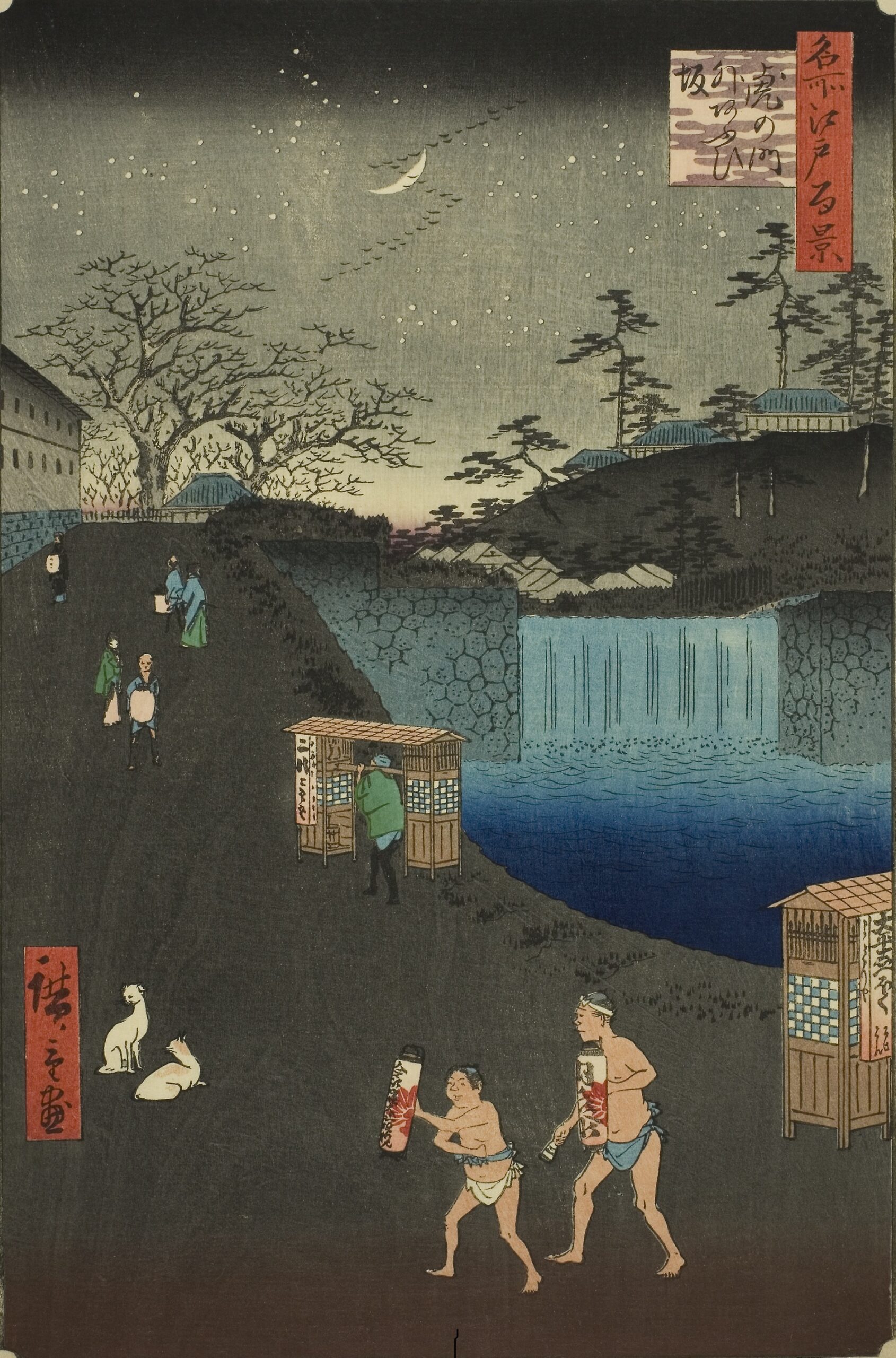
The slope on the left is Aoi-zaka.
It is said to have been named after the hollyhock planted at the guardhouse below the large hawthorn tree at the top of the slope.
Water overflowing from the reservoir flows down this slope into the outer moat.
This is where the samurai residences that defended Edo Castle were located.
On the left is the secondary residence of the Kano family, lords of Ichinomiya Domain.
The lit building in the center on the right is the main residence of Naito Noto no Kami.
The stars, crescent moon, and flying geese in the night sky indicate that it is a cold winter’s day.
The two people in the center are running around visiting shrines and temples over the course of 30 days, ringing bells and carrying lanterns.
They are performing a winter visit to pray for improvement in their skills.
The lantern held by the person on the left indicates that they are returning from Konpira Gongen.
Konpira Gongen is located within the main residence of the Kyogoku family in Marugame, Shikoku, and is open to the public on the 10th of each month.
The udon noodle vendor on the right has the words “Taihei Shippoku” written on it.
■Walking through Modern-Day Toranomon
Toranomon is now lined with skyscrapers, and its Edo-period landscape has been lost.
Walking along the streets, searching for remnants of the Edo Castle outer moat, offers a sense of history.
Aoi-zaka itself no longer exists.
By walking along the slopes from Toranomon toward Akasaka, you can relive the vestiges of the Edo-period foothills where people once traveled.
■Tourist Guide Recommendations
① Strolling along the remains of Edo Castle’s outer moat
Walking from Toranomon toward Tameike, you’ll find a path that gives you a sense of the former moat, making it the perfect historical stroll.
② Toranomon Hills and Historical Comparison
With a Hiroshige painting in hand, walking and comparing the modern-day skyline with the Edo-period slopes will give you the feeling of traveling back in time.
③ Stretching your legs toward Akasaka
Nearby, you’ll find Hie Shrine and the Akasaka Imperial Estate. Knowing the history of the slopes will allow you to see the overlapping landscapes of Edo and the present.