Utagawa Hiroshige – One Hundred Famous Views of Edo – 111 – Winter – Senzoku Pond, Kesakake Pine 歌川広重-名所江戸百景-111-冬-千束の池 袈裟懸松
Current Address: Senzoku Pond, Ota Ward
Latitude and Longitude: Latitude: 35.5969, Longitude: 139.6890
Published: February 1856
Age: 60
Senzoku Pond, Kesakake Pine (Senzoku Pond, Kesakake Pine) Tourist Guide-Style Commentary: “Senzoku Pond, Kesakake Pine”
■ Introduction
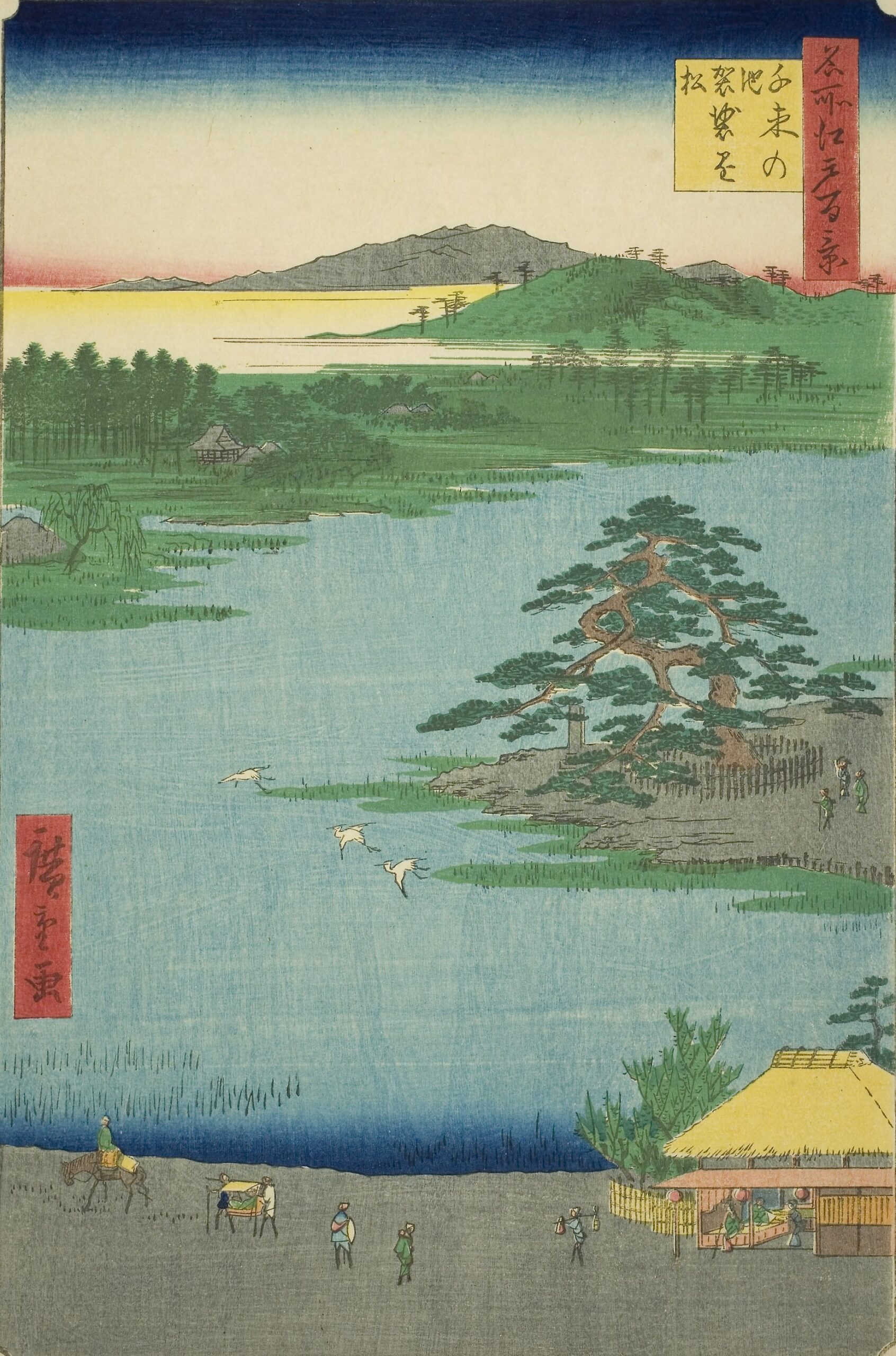
Utagawa Hiroshige’s “One Hundred Famous Views of Edo” painting, “Senzoku Pond, Kesakake Pine,” is set at Senzoku Pond, a famous spot on the outskirts of Edo.
Standing on the pond’s edge is a legendary pine tree known as “Kesakake Pine,” which has long been a popular spot among the common people.
With these pine trees and the pond in the background, Hiroshige skillfully depicts a landscape that evokes tranquil nature and history.
This painting conveys the charm of Senzoku Pond, a popular tourist destination a short journey from central Edo.
■What is Senzoku Pond?
Located in what is now Minami-Senzoku, Ota Ward, Tokyo, it is now called Senzoku Pond.
It is a large pond that stretches around Senzokuike Station on the Tokyu Ikegami Line.
One theory is that the name Senzoku Pond comes from the fact that it was a pond filled with water that could irrigate 1,000 rice fields.
The current name, Senzoku Pond, comes from legend that Nichiren Daishonin washed his feet in the pond.
During the Edo period, teahouses and rest areas lined the area around the pond, and it was bustling with common people enjoying cherry blossom viewing, moon viewing, and boating.
■ Legend of the Kasakake Pine
There are various theories about the origin of this place: one is that Minamoto no Yoritomo stopped here while hunting and hung the robe of a monk fleeing persecution on the pine branch; another is that the monk Nichiren Daishonin hung his robe here.
In any case, the pine has been passed down through the generations as the “pine tree where the robe was hung” and has become a symbol of the scenic beauty.
The Kasakake Pine was beloved by the people of Edo as a “single pine tree where history and faith intertwine,” and served as a landmark when visiting Senzoku Pond.
■ Highlights of the Painting
Senzoku Pond is located about one ri west of Ikegami Honmonji Temple.
The pine in the center is said to be the one on which Nichiren Daishonin took off his robe and hung it.
The shrine opposite is dedicated to Shichimen Daimyojin, and was built to protect the pond from a large snake that once inhabited it.
This pond was formed when groundwater from the Musashino Plateau welled up and accumulated in a depression.
Since the Heian period, it has been used for irrigation in the surrounding area.
In front of the pond is the Nakahara Kaido road, which leads to Hiratsuka.
■ Modern-day Senzokuike Pond
Today’s Senzokuike Park is a popular spot for viewing cherry blossoms and autumn leaves.
With walking paths and boating available, it remains a popular public recreation spot, just as it was during the Edo period.
The kesakake pine tree has already been lost.
The area around the pond is dotted with historical sites such as a statue of Nichiren Daishonin, the grave of Katsu Kaishu, and the legend of Yoritomo.
It is a short walk from Senzokuike Station on the Tokyu Ikegami Line.
■ Tourist Guide Recommendations
① Strolling around Senzokuike Park
The walking path that circles the pond is approximately 1.2 km long.
Enjoy the changing nature of the seasons.
② Historical Exploration
There are plenty of attractions for history buffs, including historical sites related to Nichiren Daishonin and the grave of Katsu Kaishu.
③ Seasonal Scenic Beauty
No matter the season, you can enjoy beautiful scenery, with cherry blossoms in spring, autumn leaves in autumn, and fresh greenery in early summer.