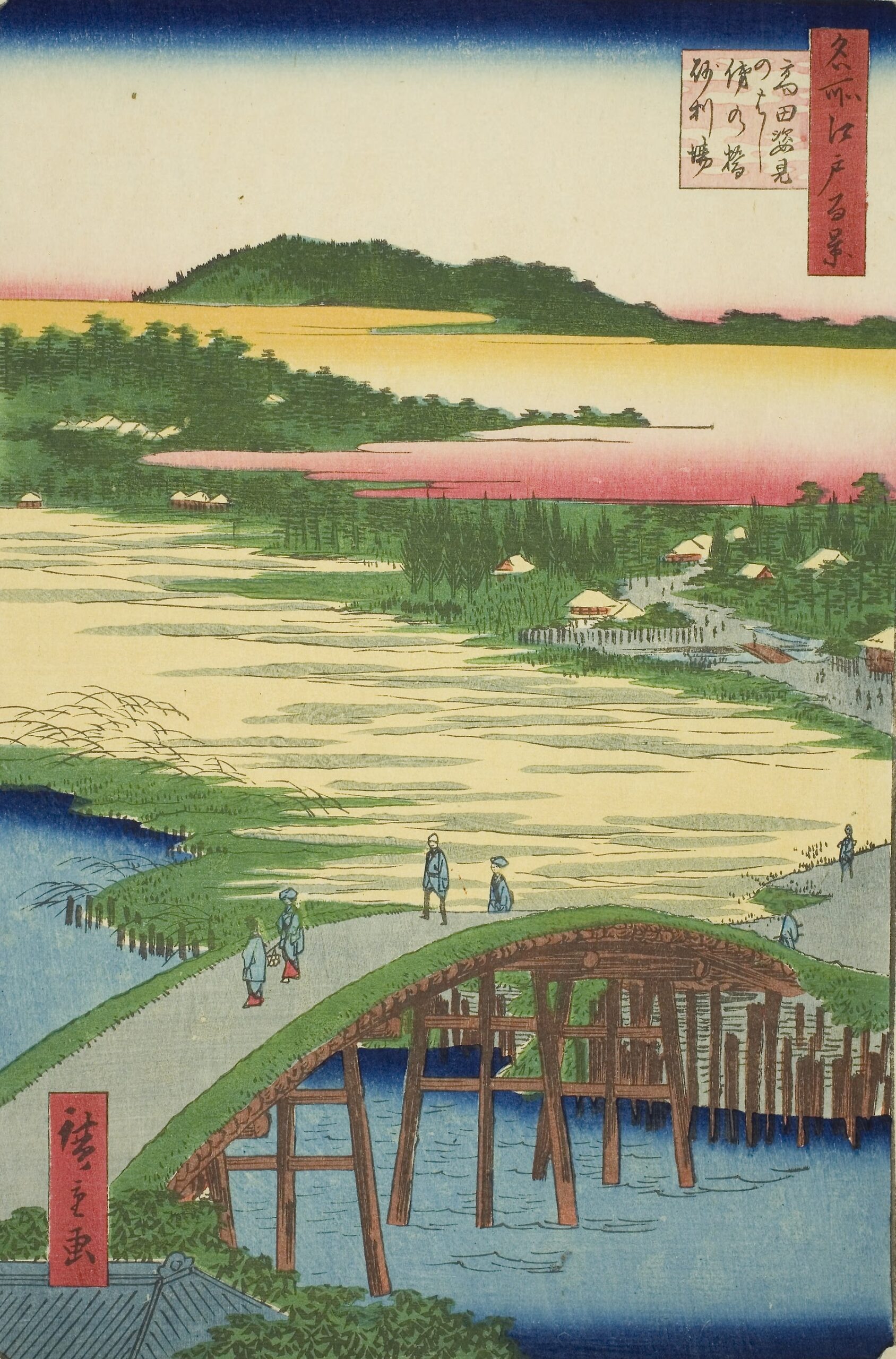
Utagawa Hiroshige – One Hundred Famous Views of Edo – 117 – Winter – Takada Mirror Bridge, Omokage Bridge, Gravel Pit 歌川広重-名所江戸百景-117-冬-高田姿見のはし 俤の橋砂利場
Current Address: Near Mejirodai and Takada, Bunkyo Ward
Latitude and Longitude: Latitude: 35.7130, Longitude: 139.7200
Published: January 1857 Age: 61
Tourist Guide-Style Commentary: “Takada Mirror Bridge, Omokage Bridge, Gravel Pit”
■Introduction
Utagawa Hiroshige’s “One Hundred Famous Views of Edo” is a series of ukiyo-e prints that vividly depict the landscapes and lives of people in Edo, covering everything from the city center to the suburbs.
“Takada Mirror Bridge, Omokage Bridge, Gravel Pit” is set in the area around Takada Village, on the outskirts of Edo.
It depicts a scene of gravel mining, which supported the construction of the city of Edo.
Unlike the glamorous towns and famous places, this illustration conveys the atmosphere of life and industry.
■Takada Village and the Name of the Bridge
Takada Village spanned the area of present-day Shinjuku and Bunkyo Wards.
It was a stopover on an important highway leading to central Edo.
Along with Waseda and Mejiro, it is a tranquil region with rural scenery and rivers.
Sugatami-no-Hashi is one of the bridges over the Kanda River.
It was named after the view of one’s own reflection in the water.
Nagatari-no-Hashi is a bridge over the Kanda River.
People of the Edo period gave bridges and rivers evocative names, such as “Omokage” (meaning “reminiscence”), to cherish their scenery.
The rivers in this area were also sources of gravel used in the construction of Edo Castle and roads.
Edo’s urban infrastructure was supported by the supply of materials from these suburbs.
■Highlights of the Painting
The subject of this painting is a bridge over the Kanda Canal, which flows through Takada Village, and another bridge over a nearby narrow waterway.
The name is a bit confusing.
The title begins with Sugatami Bridge, suggesting that, like the paper-cut illustration, the bridge in the foreground was recognized as Sugatami Bridge.
In the Meiji period, the bridge in the foreground was officially given the name Menkage Bridge.
Across the small bridge in the background, on the right is Nanzoin Temple.
To the left of Nanzoin Temple in the center is Hikawa Shrine.
The bridge between Nanzoin Temple and Hikawa Shrine is Sugatami Bridge, and the large bridge in the foreground is thought to be Omokage Bridge.
The river below Omokage Bridge is the Kanda Canal.
The gravel pit is the yellow area in the center.
The gravel pit is a nickname derived from the fact that this area was once a gravel pit.
■Walking in the Modern Takada Area
Today, the Kanda River continues to shape the local landscape and is a beloved cherry blossom viewing spot.
A stroll along the river in spring evokes the atmosphere of Hiroshige’s ukiyo-e prints.
The Sugatami Bridge and Omokage Bridge still span the Kanda River.
Crossing these modern bridges is a wonderful way to reflect on the scenery depicted in the prints.
The gravel pits from the Edo period have disappeared.
The surrounding area has become a residential area and university campus, creating a streetscape where history and modern life intersect.
■Recommended Points from the Tourist Guide
- Stroll along the Kanda River Cherry Blossom Avenue
In spring, cherry blossoms cover the river, creating a landscape that truly recreates the atmosphere of the Edo period. - Bridge Tour
A stroll along the Sugatami Bridge and Omokage Bridge offers the pleasure of comparing the compositions depicted in Hiroshige’s prints with the modern landscape. - Historical Walk
If you visit Waseda University and Takadanobaba together, you can experience the transition of the city from the Edo period to the Meiji period and the present day.