Utagawa Hiroshige – One Hundred Famous Views of Edo – 38 – Kuruwa Naka Shinonome(Red Light District) – Commentary 歌川広重-名所江戸百景-38-廓中東雲 解説
Current Address: Near Senzoku 4-chome, Taito Ward
Latitude and Longitude: Latitude 35.7290, Longitude 139.7950
Published: April 1857 Age: 61
Commentary
<1> Introduction
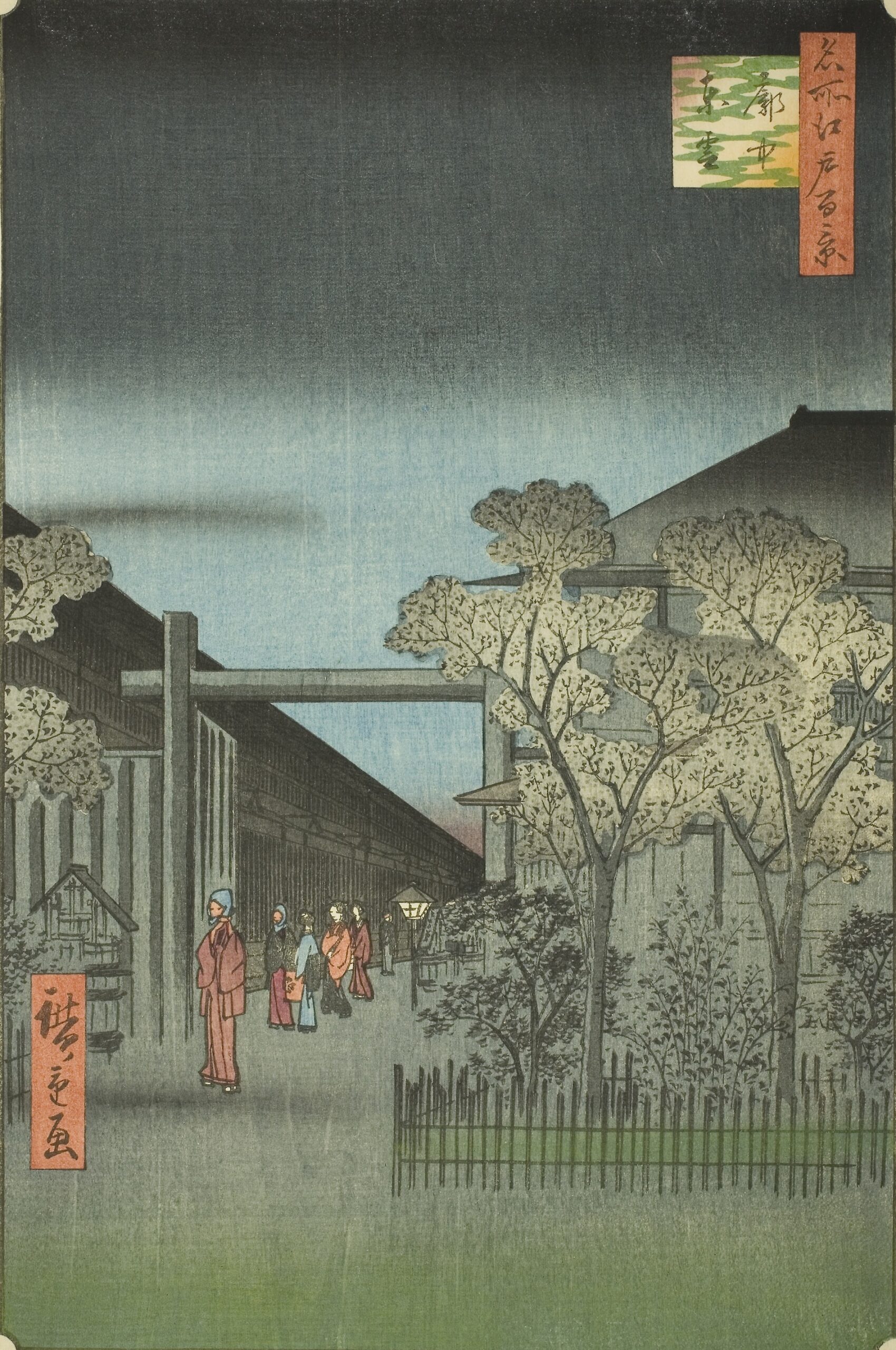
“Kuruwa Naka Shinonome” is set in Yoshiwara, Edo’s most prestigious pleasure district.
“Shinonome” refers to the time before dawn, when the sky begins to lighten.
This work skillfully captures the lingering silence after a glamorous night in Yoshiwara.
The work depicts the gap between the glamorous world of dreams and the reality that arrives at dawn.
<2> Yoshiwara Pleasure District and the “Kuruwa Naka Shinonome”
During the Edo period, Yoshiwara was an officially licensed pleasure district located northeast of Asakusa, inside the Nihonzutsumi (Japan Leisure District).
“Kuruwaka” refers to the interior of Yoshiwara.
Entering the main gate was a main street called “Nakano-cho,” lined on both sides with brothels and brothels.
At night, it became Edo’s most glamorous place, filled with the sounds of gorgeously dressed courtesans, touts soliciting customers, and the sound of shamisen instruments.
However, “Kuruwaka Nakagumo” depicts the quiet that follows the hustle and bustle, just before dawn.
Courtesans entertain customers all night, and only at dawn do they finally get time to rest.
Behind the glamorous appearance of Yoshiwara in the morning, there is also a sense of the hard work and melancholy of the women.
As dawn breaks, the traffic of townspeople and travelers stops for a while, and only the occasional figure of someone cleaning or running errands for the morning can be seen.
The dawn sky is a symbolic element that marks the transition between the lingering afterglow of the feast and the start of a new day.
This time of day can be seen as connecting the extraordinary world of the pleasure quarter with real society.
<3> Highlights of the Painting
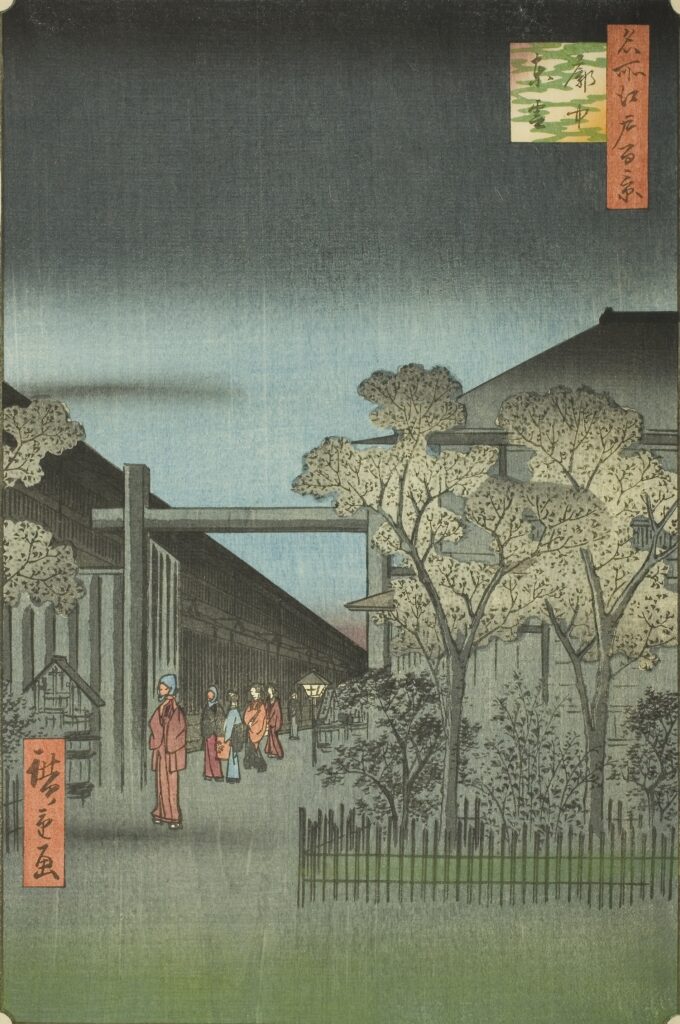
Nakano-cho, Yoshiwara’s main street, is depicted in the center of the painting, with a perspective that continues into the distance.
The buildings on both sides are lined up in a regular pattern, and the orderly streetscape creates an all-too-familiar atmosphere.
The depiction of the sky symbolizes the east(sky clouds) in the title.
The color changes from a still-dark indigo blue to a faint white as the sky in the east, evoking the end of night and the beginning of a new day.
Although Yoshiwara is known for its glamour, there are few people in this work.
This emphasizes the tranquility after the hustle and bustle of the previous night has passed.
The buildings of the brothels where the courtesans spent their time are lined up on both sides, their dark shadows contrasting with the brightness of the sky.
This painting depicts Shin Yoshiwara, Edo’s only licensed red-light district, located north of Asakusa.
The men leaving the brothel all hide their faces with their heads turned.
The faint darkness around the branches suggests that the flowers are in full bloom.
<4> Yoshiwara for the People of Edo
Yoshiwara was a place of longing for the common people of Edo, yet at the same time, a dreamlike existence.
Only a limited number of people could actually go there to enjoy themselves.
Its mention in ukiyo-e and literature captured the imagination of many.
Yoshiwara was more than just an entertainment district; it was also a cultural center where kabuki, haiku, fashion trends, and music were disseminated.
<5> Modern-day Remnants
The Yoshiwara Daimon intersection remains in what is now Senzoku, Taito Ward, marking the location of the entrance to the red-light district.
Nakano-cho began from here.
The streets of the former red-light district are still dotted with historical sites that recall the past, such as the Yoshiwara Benzaiten shrine and a memorial tower for courtesans.
Yoshiwara continues to be featured in films, novels, and rakugo (traditional Japanese storytelling) today, remaining a symbolic setting for Edo culture.
<6> Sightseeing Guide
1. Walking from Yoshiwara Daimon to the Former Nakanocho Gate
Strolling while imagining Hiroshige’s compositions will give you a sense of the dreamlike atmosphere of Edo.
2. Yoshiwara Benzaiten and Yoshiwara Shrine
A place of worship for courtesans and townspeople, it is the spiritual anchor of Yoshiwara culture.
3. Pairing with Asakusa
Visiting Sensoji Temple and Nihonzutsumi will deepen your understanding of both Edo’s common people’s culture and its pleasure quarters.
4. Visit during the Morning Glow
A stroll under the morning sky will allow you to fully experience the tranquil atmosphere of Hiroshige’s “Kuruwa-Naka Shinonome” .