Utagawa Hiroshige – One Hundred Famous Views of Edo – 35 – Spring – Masaki, the Forest of the Suijin on the Sumida River – Commentary 歌川広重-名所江戸百景-35-春-隅田川水神の森真崎 解説
Current Address: Sumida River Shrine, 2-chome, Tsutsumi-dori, Sumida Ward
Latitude and Longitude: Latitude 35.7208, Longitude 139.8129
Published: August 1856 Age: 60
Commentary
<1> Introduction
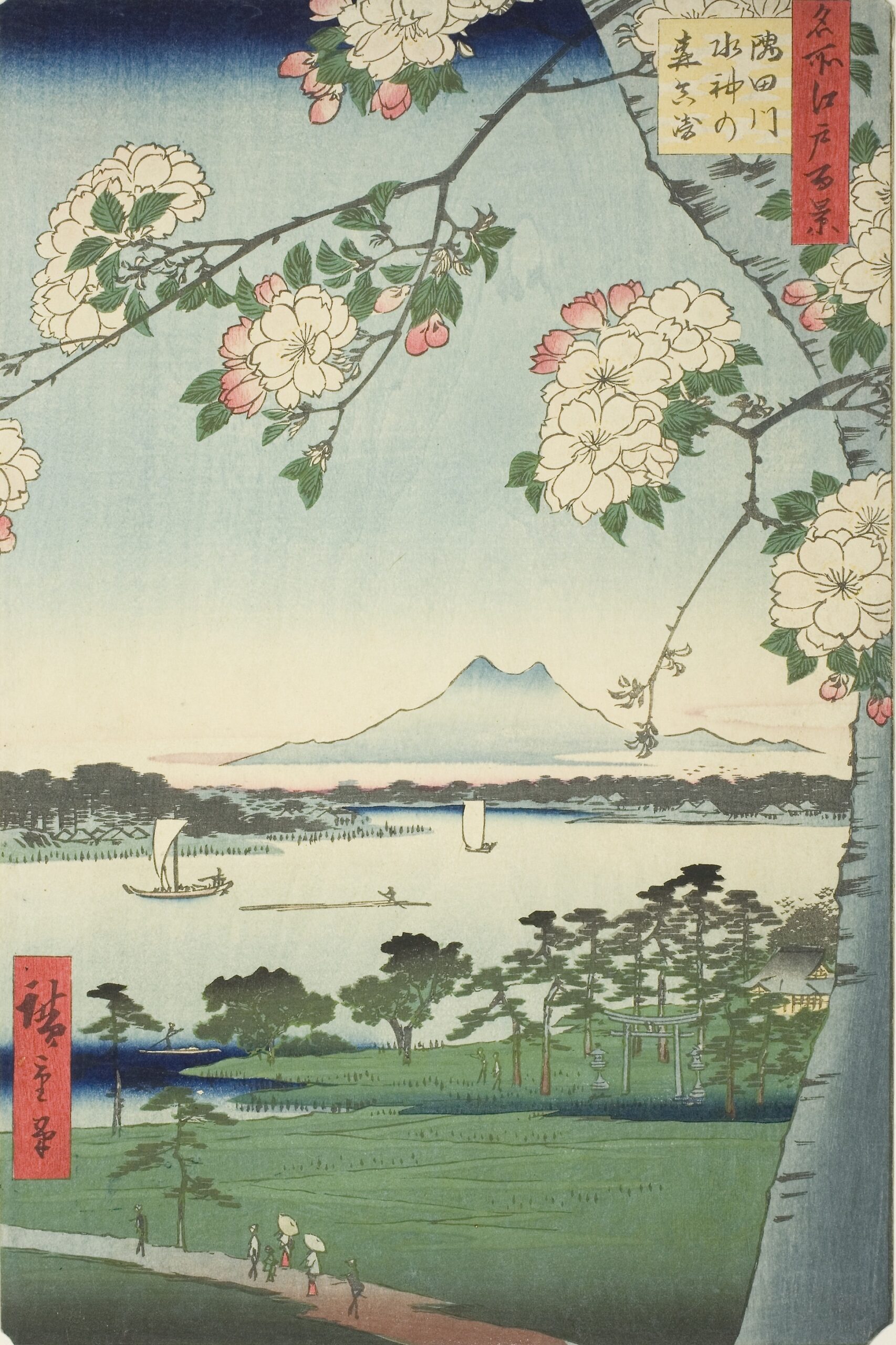
“Masaki, the Forest of the Suijin on the Sumida River” depicts the atmospheric landscape of the lower Sumida River.
The flowing river, the green of the forest, and the distant Masaki cape harmonize in harmony.
This landscape was a place of relaxation for Edo citizens and a symbol of waterside worship.
<2> About Masaki and the Suijin Forest
This forest, located in what is now Higashi-Komagata, Sumida Ward, Tokyo, stretched along the east bank of the Sumida River.
A “Water Shrine” was enshrined within the forest, attracting the faith of those praying for safe water transport.
Suijin, the god of water, presides over rivers and waterside areas, and was deeply worshipped as a being who prevents floods and water damage and protects the safety of boats.
The forest, with its pleasant river breeze and scattered teahouses, was also a popular tourist destination.
“Masaki” refers to the cape-like geographical feature jutting out where the Sumida River makes a large bend.
Jumping out into the river, Masaki offered a panoramic view of the Sumida River and the boats passing by, making it a representative viewing spot in Edo.
Many citizens visited throughout the year, enjoying the cherry blossoms of spring, playing in the river in summer, and viewing the autumn leaves in autumn.
<3> Highlights of the painting
In the foreground, cherry blossoms on the Sumida embankment can be seen, and people walking along the footpath are on their way to the Masaki Ferry crossing.
In the middle ground, the torii gate of Suijin no Mori, a lantern, and Masaki on the opposite bank of the Sumida River are visible.
Mount Tsukuba is depicted in the background.
Hiroshige’s signature “diagonal gaze” is used effectively.
A cool breeze blows across the water’s surface, creating a tranquil scene symbolizing Edo’s waterside culture.
Upstream, beyond the Sumida Bank, stands Suijin Shrine, the main guardian deity of the Sumida River.
Because this shrine is located on a small hill, it becomes like a floating island when the river floods.
It never submerged.
Suijin Shrine is also known as Sumida River Shrine or Ukishima Shrine.
The shrine originated when Minamoto no Yoritomo sensed the spirit of the water god while crossing the river and built it here.
The deity is the dragon god, and many of his followers, shipowners who used the Sumida River, formed a Suijin-ko (water god worship) association.
In the foreground are cherry blossoms on the Sumida Bank, and people walking along the footpath are on their way to the bridge where Masaki Ferry crosses.
In the middle ground are the torii gate of Suijin no Mori (Water God Forest), a lantern, and, across the Sumida River, Masaki on the opposite bank.
Mount Tsukuba is depicted in the distance.
<4> Edo Commoners and This Scenery
People visited Suijin Shrine to pray for the safety of the river, while also cooling off at teahouses and enjoying boat rides.
The Sumida River was Edo’s main artery, supporting the flow of goods.
The area around Suijin no Mori (Water God’s Forest) also served as a resting spot for boats plying the river.
Many haiku and waka poems were written about the Sumida River, and it was a place that nurtured inspiration for writers and artists.
<5> Modern Traces
Today, Suijin Shrine remains in Higashikomagata, Sumida Ward, conveying the memory of the landscape depicted by Hiroshige.
While modern bridges and skyscrapers line the streets, a stroll along the riverside allows you to imagine the waterside atmosphere of the Edo period.
The topography of the remains of Masaki has changed due to urbanization.
You can sense its remnants by walking along the Sumida River Terrace and the embankment.
<6> Tourist Guide
1. Visiting Suijin Shrine in Higashikomagata, Sumida Ward
Experience the setting of Hiroshige’s paintings on site.
② Stroll along the Sumida River Terrace
Walking along the promenade along the Sumida River, you can imagine the river scenery from the Edo period.
③ Combine with a visit to Asakusa
Suijin no Mori is close to Asakusa, so you can enjoy it together with Kaminarimon Gate and Sensoji Temple.