(まなやま・さんやぼりやけい)
Utagawa Hiroshige – One Hundred Famous Views of Edo – 34 – Spring – Night View of Manayama San’yabori 歌川広重-名所江戸百景-34-春-真乳山山谷堀夜景 解説
(まなやま・さんやぼりやけい)
Current Address: Minomiya Shrine, 2-chome, Mukojima, Sumida Ward
Latitude and Longitude: Latitude 35.7182, Longitude 139.8064
Published: August 1857 Age: 61
Explanation
<1> Introduction
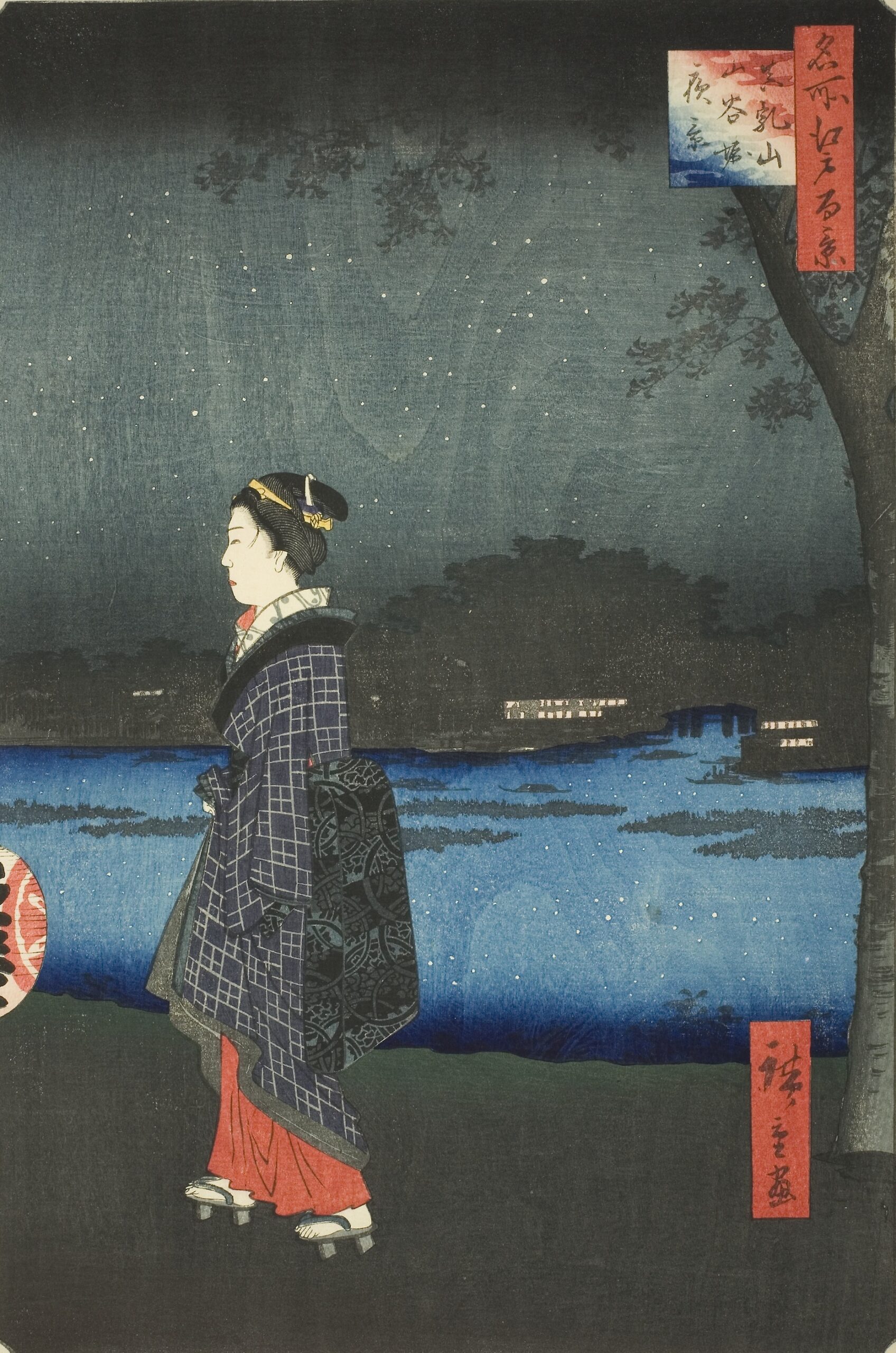
“Night View of Manayama San’yabori” depicts a fantastical nightscape set in the Asakusa area in northeastern Edo.
The painting features Manayama, located northeast of Sensoji Temple, and San’yabori, known as the gateway to the Yoshiwara pleasure district.
The boats and lights floating in the darkness of the night vividly convey the bustle of Edo’s entertainment district and the nocturnal movement of people.
<2> What are Mt. Shinchiyama and Sanyabori?
Mt. Shinchiyama is a small hill located northeast of the main hall of Sensoji Temple.
It is now a temple called Matsuchiyama Shoden.
It has been worshiped by common people since the Edo period.
Shoten (Kankiten) is worshipped as the god of prosperity in business and marital harmony, and many people visit to pray for love.
From the small hill, you can see the Sumida River and Sanyabori, making it a scenic spot overlooking the city of Edo.
Sanyabori was a busy canal that served as a route for boats heading from the Sumida River to the Yoshiwara pleasure district.
As a transportation route connecting Asakusa and Shin Yoshiwara, many boats traveled back and forth, even at night.
Boats carrying people heading for entertainment passed by, and teahouses and waiting rooms lined both banks of the moat.
<3> Highlights of the painting
In the pitch-black darkness, lights flicker on the river surface and boats sail back and forth.
A subdued atmosphere is expressed, distinct from the bustle of the daytime.
The outline of Mount Shinchiyama towering over the hills creates a mystical atmosphere.
Lanterns and bonfires are lit on the boats, conveying the excitement and anticipation of the people heading to Yoshiwara.
The painting depicts the distinctive features of Edo’s urban space, where entertainment and faith coexisted side by side.
Bold depictions of nighttime scenes are rare in ukiyo-e, so Hiroshige’s choice of a night view was groundbreaking in itself.
Mount Shinchiyama is a scenic spot overlooking the Sumida River and was formerly known as Mount Akatsuchi or Mount Mado.
It is now written as Mount Matsuchiyama.
This was a large mountain named after the Asakusa Kannon Temple.
It is said that it was cut down to become smaller when the Nihonzutsumi embankment was constructed.
On the mountain stands the Shokannon Souryuin temple, which enshrines a pair of statues of Kankiten.
Common people affectionately called him Shoten-sama.
Originally a general serving the Hindu god Shiva, he was later associated with Buddhism.
During the Edo period, he was believed to bring prosperity to business and marital harmony.
Under cherry trees in the foreground, a geisha walks along the Sumida embankment, guided by the light of a lantern leading her ahead.
This is Minomiya Shrine, and the hill on the opposite bank is Mount Magichiyama.
Below it, you can see the lights of a restaurant.
The painting also depicts Imado Bridge over the Yamayachibori moat.
<4> Edo Commoners and This Scenery
Mount Magichiyama was used by many people as a gateway to nighttime entertainment.
Not only commoners, but samurai and merchants also traveled by boat to Yoshiwara.
After offering prayers at Mount Magichiyama, they took a boat from Yamayachibori to Yoshiwara. Experience the unique Edo culture where faith and entertainment intersected.
<5> Modern-Day Remnants
Matsuchiyama Shoden Temple still remains in Asakusa today, known for its blessings of marital harmony and business prosperity.
Enjoy views of the Sumida River from the temple grounds.
The San’yabori canal has been filled in and is now a park and road.
Walking around Asakusa, you can see remnants of the past in place names and monuments.
Relive the atmosphere of the past by strolling through the night view of Sensoji Temple and the Sumida River, illuminated by lanterns and other lights.
<6> Tourist Guide
1. Matsuchiyama Shoden Pilgrimage
Experience the faith of the Edo commoners that continues to this day.
2. Sensoji Temple Nighttime Illumination
Asakusa at night is the perfect place to reminisce about the Edo night view.
3. Stroll Along the Remains of San’yabori
Experience the historical vestiges of Edo-period boat traffic by walking through parks and roads, reminiscing on the waterways of the Edo period.