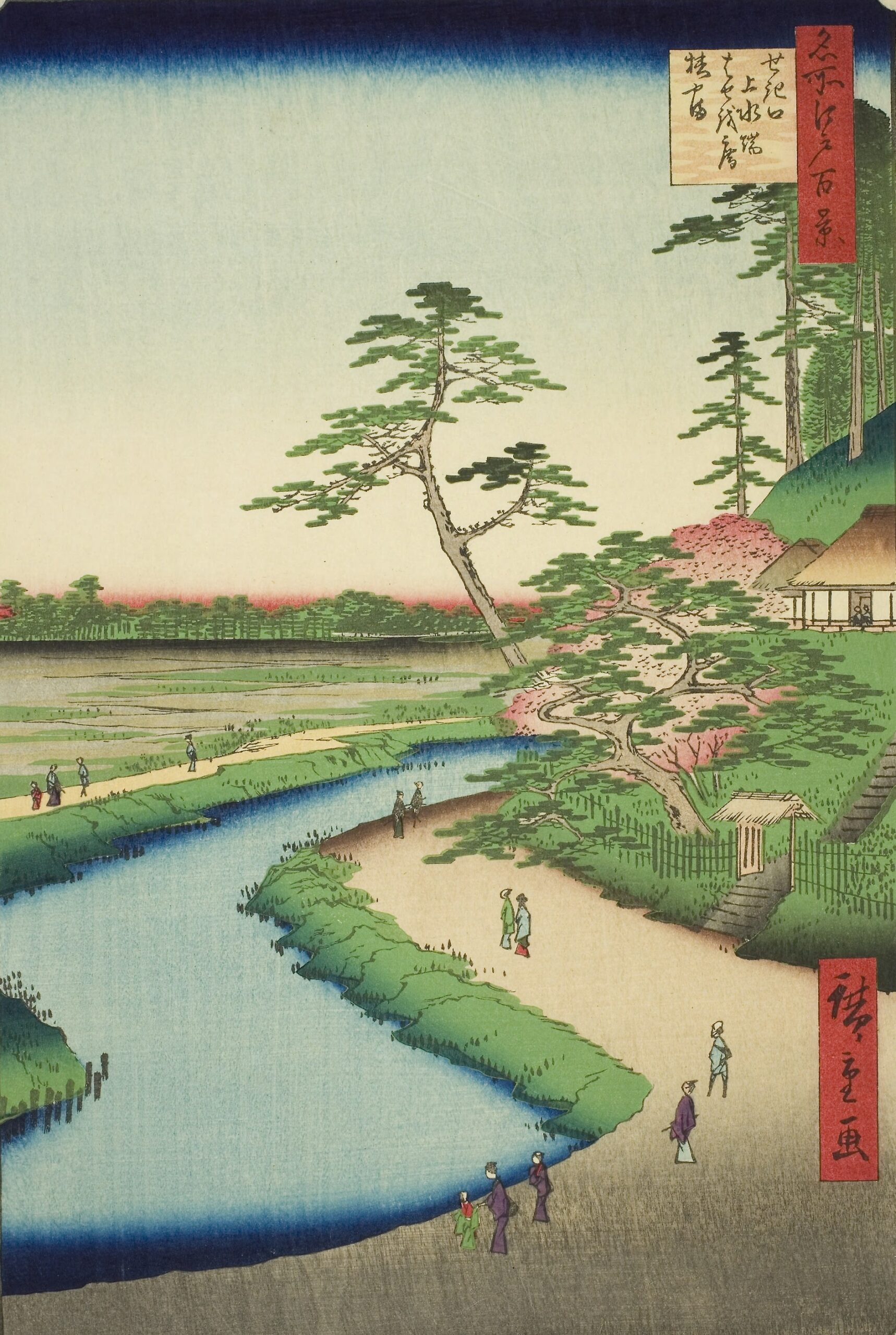
Utagawa Hiroshige-One Hundred Famous Views of Edo-40-Spring-Sekiguchi Waterway, Hasewo-an, Tsubakiyama-Commentary 歌川広重-名所江戸百景-40-春-せき口上水端はせを庵椿やま 解説
Current Address: Near Chinzanso, 2-10 Sekiguchi, Bunkyo Ward
Latitude and Longitude: Latitude 35.7130, Longitude 139.7400
Published: April 1857 Age: 61
Commentary
<1> Introduction
This work is based on the area around the Sekiguchi Oarai Weir.
This area plays an important role as an intake point for the water supply.
It was also a quiet area beloved by literati and artists.
The work depicts Hasewo-an, associated with haiku poet Matsuo Basho, and Tsubakiyama, a famous spot for camellias.
<2> About the Tamagawa Canal, Sekiguchi Oarai Weir, Bashoan, and Tsubakiyama
The Tamagawa Canal was an artificial waterway dug in 1653 to supply drinking water to the city of Edo.
It drew water from the upper reaches of the Tama River and channeled it from Nerima to the Yotsuya and Kanda areas.
It could be said to be the “water of life” that supported Edo’s growing population.
The Sekiguchi Oarai Weir was a dam located in Sekiguchi, Bunkyo Ward, and was one of the intake points for Edo’s water supply.
It regulated the water volume and distributed it throughout the city.
It featured large wooden sluice gates and stonework, and functioned as an important water facility.
There are two theories about the name Sekiguchi: one is that it comes from the mouth of a dam built to separate water from Inokashira into the Edogawa River and the Kanda Canal, and the other is that it comes from the presence of a checkpoint on the Oshu Kaido road.
The connection between Matsuo Basho and Sekiguchi lies in the fact that this area was home to Hasewo-an, a small thatched hut where the haiku poet Matsuo Basho is said to have lived for a time.
The hut was Basho’s residence immediately before he set out on his journey to write “The Narrow Road to the Deep North.”
Many of Basho’s poems emphasize harmony with nature.
The name “Tsubakiyama” comes from the fact that many camellias grew wild in this area, hence the name “Tsubakiyama.”
During the Edo period, it was known as a famous flower spot, attracting many visitors in the spring.
During the Meiji period, it became the residence of Yamagata Aritomo, known as “Chinzanso,” and is now the famous Hotel Chinzanso Tokyo.
<3> Highlights of the painting
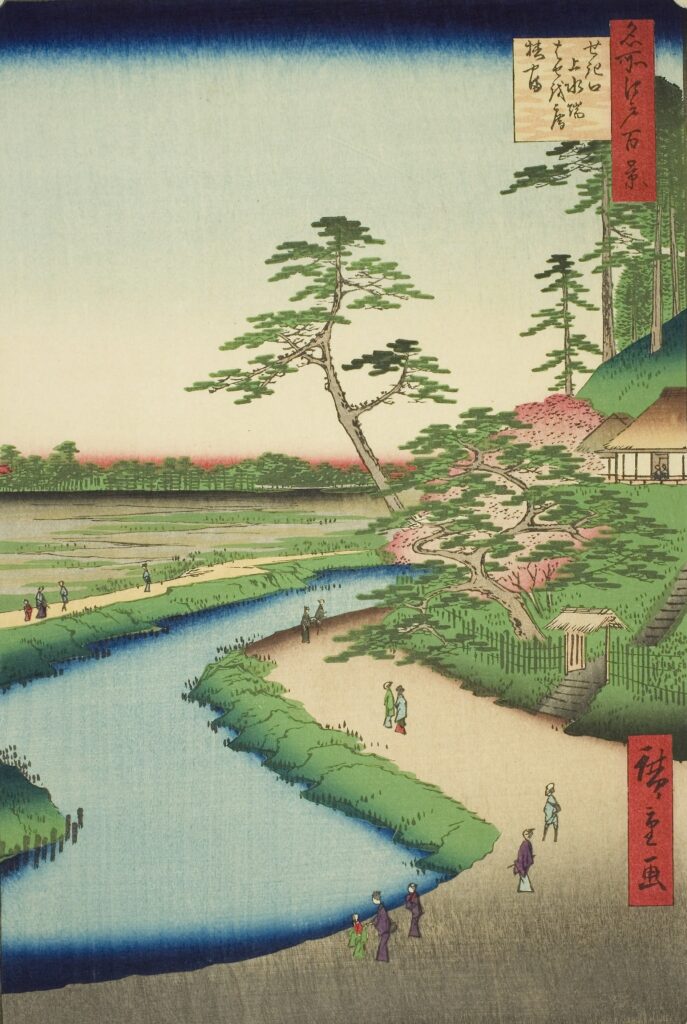
Although the shrine itself cannot be seen, there is Suijin Shrine on the mountain to the right.
This slope was named Tsubakiyama because of the abundance of camellias on it.
The rice fields of Waseda spread out on the left bank.
The building on the right is Basho-an.
Basho-an was built in 1743 on the 50th anniversary of Basho’s death, initiated by Hakutoen Sozui and Joan Makko.
It is said that Basho lived in the water guardhouse during the dam reconstruction work.
<4> Modern-day Sekiguchi and Tsubakiyama
Today, a monument commemorating the “Oarai Weir Site” remains in Sekiguchi, Bunkyo Ward, and a walking path has been developed marking the site of the Tama River Aqueduct.
You can experience the history of water in Edo while enjoying a stroll along the river.
The Tsubakiyama area is now a popular garden and hotel.
The vast Japanese garden is filled with camellias and other flowers that bloom throughout the seasons, conveying vestiges of the Edo period.
Basho-an itself no longer exists.
A monument commemorating Basho stands nearby, and many people visit as a literary stroll spot.
<5> Tourist Guide
1. Strolling through Chinzanso Garden
This Japanese garden, where you can enjoy flowers of all seasons, is a must-see.
You can feel the resemblance to Hiroshige’s painting “Tsubakiyama.”
2. Touring the Oarai Weir Site
While walking along the trail, you can learn about the history of the Tamagawa Canal, which supported the lifeline of Edo.
3. Exploring Places Associated with Basho
The Bunkyo Ward area is home to many historical sites associated with Basho, making it a recommended strolling spot for haiku lovers and history buffs.