Utagawa Hiroshige – One Hundred Famous Views of Edo – 42 – Flowers on the Tamagawa tsutsumi (embankment) 歌川広重-名所江戸百景-42-玉川堤の花 解説
Current Address: Near Shinjuku 1-2-chome, Shinjuku Ward
Latitude and Longitude: Latitude 35.687415, Longitude 139.713040
Published: February 1856 Age: 60
Explanation
<1> Introduction
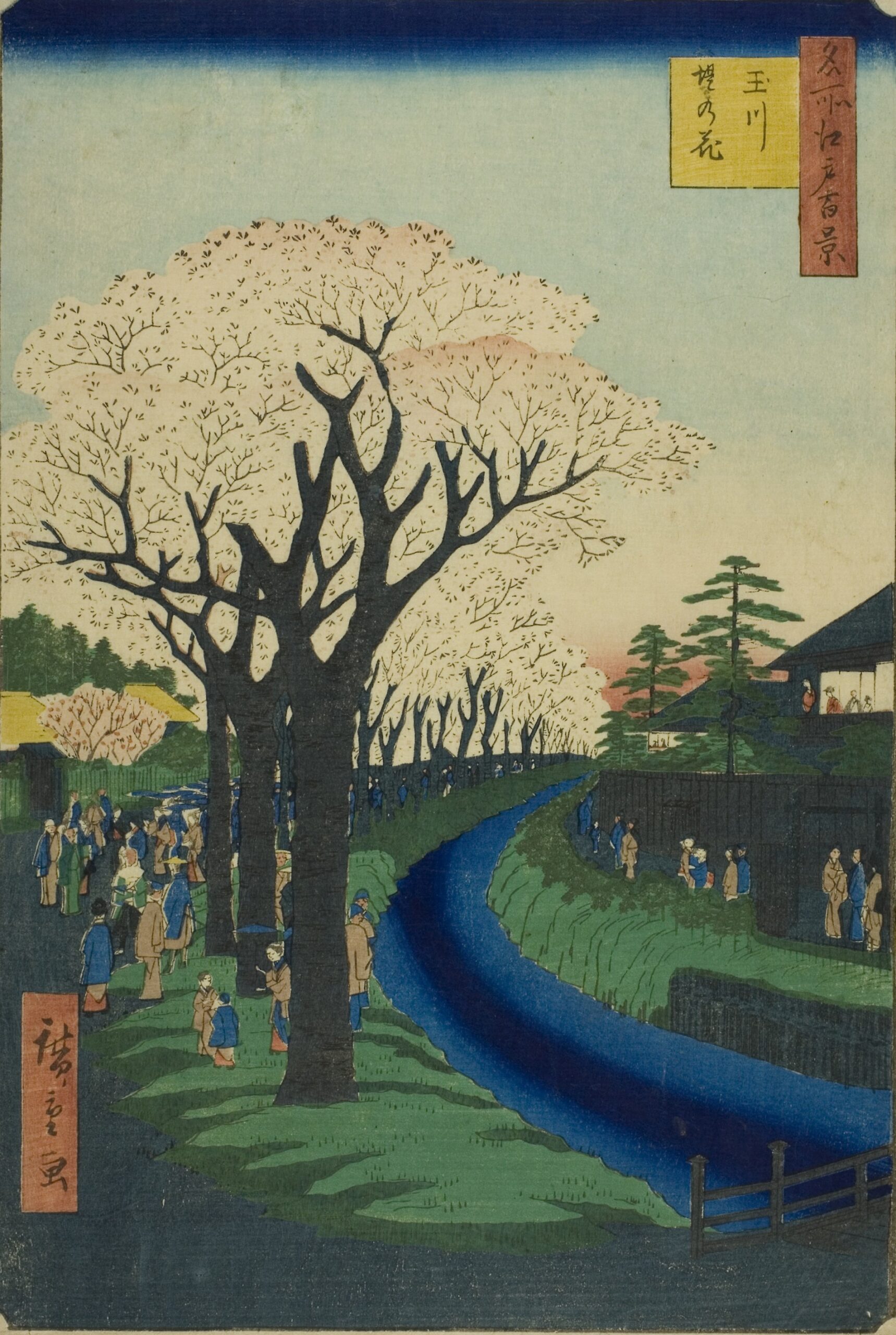
“Flowers on the Tamagawa tsutsumi( Bank)” depicts the Tamagawa tsutsumi, a famous cherry blossom viewing spot that brought color to spring in Edo, alongside Ueno and the Sumida River.
The painting depicts the river and its rows of cherry trees as a single entity.
<2> About the Tamagawa tsutsumi
The Tamagawa Bank refers to the Tamagawa River basin stretching from present-day Setagaya to Chofu and Komae. During the Edo period, the bank was built as part of flood control work, and cherry trees were planted to protect the tsutsumi.
The cherry trees were not only decorative but also served to protect the bank.
Eventually, the cherry trees grew large, and the row of trees along the river became a famous spot known as the “Tamagawa Embankment Cherry Blossoms,” a popular spring cherry blossom viewing spot for Edoites.
Cherry blossom viewing was a major event for people in the Edo period.
Samurai and townspeople alike would bring sake and bento boxes and sit by the river to admire the flowers.
Relatively close to the city center, the Tamagawa Embankment gained popularity as a luxurious spot where people could enjoy boating and cherry blossom viewing at the same time.
<3> Highlights of the painting
The row of cherry trees stretches from foreground to background, and as the river flows, the eye is drawn into the distance.
The cherry blossoms reflected on the river’s surface convey an air of spring in full bloom, brimming with seasonal feeling.
Beneath the cherry blossoms are depicted tiny figures enjoying cherry blossom viewing.
Some are hosting banquets, some are strolling, and some are boating on the river.
The cherry blossom branches are boldly placed in the foreground, creating a sense of depth through their contrast with the distant river view.
The viewer feels as if they are standing beneath the cherry blossoms, gazing off into the distance while feeling the river breeze.
Flowing across the screen is the Tamagawa Canal, which, along with the Kanda Canal, supplied Edo with water.
Constructed between 1653 and the following year, it drew water from the Tama River, passed through Musashino, and flowed behind Naito Shinjuku.
Between 1716 and 1636, cherry trees were planted along the canal to reinforce the banks and add to the beauty of the area.
The cherry trees are now in full bloom, attracting many visitors, including women with matching umbrellas and families with children.
Facing the river, on the left bank is the secondary residence of the Naito family, lords of Takato Domain in Shinshu, and its crowned gate can just be seen on the left edge.
The right bank is likely the back of the Naito Shinjuku inn.
The woman in a red kimono leaning out from the second floor with a customer is a female servant.
Many inns had female servants who ostensibly served as waitresses but in reality served as prostitutes, making Shinjuku a famous brothel for brothels.
<4> Cherry Blossom Viewing Culture among the Common People of Edo
During cherry blossom viewing season, people enjoyed the luxury of viewing the cherry blossoms from the river on houseboats along Tamagawa.
The sight of the cherry blossoms reflected on the water and the flowing petals was also elegant, and this atmosphere is also captured in Hiroshige’s paintings.
Cherry blossom viewing was an important form of entertainment for the common people, offering a welcome respite from their daily lives.
Not only townspeople and farmers, but also samurai and literary figures gathered on the Tamagawa banks, and it was common to see them composing poetry beneath the blossoms.
The people of Edo highly valued the changing seasons.
Flower viewing in spring, fireworks in summer, leaf-viewing in autumn, and snow-viewing in winter.
Among these, cherry blossom viewing was a particularly special event, and the cherry blossoms along the Tamagawa banks were a symbol of the arrival of spring to the people of Edo.
<5> Tamagawa’s Cherry Blossoms Remain Modern
Even today, rows of cherry blossom trees dot the Tamagawa River, attracting many visitors in the spring for cherry blossom viewing.
Walking along the modern-day banks and imagining Hiroshige’s ukiyo-e prints, you can experience the same sensation of gazing up at the cherry blossoms as the people of the Edo period. It’s truly an experience of empathy that transcends time and space.
Cherry Blossom Festivals and other events are held today, carrying on Edo traditions in a different form.
The cherry blossoms along the Tamagawa River banks can be considered a cultural heritage that connects the past and the present.