Utagawa Hiroshige – One Hundred Famous Views of Edo – 58 – Summer – Kameido Tenjin Shrine Grounds 歌川広重-名所江戸百景-58-夏-亀戸天神境内 解説
Current Address: Kameido Tenjin Shrine Grounds, 3-chome, Kameido, Koto-ku
Latitude and Longitude: 35.7100, Longitude: 139.8263
Published: August 1857 Age: 61
Explanation
<1> Introduction
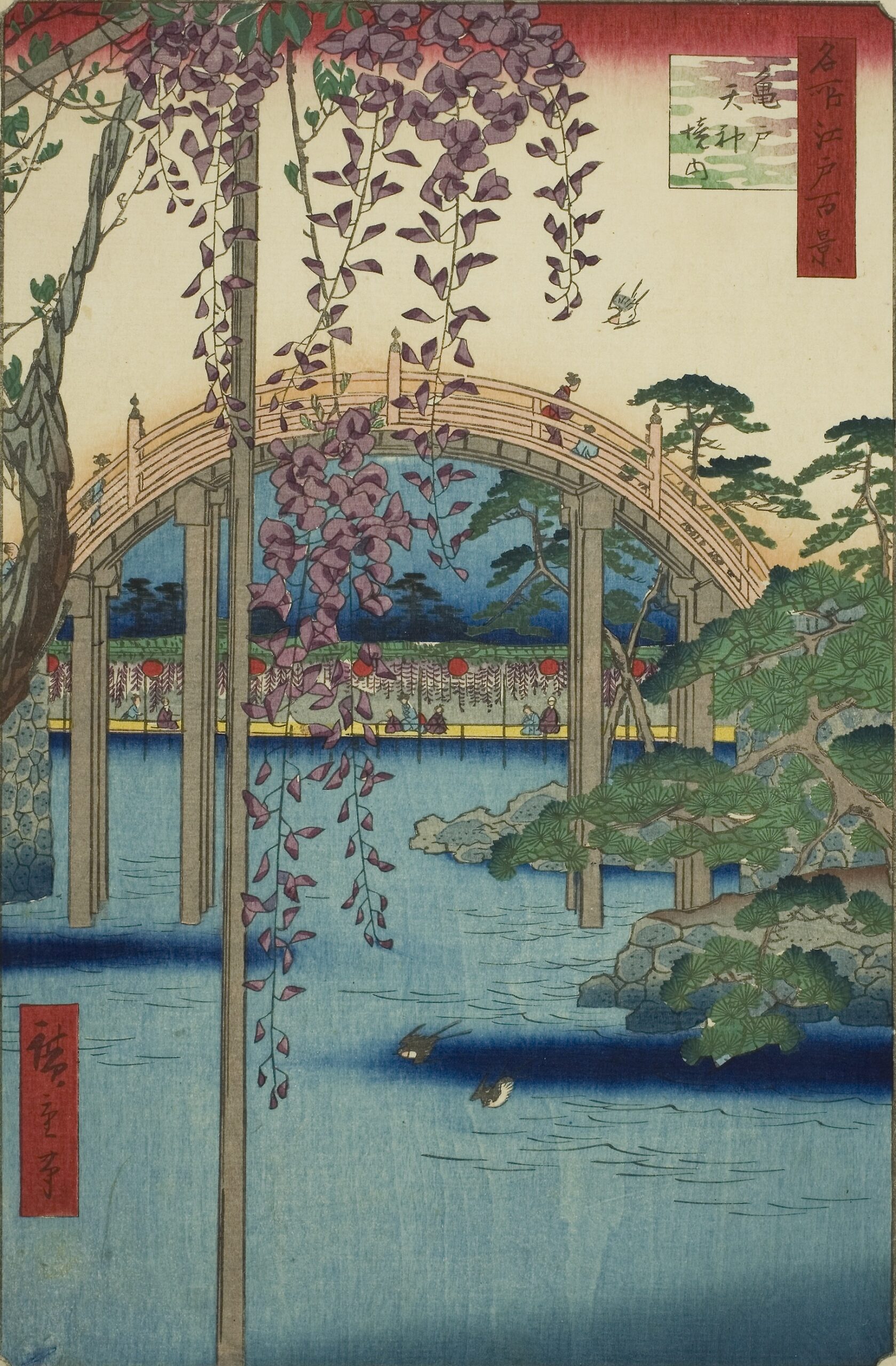
“Kameido Tenjin Shrine Grounds” is set at Kameido Tenjin Shrine, renowned as one of Edo’s finest plum and wisteria viewing spots.
This shrine, dedicated to Tenjin, enshrines Sugawara no Michizane, the god of learning. For Edoites, it was not only a place to pray for exam success and academic success, but also an elegant recreational spot where they could enjoy the flowers of the seasons.
The painting depicts the grounds with pilgrims and gorgeous flowering trees, beautifully portraying a space where faith and entertainment intersected for the Edo commoners.
<2> About Kameido Tenjin
In 1646, the monk Ten’on, a devout believer in Dazaifu Tenmangu Shrine in Kyushu, enshrined a branch of the deity and built a shrine here.
Originally called “Kameido Tenmangu Shrine,” the shrine became known affectionately as “Kameido Tenjin” among the common people.
Enshrining Sugawara no Michizane, the shrine attracted many worshippers as the god of learning.
During the Edo period, temple school students and scholars also visited the shrine, and worship spread from commoners to samurai.
Kameido Tenjin is particularly famous for its plum blossoms and wisteria.
Many plum trees are planted within the shrine grounds, and in spring, fragrant plum blossoms welcome worshippers.
In addition, in May, wisteria trellises decorate the grounds, and their beauty became known throughout Edo as “Kameido’s Wisteria.”
<3> Highlights of the Painting
Kameido Tenjin Shrine has been affectionately known as Kameido’s Tenjin-sama.
According to the shrine’s history, the shrine’s origins date back to 1646, when the chief priest of Dazaifu Tenmangu Shrine, Otorii Shinsuke, had a spiritual dream and carved a statue of Sugawara no Michizane out of the sacred Tobiume plum tree. He then traveled to Edo and built a small shrine in Kameido Village.
The shrine grounds were built to replicate Dazaifu Tenmangu Shrine’s main building, Shinji Pond, Taiko Bridge, and Sakuramon Gate, making it the largest Tenmangu shrine in Edo.
Due to the large number of pilgrims, restaurants and teahouses line the streets in front of the gate.
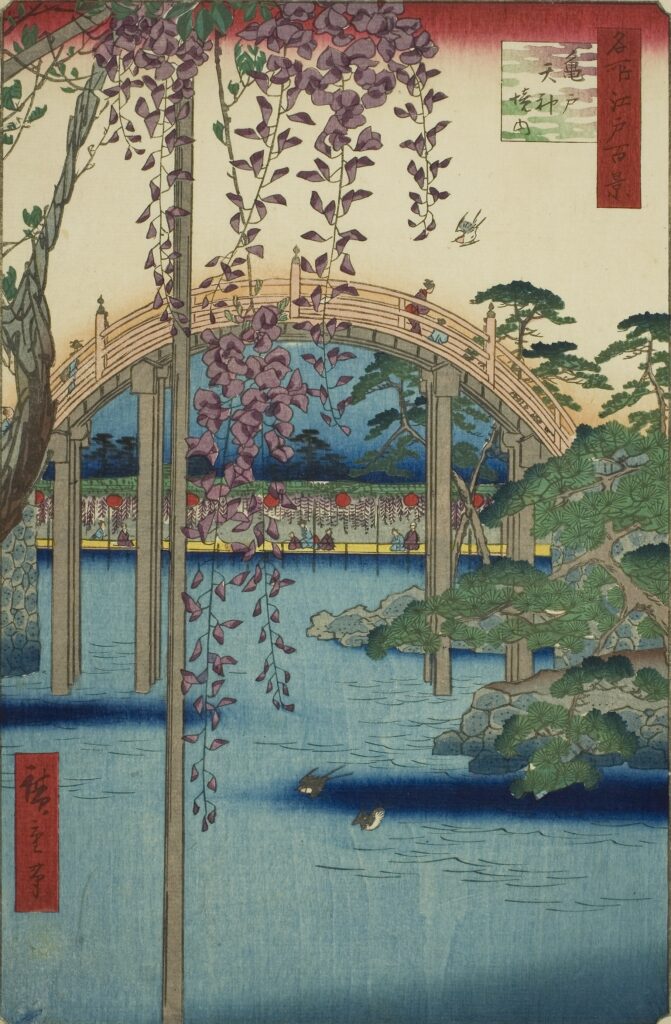
In the foreground are the wisteria trellis, Shinji Pond, pine trees, and three swallows.
In the middle is the Taiko Bridge (Soribashi) spanning the pond.
In the background, people can be seen from under the bridge, enjoying the wisteria trellis while cooling off on a veranda on the opposite bank.
<4> Modern-day Kameido Tenjin
The Plum Festival is held here from February to March, and the grounds are decorated with white and red plum blossoms. The Wisteria Festival is held from late April to May.
The dangling flowers reflected in the pond create a mystical beauty that has remained popular since the Edo period.
At night, the temple is illuminated, creating an even more mystical atmosphere.
It is about a 15-minute walk from Kameido Station on the JR Sobu Line.
With a view of the Skytree, it’s a great spot to combine a stroll through the downtown area.
<5> Sightseeing Guide
1. View of Taiko Bridge and Shinji Pond
The Taiko Bridge in the center of the temple grounds, with the pond and wisteria trellis in the background, is a great photo spot. You can enjoy the composition just like in Hiroshige’s ukiyo-e.
2. Plum and Wisteria Blossom Viewing
The charm of Kameido Tenjin Shrine is the opportunity to enjoy different flowers with each season.
Plum blossoms in spring, wisteria in early summer, and autumn foliage in autumn create a beautiful landscape.
3. Combine a Stroll Through the Downtown Area
We also recommend combining a visit to Kameido Tenjin Shrine with traditional downtown cuisine such as Kameido gyoza and kuzumochi.