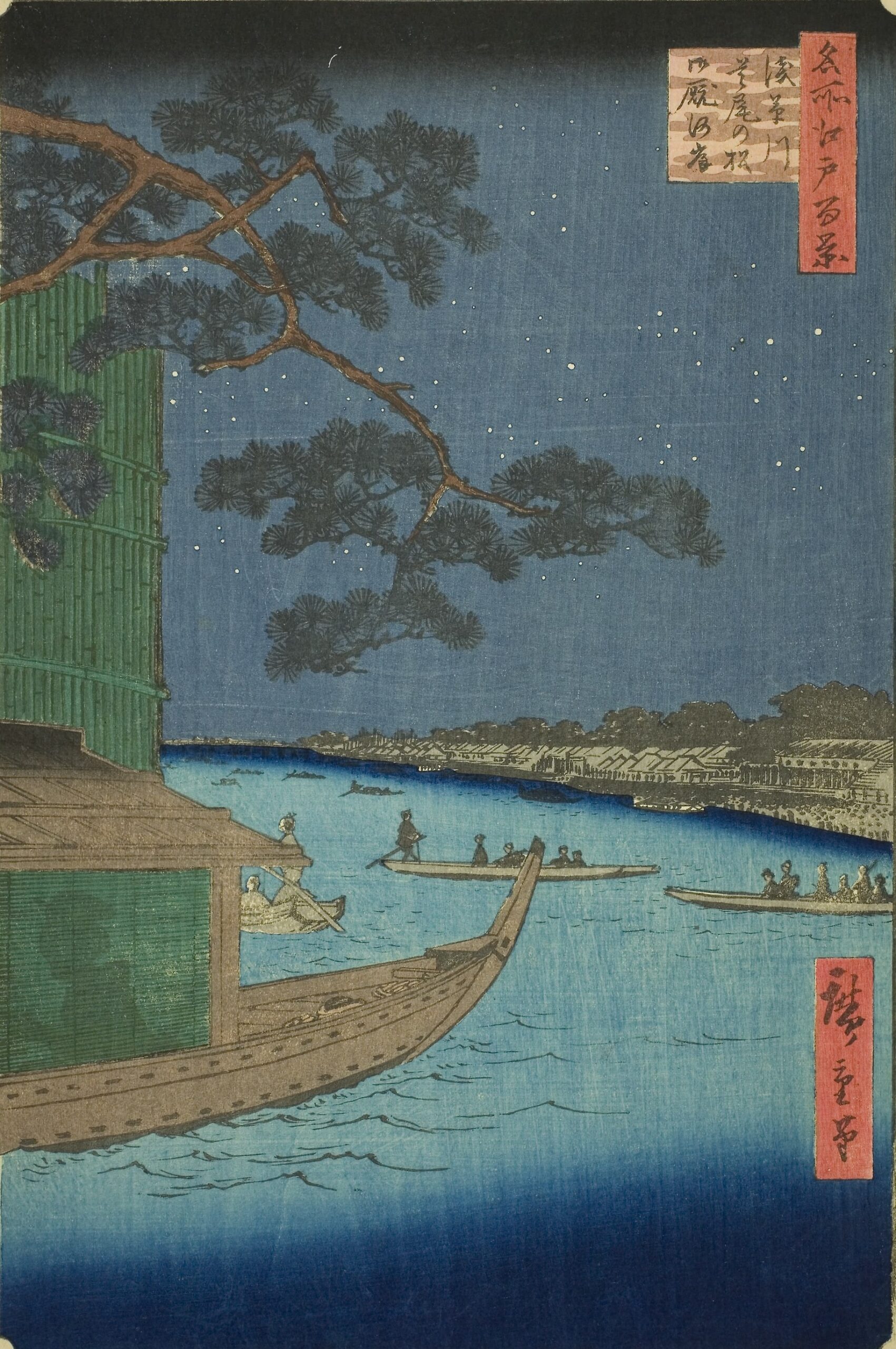
Utagawa Hiroshige – One Hundred Famous Views of Edo – 55 – Summer – Asakusa River, Shubi no Matsu Onmayagashi (Shubi Pine Grove) – Commentary 歌川広重-名所江戸百景-55-夏-浅草川首尾の松御厩河岸 解説
Current Address: 1-chome, Kuramae, Taito Ward
Latitude and Longitude: Latitude: 35.7090, Longitude: 139.7980
Published: August 1856 Age: 60
Commentary
<1> Introduction
“Asakusa River, Shubi no Matsu Onmayagashi” is set against the backdrop of the Sumida River and the surrounding area of Sensoji Temple, vividly portraying the leisure activities and waterside culture of the Edo common people.
The “Shubi no Matsu” (Shubi Pine Grove) featured in this painting is an old pine tree, renowned as one of Asakusa’s most famous landmarks, and a special presence associated with Edo people’s prayers for love and festival enjoyment.
This pine tree is placed majestically on the canvas, with the flowing Sumida River and the bustling Onmayagashi riverbank depicted in the background, expressing the atmosphere of Edo’s water capital.
<2> What are the Shou no Pine and Onmayagashi?
The Shou no Pine is a huge pine tree that stood near the bank of the Sumida River, east of Sensoji Temple.
It was a well-known and renowned tree among the people of Edo.
It is said to have reached a height of several tens of meters, and its majestic appearance made it an ideal landmark for people passing by the river.
“Shou” means the outcome or result of something.
This gave rise to the custom of praying for a successful union, particularly in relation to love and matchmaking.
It was said that praying under this pine tree would result in your love being fulfilled.
As a result, it was a popular spot for young men and women and worshippers, and was known as Asakusa’s “love spot.”
It frequently appears in Edo’s manners, customs, and senryu (senryu) and kyoka (comic poetry), and witty phrases such as “Pilgrimage to the Success Pine Tree and Pray for Success” became widespread.
It can be said to have been a symbolic spot where commoner humor and faith blended together.
“Momayagashi” was one of the riverbanks along the Sumida River, and its name comes from the stables associated with the shogun’s family and the shogunate.
Edo’s riverbanks prospered based on water transportation, and each had its own unique characteristics.
Momayagashi was particularly close to Sensoji Temple, so it was a popular place with worshippers and tourists.
<3> Highlights of the painting
The large pine tree in the foreground takes center stage.
With its powerful branches and thick trunk, it truly boasts the presence of a “famous tree” admired by the people of Edo.
Beyond the pine trees is the wide Sumida River, with boats passing by indicating its role as a key waterway that supported both daily life and tourism.
At Onmayagashi, people can be seen getting on and off and loading and unloading cargo.
The human touch in the painting goes beyond a simple landscape and makes it a record of the lives of ordinary people at the time.
In the background is the bustling temple town of Asakusa, creating a unique Edo landscape where temple, river, and town are united.
The Shou no Pine was located between the fourth and fifth piers of the eighth pier of the Shogunate’s Asakusa Storehouse, which was located upstream from Ryogoku Bridge on the west bank of the Sumida River.
The pine’s branches stretch out over the river, and customers visiting Yoshiwara would consult here before heading out.
Onmayagashi was the site of the Shogunate’s stables, located upstream from Asakusa Kuramae.
It later became a ferry crossing connecting Miyoshicho and Ishiharacho.
Ferry boats, boar-tooth boats, and summer boats can be seen on the river.
<4> Walking Around the Asakusa River in Modern Times
Unfortunately, the Shou no Matsu (Shuo Pine) died in the early Meiji period.
It can no longer be seen today.
However, you can get a sense of the atmosphere of the time by walking around Sensoji Temple and the Sumida River.
A monument marking the site of the Shou no Matsu remains in Asakusa.
<5> Sightseeing Guide
1. Visiting Sensoji Temple and Historical Stroll
After walking down Nakamise Street and visiting Sensoji Temple, visit the Shou no Matsu Monument. You’ll have the same experience as ordinary Edo residents.
2. Learning About Edo Culture
At the nearby Sumida Hokusai Museum and Edo-Tokyo Museum, you can learn more about ukiyo-e and Edo lifestyles and culture.
3. Pilgrimage to Pray for Love
In connection with the Shou no Matsu (Shuo Pine), the Asakusa area is dotted with shrines and temples said to grant love.
It’s also recommended as a modern-day “matchmaking stroll.”