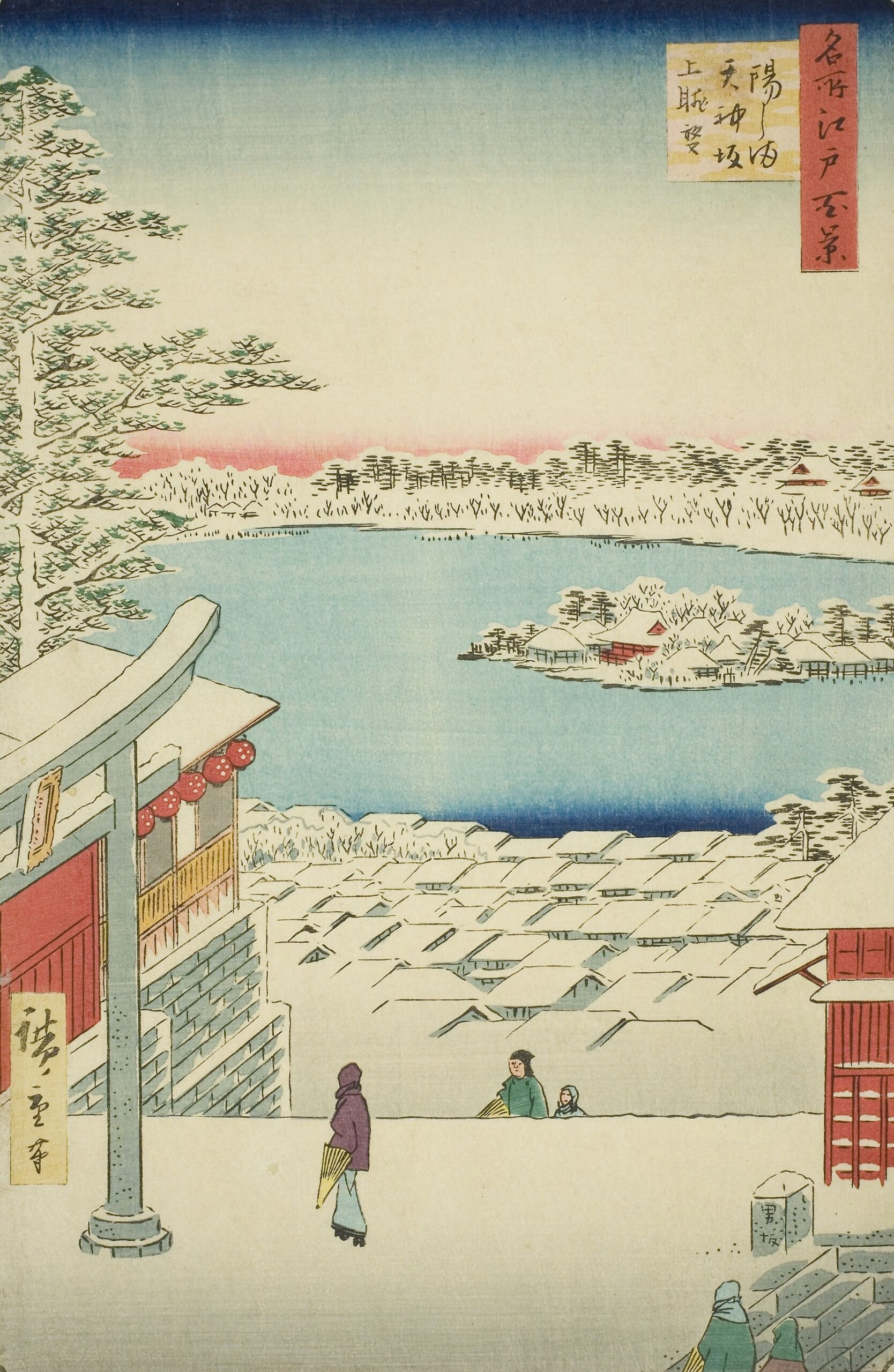
Utagawa Hiroshige – One Hundred Famous Views of Edo – 118 – Winter – View from Yushima Tenjin Hill 歌川広重-名所江戸百景-118-冬-湯しま天神坂上眺望
Current Address: Yushima Tenmangu Shrine, Bunkyo Ward
Latitude and Longitude: Latitude: 35.7136, Longitude: 139.7699
Published: April 1856 Age: 60
Tourist Guide-Style Commentary: “View from Yushima Tenjin Hill”
■Introduction
Utagawa Hiroshige’s “One Hundred Famous Views of Edo” is a series of 119 ukiyo-e prints vividly depicting the four seasons and famous places of Edo.
One of the prints, “View from Yushima Tenjin Hill,” depicts the view from the grounds of Yushima Tenjin (Yushima Tenmangu Shrine), located in Yushima, Bunkyo Ward, Tokyo.
This shrine, dedicated to Sugawara no Michizane, the god of learning, has been worshipped as the “god of exams” since the Edo period and continues to attract many worshippers today.
Hiroshige paints an open landscape overlooking the city of Edo from the top of a hill, skillfully blending the people gathered at the shrine with the cityscape in the distance.
This work symbolizes a famous spot where Edo residents could enjoy three elements at once: recreation, faith, and a view.
■About Yushima Tenjin
This ancient shrine is said to have been founded in 458, and in 1355 enshrined Sugawara no Michizane.
During the Edo period, it came under the patronage of the shogunate and attracted a wide range of worshippers as the god of learning, from Edo commoners and samurai to children attending temple schools.
It is also known as a famous plum blossom spot, nicknamed “Yushima’s White Plum Blossoms.”
Since the Edo period, the shrine has been bustling with cherry blossom viewers in the spring.
It has appeared frequently in ukiyo-e prints and kyoka poetry, and was beloved by the people of Edo.
The shrine is located on high ground, offering a panoramic view of Edo from its grounds.
The view from the top of the hill is known as a “famous spot for scenic views” and was a subject of Hiroshige’s paintings.
■Highlights of the Painting
This painting depicts a clear day after a snowfall.
People are gathering here and there as they climb the hill.
Yushima Tenjin Shrine is located on the way down from Hongo-dai to Ueno.
There are two roads leading to the shrine: Onna-zaka (Women’s Hill) in the foreground and Otoko-zaka (Men’s Hill) with a steeper slope to the right.
From Onna-zaka, visitors can see Benzaiten at Shinobazu Pond, the red buildings of Kan’ei-ji Temple, and the forests on both banks of the Sumida River.
Yushima Tenjin Shrine is one of Edo’s oldest shrines, and was already there when Ota Dokan built Edo Castle.
It was rebuilt in 1475.
The torii gate of Yushima Tenjin Shrine can be seen on the left.
The building with a row of lanterns on the left is a teahouse.
There were also brothels and male prostitute bookstores in front of the shrine.
■Walking around modern-day Yushima Tenjin
The Plum Blossom Festival is still held from February to March.
The white and red plum blossoms that fill the temple grounds captivate visitors.
Experience the “Yushima Plum Viewing” experience unchanged since the Edo period.
As the deity of learning, the grounds are still filled with votive plaques offering prayers for success.
Today’s students make the same wishes as the children of Edo’s terakoya schools.
The view from the top of the hill is now a cityscape of skyscrapers.
The sense of openness from the top of the hill remains strong.
This is a spot where you can feel the overlap of history and the city.
■Tourist Guide Recommendations
- Visit during plum blossom season
Late February to March is the best time.
You can enjoy the world of Hiroshige’s “White Plum Blossoms of Yushima.” - Visit for academic success
Yushima Tenjin is popular not only with students preparing for exams, but also with those praying for success in qualification exams and academic success.
We also recommend the experience of offering a votive plaque.
3. Combine with a stroll around Bunkyo
By walking around Shinobazu Pond and Ueno Park, you can recreate the “picnic route” of the Edo period.