Utagawa Hiroshige – One Hundred Famous Views of Edo – 18 – Spring – Oji Inari Shrine 歌川広重-名所江戸百景-18-春-王子稲荷の社 解説
Current Address: Oji Inari Shrine, Kishimachi 1-chome, Kita-ku
Latitude and Longitude: Latitude 35.7520, Longitude 139.7366
Published: September 1857 Age: 61
Explanation
<1> Introduction
“Oji Inari Shrine” is a work based on Oji Inari Shrine, a famous shrine in northern Edo.
It is an intriguing work that offers insights into both the faith and leisure activities of the common people.
Oji Inari was a central figure in Inari worship in the Kanto region, widely known for its foxfire legend and New Year’s events. Ukiyo-e prints depict the shrine grounds bustling with pilgrims in great detail, illustrating how Edoites combined faith and entertainment.
<2> About Oji Inari
Oji, located north of Edo, was a sparsely populated farming village. Oji Inari Shrine is an ancient shrine said to have been enshrined from Fushimi Inari during the Heian period, and served as a center of Inari worship in Musashi Province.
During the Kamakura period, it was revered as the guardian deity of the Toshima clan, and in the Edo period, it was also fervently protected by the Tokugawa Shogunate.
Many common people visited the shrine to pray for prosperity in agriculture, business, and household safety, and the shrine was extremely lively on New Year’s visits and festival days.
There is a legend at Oji Inari that says, “On the night of New Year’s Eve, foxes from all over the Kanto region gather here and set off for Hatsuuma.”
<3> Highlights of the painting
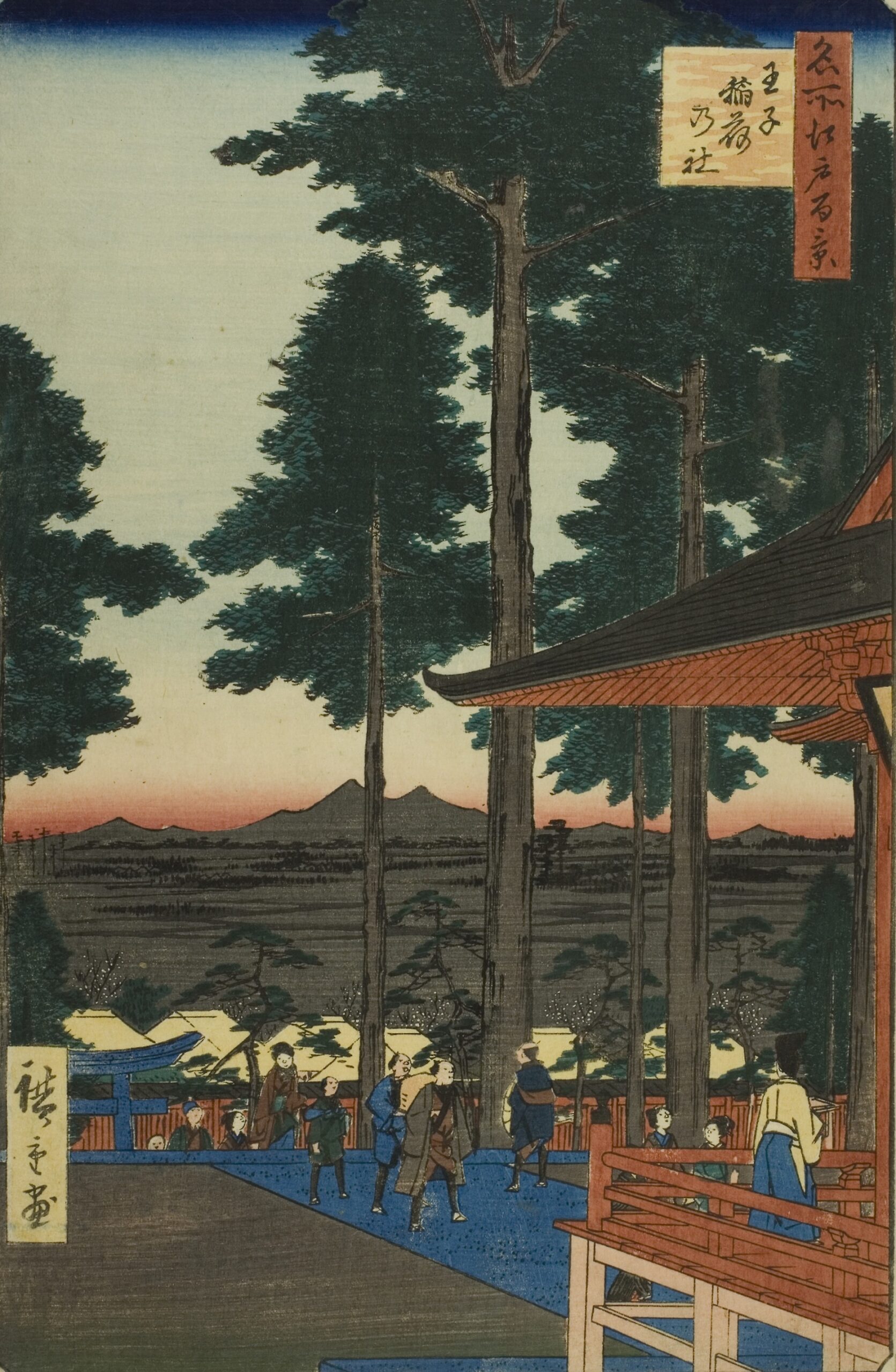
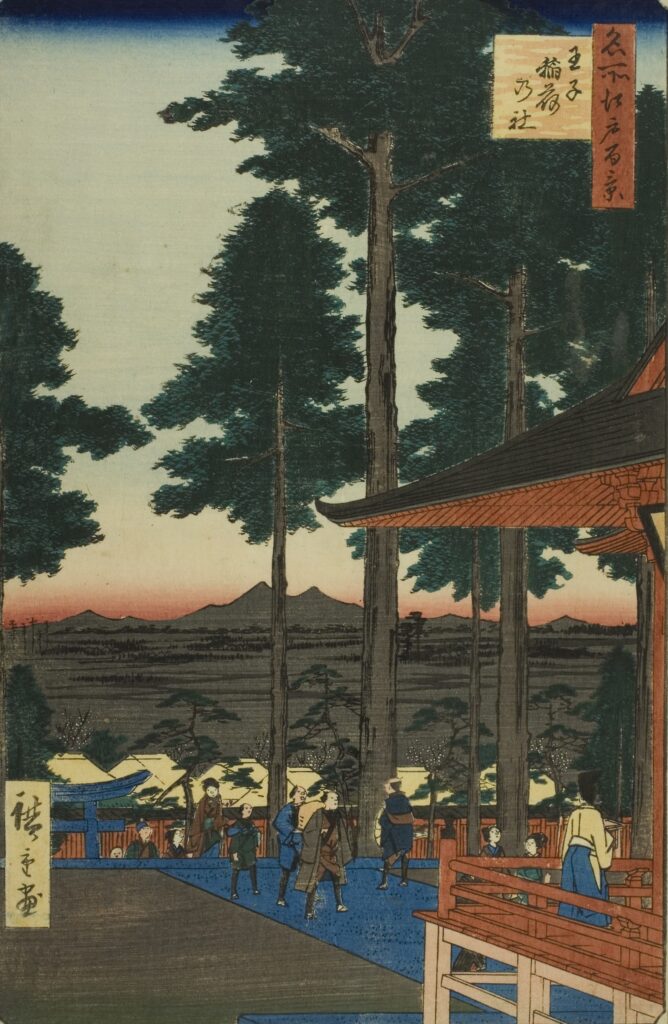
“Oji Inari Shrine” vividly depicts the grounds with worshippers coming and going.
People lining up to pray and shopping at the food stalls are reminiscent of modern-day hatsumode (first visits to a shrine).
The vermilion-lacquered main shrine building is depicted in the center, with the worship hall rising behind it.
The figures of worshippers walking along the approach to the shrine highlight the shrine’s prestige and the fervor of its deities.
The depiction of a fox statue, symbolic of Inari Shrine, further enhances the atmosphere of the grounds.
Foxes are considered messengers of the god Inari and are worshipped as guardian deities for bountiful harvests and prosperous business.
With Mount Asuka and the trees along the Shakujii River spreading out in the background, the shrine building and nature blend in impressive harmony, creating a striking landscape.
From the main shrine, located on a hilltop reached by climbing stone steps, you can see far into the distance.
Mount Tsukuba is depicted beyond the rice fields.
The torii gate appears to be located halfway up the steps, but it is actually located at the bottom.
Part of the vermilion-lacquered lattice outer enclosure can be seen beyond the torii gate, and only the roofs of the tea shops lined up outside it can be seen.
The chief priest is depicted at Inari Shrine on the right.
<4> Edo Commoners and Oji Inari
Hatsuuma, held on the first day of the horse month in February, was Oji Inari’s largest festival, attracting large crowds from all over Edo.
The grounds were bustling with food stalls and theaters, creating the atmosphere of a huge festival.
The legend of foxes gathering at Oji Inari on New Year’s Eve captured the imagination of Edo commoners, leading to events centered around fox masks and foxfires.
Alongside Asukayama and Oji Gongen, Oji Inari was a popular destination combining “pilgrimage and entertainment.”
Many people visit to view the cherry blossoms in spring or the autumn leaves.
<5> Modern-day Oji Inari
Still located in Kishimachi, Kita Ward, it continues to attract worshippers as one of Tokyo’s leading Inari shrines.
The Hatsuuma Festival continues to draw large numbers of pilgrims, just as it did in the past.
Every year from New Year’s Eve to New Year’s Day, the “Oji Fox Procession” is held, featuring people marching in white robes and wearing fox masks.
It’s a perfect example of how Hiroshige’s legend continues to live on in modern times.
Conveniently located just a five-minute walk from JR Keihin-Tohoku Line’s Oji Station, it’s a great place to visit in addition to Asukayama Park and Oji Shrine.
<6> Tourist Guide
1. Hatsuuma Festival
This is Oji Inari’s largest festival, continuing since the Edo period.
The lucky “Hatsuuma kite” is also popular.
2. Fox Procession
This is a mystical traditional event held from New Year’s Eve to New Year’s Day.
3. Combined Sightseeing with Asukayama
Experience Edo-era outings by strolling through Asukayama Park, a famous cherry blossom viewing spot.
4. Stone Fox Statue
One of the joys of the festival is finding the fox statues scattered throughout the temple grounds.