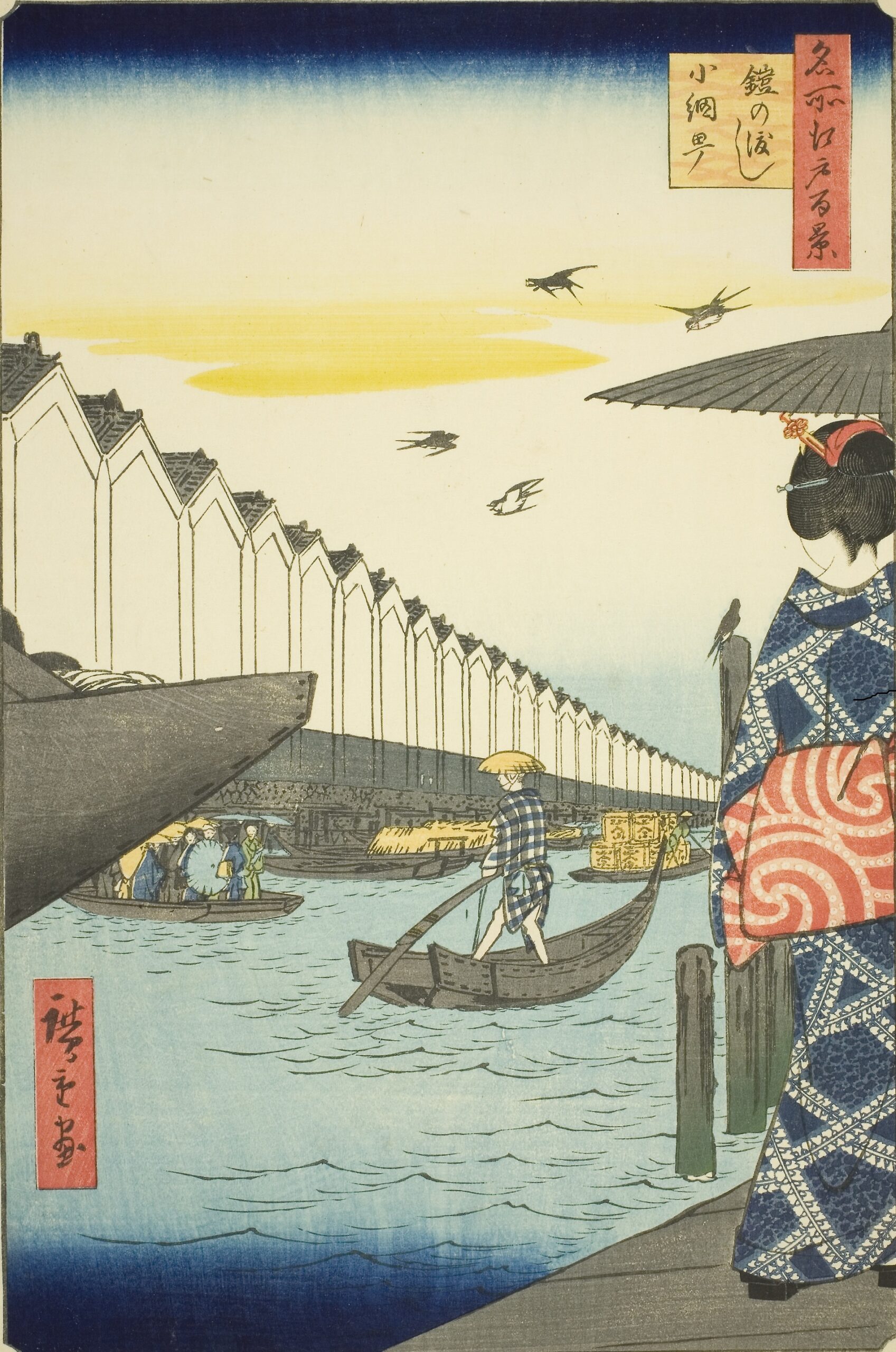
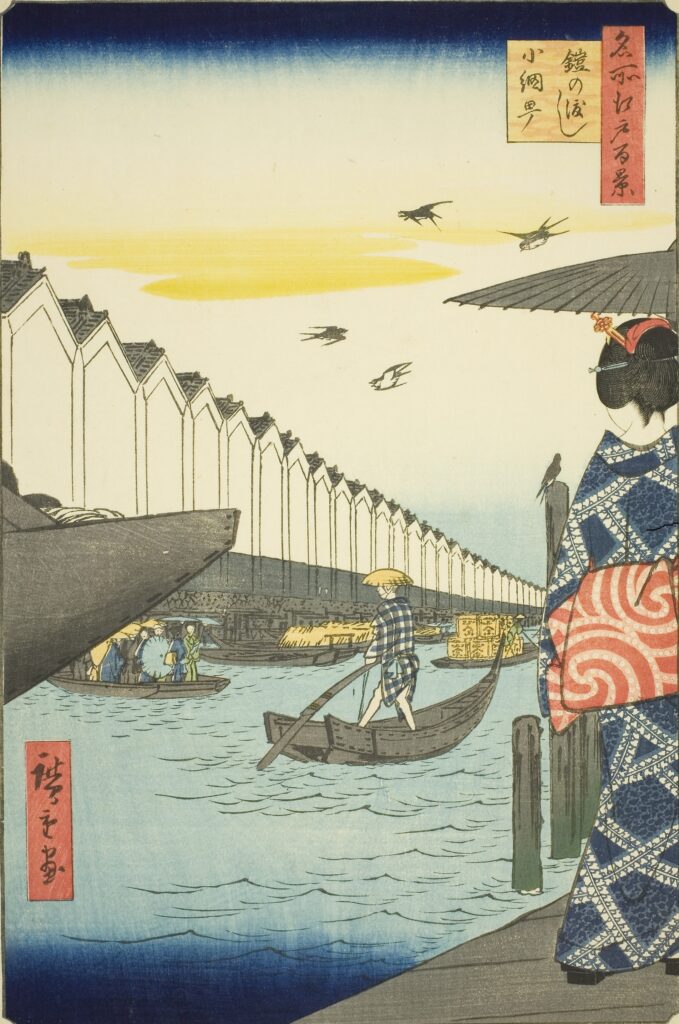
Utagawa Hiroshige – One Hundred Famous Views of Edo – 45 – Summer – Yoroi-no-Watashi (Ferry Crossing) Koamicho – Commentary 歌川広重-名所江戸百景-45-夏-鎧の渡し 小網町 解説
Current Address: Near Koamicho, Nihonbashi, Chuo Ward
Latitude and Longitude: Latitude 35.6840, Longitude 139.7785
Published: October 1857 Age: 61
Commentary
<1> Introduction
“Yoroi-no-Watashi (Ferry Crossing) Koamicho symbolizes Edo’s water transport culture.
The painting depicts a ferry landing established in place of a bridge over the Nihonbashi River.
While located in the center of Edo, the river is wide, and instead of a bridge, ferries transported people and cargo, making it an essential means of transportation for the common people of Edo.
<2> What is Yoroi-no-Watashi?
“Yoroi-no-Watashi” was one of the ferry landings on the Nihonbashi River.
It connected the Nihonbashi Koamicho area in present-day Chuo Ward to the opposite bank.
The name dates back to a legend surrounding Taira no Masakado.
According to legend, Masakado’s armor was once recovered from the riverbed here.
Since then, the place has been known as the “Armor Ferry.”
Such historical legends remain strong in the city of Edo, and were passed down naturally as part of the daily lives of ordinary people.
<3> Highlights of the Painting
A large ferryboat is depicted in the foreground, with people boarding and disembarking depicted in detail.
Boats are not only a means of river transportation, but also a symbol of life in Edo.
The surface of the Nihonbashi River stretches into the background of the canvas, with townhouses and warehouses lined on both banks.
Beyond that, the Nihonbashi streetscape spreads out, creating a sense of Edo as an urban landscape.
The fact that samurai, merchants, and commoners all used the same boat speaks to the fact that it was a place where Edo society intersected.
There are three ancient legends surrounding this ferry.
One: When Minamoto no Yoshiie set out to conquer Oshu, he followed the example of Emperor Yamato Takeru and buried his armor here to pray for safety.
2. When Yoshiie attempted to cross into Kazusa Province, a storm blew in and the sea became rough, so he sank his armor and prayed to the dragon god.
3. When Taira no Masakado took his head and armor, he dropped the armor on this land. A mound was built there and it became Mount Kabuto.
This ferry connected Kayabacho to Koamicho.
Further ahead was Nihonbashi Bridge, which played an important role in transporting goods.
In the foreground, a woman with a parasol waits on the riverbank for a ferry.
Ferryboats, tea boats, and boar-tooth boats can be seen on the river.
On the opposite bank, a row of shipping wholesaler storehouses line the eaves.
Four swallows, representing the summer season, fly in the sky.
4. Relationship with the Common People of Edo
In the early Edo period, during the Keicho era, when Edo Castle was built, the area around Koamicho was a small island at the mouth of the Nihonbashi River.
As Edo’s front islands, including Hatchobori and Reiganjima, were reclaimed,
it transformed into a riverside town along the Nihonbashi River.
Because of its location facing the Nihonbashi River, the town developed as an important location for water transportation.
In addition to being home to shops and wholesalers handling rice imported into Edo, the area also dealt in a large amount of salt produced in Gyotoku.
<5> Walking around modern-day Nihonbashi
The current location of Yoroi-no-Watashi Ferry is near Koamicho, Nihonbashi, Chuo Ward, Tokyo.
The river has been reclaimed and the banks improved, and the original ferryboats no longer remain, but remnants of its existence remain in place names and historical sites.
The Koamicho area has long been a thriving commercial district, and even today it is home to a mix of office buildings and long-established shops.
Nearby is Koami Shrine, famous for its blessings of good luck and protection from evil, so it is recommended to visit it after visiting the former ferry landing.
If you go a little further, you can stroll along the promenade that runs along the modern-day Nihonbashi River.
Looking up from the water’s edge, you’ll see numerous bridges, evoking the prosperity of Edo, a city built on water transportation.
<6> Tourist Guide
1. Historical Site Exploration
Walk through the Koamicho neighborhood and trace the remains of the former ferry landing. You’ll also find stone monuments and information boards in the area that evoke the Edo atmosphere.
2. Visit Koami Shrine
A short walk from the former ferry landing. Popular as one of Tokyo’s most powerful spots, this shrine offers a mysterious connection between Edo and the present.
3. Nihonbashi River Cruise
Aboard a boat, you can experience Edo’s “City of Water” from the river.
As you gaze upon the bridges and embankments, you’ll imagine Hiroshige’s perspective.