Utagawa Hiroshige – One Hundred Famous Views of Edo – 19 – Spring – Oji Otonashigawa Weir Rises, Singing “A Great Worldly Waterfall” – Commentary 歌川広重-名所江戸百景-19-春-王子音無川堰棣 世俗大瀧ト唱 解説
Current Address: Near Honmachi 1-chome, Oji-cho, Kita-ku
Latitude and Longitude: Latitude 35.7521, Longitude 139.7378
Published: February 1857 Age: 61
Commentary
<1> Introduction
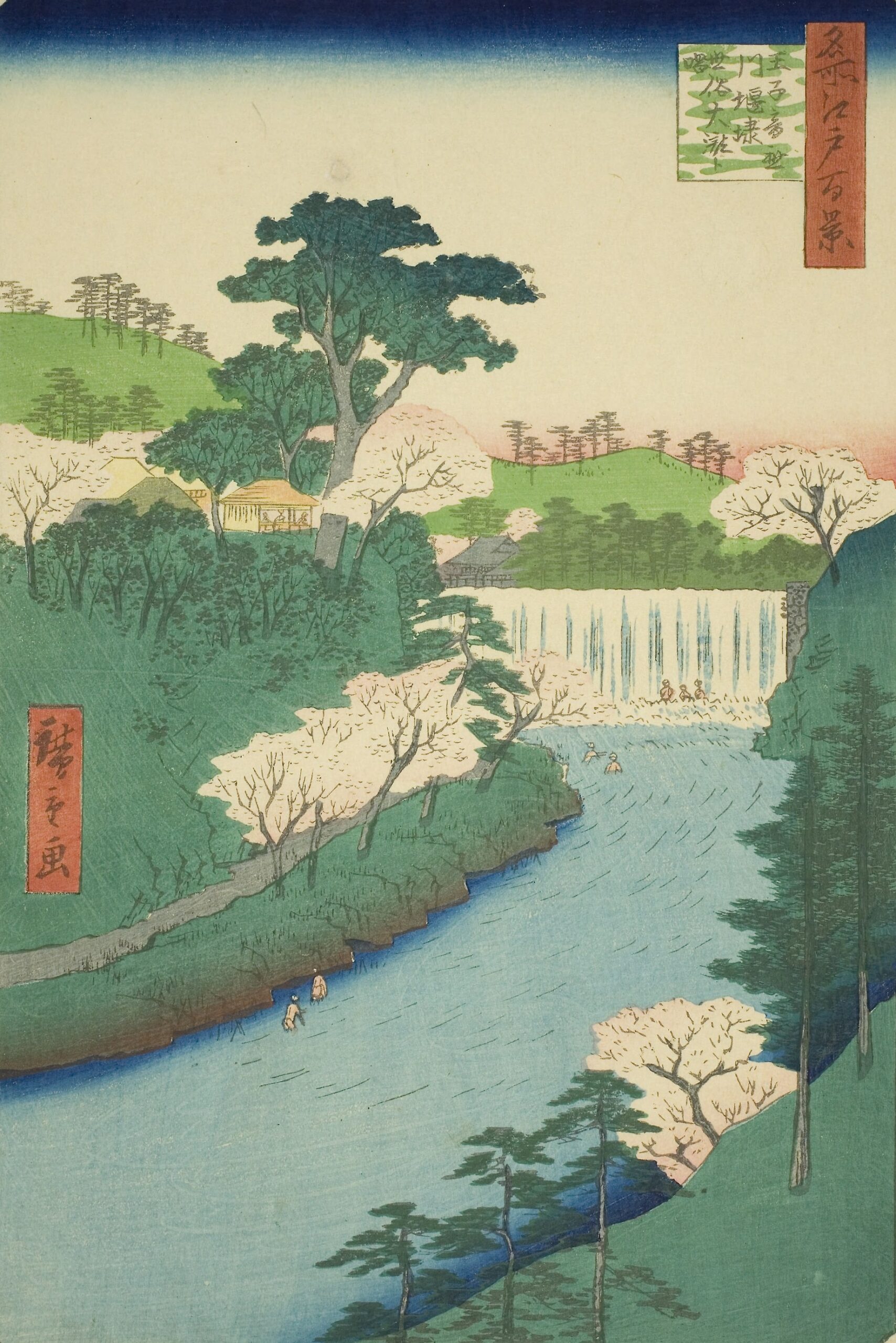
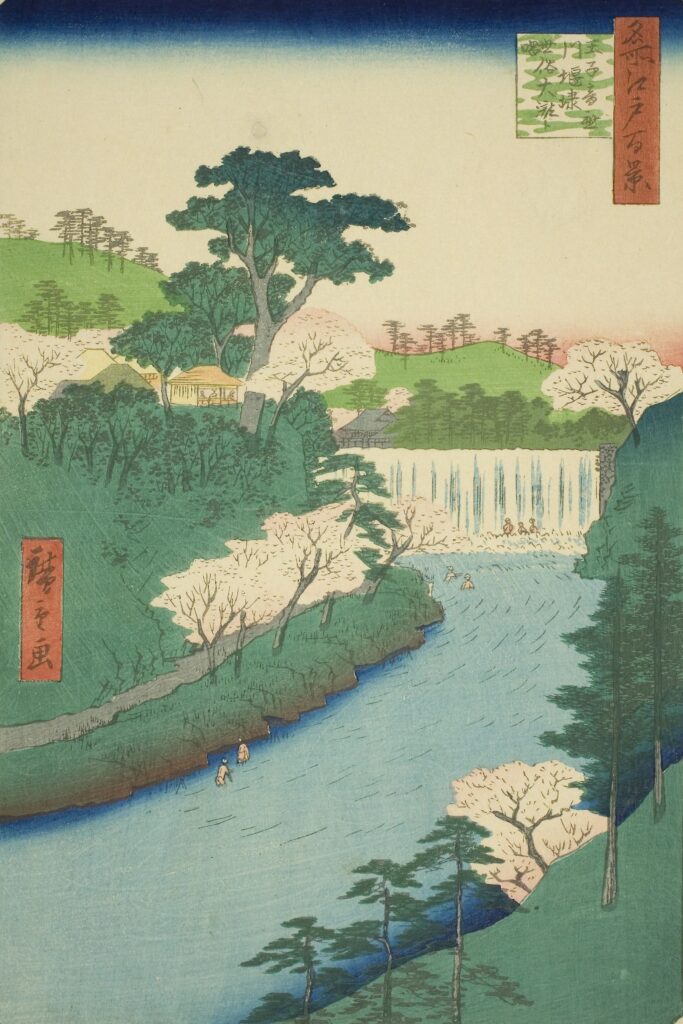
“Oji Otonashigawa Weir Rises, Singing “A Great Worldly Waterfall” depicts the landscape of the weir built on the Otonashigawa River in Oji, a famous northern sightseeing spot.
At the time, the waterfall from this weir was known as “Otaki” (Great Waterfall), and it was a popular waterfall viewing spot easily accessible to the common people. The people of Edo also cherished the landscapes created by combining natural features with manmade ingenuity.
<2> What is the Otonashi River?
The Otonashi River is the name given to the area of the Shakujii River near Oji today.
Although the river is narrow, it meanders and is filled with abundant water, and trees grow lushly along the riverside.
During the Edo period, the Otonashi River area was known for its waterfalls, known as the “Seven Oji Waterfalls.”
Strolling along the river was a source of relaxation for the common people of Edo.
A seki (dam) refers to a weir (levee or sluice gate) built on a river.
Water flows down from the weir on the Oji Otonashi River, creating the appearance of a small waterfall, which people called the “Otaki” (big waterfall).
Located downstream of the Shakujii River, it flows between Asukayama and Oji Inari Shrine before joining the Sumida River.
The scenery from Kongoji Temple to the Oseki weir resembles a valley, and is known as a scenic spot for cherry blossoms in spring and autumn leaves in autumn.
<3> Highlights of the Painting
The white spray of water falling from the weir is depicted with bold brushstrokes.
While the actual waterfall is not large, the movement of the water flowing throughout the entire canvas creates a powerful impact.
People are gathered at the water’s edge in the foreground, conveying the joyous atmosphere of common people who have come for an outing or to view the waterfall.
People are depicted in their own way, with some cooling off near the basin and others gazing from afar.
Dense trees line the river, and the seasonal greenery enhances the landscape. This is a depiction of a scenic spot typical of the Edo period, where man-made objects and nature coexist in harmony.
Although the actual drop was small, Edo commoners found elegance in such small-scale landscapes and enjoyed them, calling them “Otaki” (Great Waterfall).
This playful spirit evokes the culture of the time.
This waterfall was constructed in 1657 for irrigation purposes and was commonly called Otaki.
The waterfall’s upper reaches were known as the Otonashi River, due to its gentle flow.
With Asukayama to the east and Oji Inari Shrine to the west across the river, the area was bustling with tourists and had many traditional Japanese restaurants.
People bathing in the waterfall and attempting to fish can be seen at the large waterfall in front.
Cherry blossoms in full bloom and a rest hut are depicted on the cliff.
A teahouse can be seen on the hill to the left, and Kinrinji Temple can be seen beyond the waterfall.
<4> Edo Commoners and Viewing the Waterfall
Oji is only a few ri (approx. 1.5 mi) from central Edo.
Oji was a great tourist destination, accessible on horseback or on foot for a day trip.
The Otonashi River’s dam was a popular spot along the way.
In the height of summer, the spray from the falling water enveloped the surrounding area, providing a cooling refuge.
For commoners, viewing the waterfall was a refreshing experience, a way to escape the city heat.
The river was also a popular subject for poetry and haiku, and people loved to write elegant poems about its small waterfalls and streams.
<5> Modern-Day Otonashi River
In what is now Oji, Kita Ward, Otonashi Water Park is a waterside park modeled after the river’s original course.
The former “Otaki” waterfall has also been restored, allowing you to experience the charm of Edo in modern times.
The nearby Asukayama Park is known as a famous cherry blossom viewing spot, and by strolling around the park, including Oji Inari Shrine and Oji Shrine, you can experience a sightseeing course similar to that of the Edo period.
It is just a few minutes’ walk from Oji Station on the JR Keihin-Tohoku Line and Tokyo Metro Namboku Line.
What was once a popular day trip destination for Edo commoners is now a convenient tourist destination from the city center.
<6> Tourist Guide
① Otonashi Waterside Park
This waterside park recreates the riverside of the time, perfect for strolling and splashing around in the water.
② Otonashi Bridge
Viewing the river from the modern-day bridge, you can see the scenery from the ukiyo-e art.
➂ Asukayama Park
A famous spot, especially recommended during cherry blossom and autumn foliage seasons.
➃ Local Food and Drink
Experience the Edo-period atmosphere at long-established Japanese confectionery shops and soba restaurants around Oji.