Utagawa Hiroshige – One Hundred Famous Views of Edo – 44 – Summer – A Brief Map of Nihonbashi-dori 1-chome 歌川広重-名所江戸百景-44-夏-日本橋通一丁目略圖 解説
Current Address: Near Nihonbashi 1-chome, Chuo Ward
Latitude and Longitude: Latitude 35.6820, Longitude 139.7740
Published: August 1858 Age: 62
Commentary
<1> Introduction
The “A Brief Map of Nihonbashi-dori 1-chome” is a fascinating snapshot of everyday life in Nihonbashi, the commercial center of Edo.
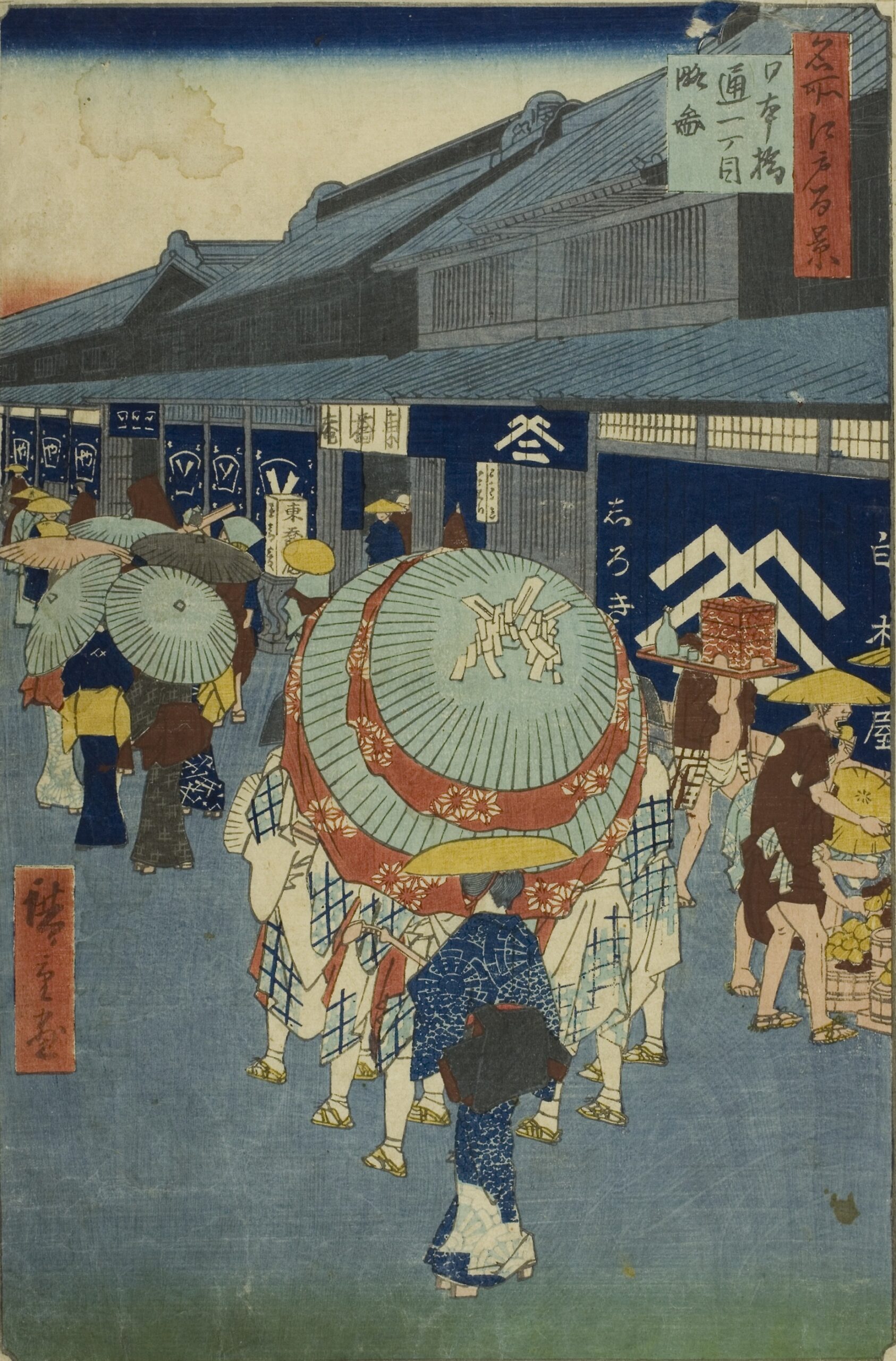
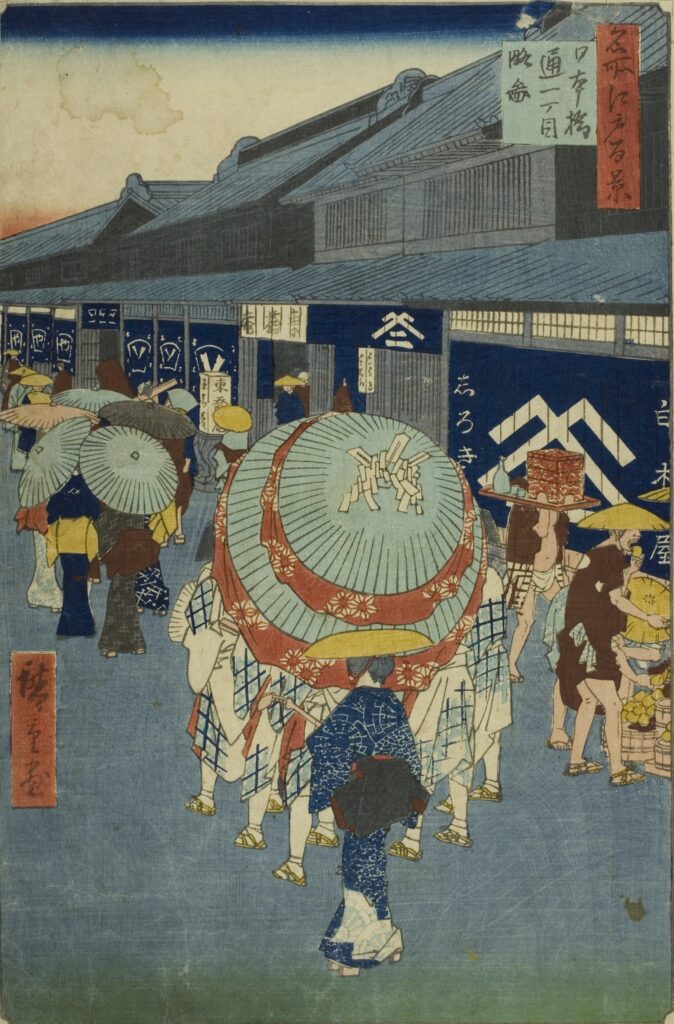
Set in front of a large kimono store called Shirokiya on a hot summer day in Edo, the map vividly depicts people passing by, dancing, street stalls, soba shops, merchants, and scenes of people using parasols and hats.
More than just a streetscape, the map offers a glimpse into the customs and townspeople’s culture of the time, making it valuable both historically and culturally.
<2> What is Nihonbashi-dori 1-chome?
Nihonbashi-dori 1-chome was a prime commercial location south of Nihonbashi Bridge during the Edo period, facing the main north-south street from the foot of the bridge.
It is one section of a group of neighborhoods along the street just south of the bridge.
It roughly corresponds to today’s Nihonbashi district in Tokyo’s Chuo Ward.
Nihonbashi was considered the starting point of Edo’s five main roads, and was a hub where goods were collected from all over Japan and distributed throughout the country.
The area around Nihonbashi-dori 1-chome was a bustling shopping district lined with many kimono shops, wholesalers, and merchants.
Shirokiya, in particular, was one of Edo’s three major kimono shops, along with Echigoya and Daimaru.
It was renowned as a large store.
This concentration of commerce and the high volume of foot traffic are well reflected in the bustling depiction of this diagram.
<3> Highlights of the painting
The town is Odori-cho, stretching from Kanda-Suga-cho to Shiba-Kanasugi, and stretches for four blocks.
On the corner of 1-chome on the right is Shirokiya, founded in 1662.
A magurumi seller stands in front of the store.
A delivery man is coming out from the soba restaurant Higashibashi-an next door.
In the center are people performing the Sumiyoshi dance, street performers who perform the rice-planting dance at Sumiyoshi Shrine in Osaka.
They wear silver screens attached to the edges of their sedge hats, white kimonos with ink-dyed loincloths, white hand guards, leg warmers, a crimson apron, and a white cloth covering their mouths.
One person sings while striking the handle of an umbrella, attached with a gohei (sacred wand), with a split bamboo stick.
The dancers circle around the area holding fans.
Behind them is a female courtesan holding a shamisen.
Both groups are wearing cotton clothing, indicating that there is a cotton shop nearby.
<4> Relationship with the Common People of Edo
Small businesses such as soba shops, street stalls, delivery services, and melon sellers provide a realistic glimpse into the lives of ordinary people.
Depictions of people buying and selling goods, seeking food, and passing through town reveal that this area functioned as a daily street.
Sumiyoshi Dance and street performances provided entertainment and social opportunities for townspeople.
Such entertainment added color to the lives of ordinary people.
In this way, the “Nihonbashi-dori 1-chome Outline Map” provides a true snapshot of the urban space where ordinary people lived, did business, and enjoyed themselves.
<5> Walking around Nihonbashi Today
The site of Shirokiya has been redeveloped into the COREDO Nihonbashi shopping complex.
Some of the street names from the Edo period remain in the Nihonbashi area, creating a blend of historic streets and modern urban elements.
Today, Nihonbashi is one of Tokyo’s financial, commercial, and tourist centers. Lined with historic buildings, long-established shops, modern buildings, and commercial facilities, this neighborhood blends tourism and business.
<6> Tourist Guide
1. Visit the Shirokiya Site and COREDO Nihonbashi
Visiting the former site of Shirokiya allows you to compare Hiroshige’s illustrations with the current landscape.
COREDO Nihonbashi also features a historical exhibition space, making it a great base for learning about Edo-period townscapes.
2. Strolling Around Surrounding Historic Sites
Stroll around Nihonbashi’s bridges, the remains of the fish market, the wholesale district, and the long-established shopping district that continues from the Edo period.
It’s also fun to stroll around looking for vestiges of Edo, such as the noren curtains of long-established shops, the cobblestone streets, and townhouse-style architecture.
3. Utilizing Exhibition Facilities and Art Museums
These include the Edo-Tokyo Museum, the Mitsui Memorial Museum of Art, and a museum specializing in ukiyo-e.