Utagawa Hiroshige – One Hundred Famous Views of Edo – 46 – Summer – Shoheibashi Seido Kanda River 歌川広重-名所江戸百景-46-夏-昌平橋聖堂神田川 解説
Current Address: Near Kanda-Awajicho 2-chome, Chiyoda Ward
Latitude and Longitude: Latitude 35.7011, Longitude 139.7695
Published: September 1857 Age: 61
Explanation
<1> Introduction
“Shoheibashi Seido Kanda River” is a work symbolizing Edo’s center of learning and transportation.
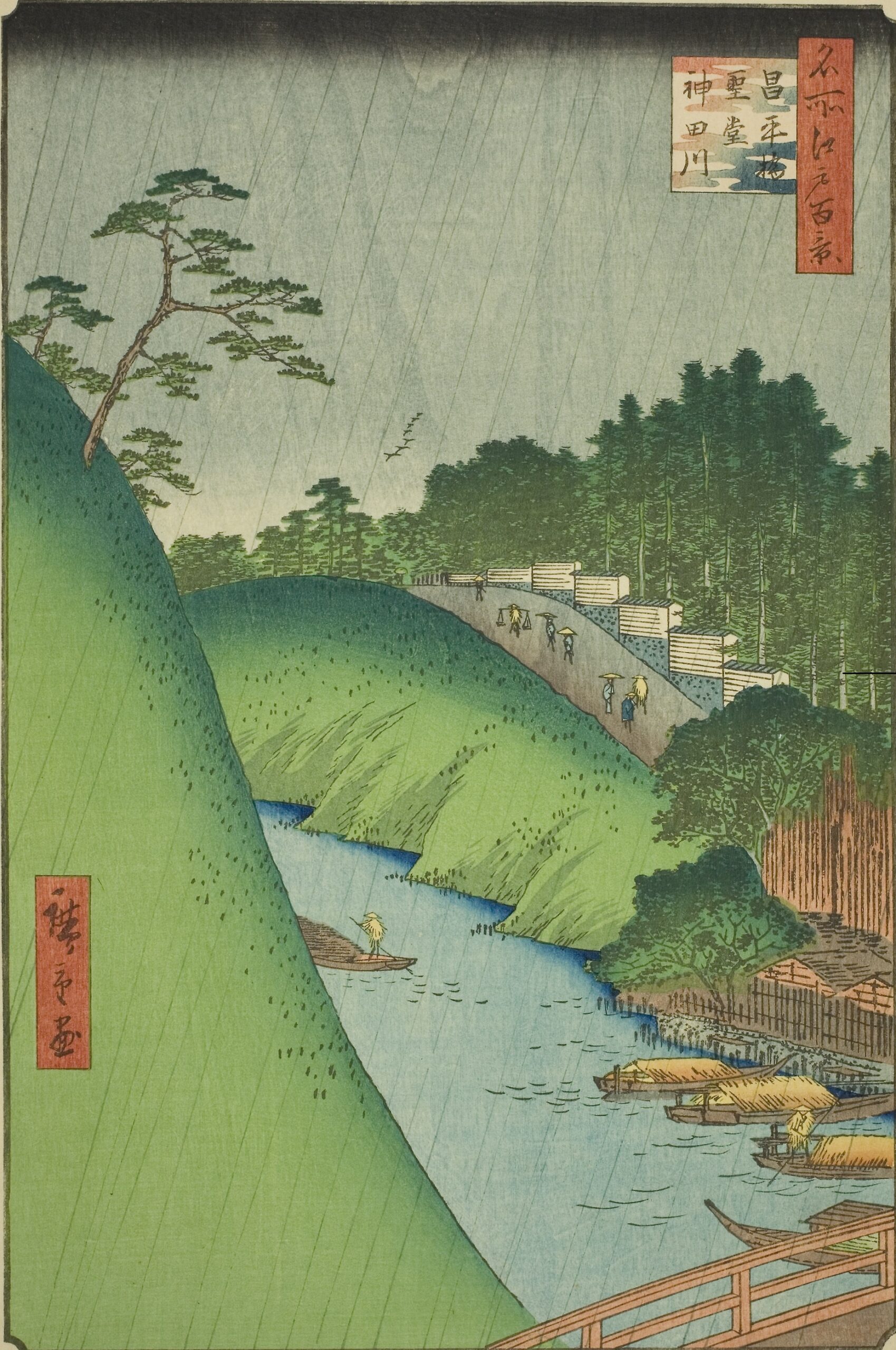
This ukiyo-e depicts the Shoheibashi Bridge spanning the Kanda River and the nearby Yushima Seido.
The flowing river, people crossing the bridge, and the hall of learning standing in the background are a testament to the landscape.
The landscape eloquently demonstrates that Edo was not just a commercial city, but also a center of culture and education.
<2> About Shoheibashi Bridge and Seido
Shoheibashi Bridge is a bridge over the Kanda River and was one of Edo’s key transportation hubs.
The bridge’s name comes from the nearby “Shoheizaka Hill.” The “Yushima Seido,” the shogunate’s center of Confucian education, was located at the top of the hill, hence the name “Shoheibashi.”
Yushima Seido is a Confucius temple built by the fifth Tokugawa shogun, Tsunayoshi, to encourage Confucianism.
The “Shoheizaka Gakumonjo,” an academic institution directly under the shogunate, was later established here and became a center of official learning throughout the Edo period.
It was like Edo’s version of the University of Tokyo, producing many scholars and talented people.
<3> Highlights of the painting
The Kanda River, which crosses the center, was an important waterway supporting Edo’s water transportation.
Boats floating on the water provide a glimpse of the time, supporting the movement of goods and people.
Merchants and travelers pass by on the bridge, giving a sense of both the daily lives of common people and the bustle of the city.
The cathedral depicted in the background, centered around the black-painted Taiseiden Hall, its solemn atmosphere lends weight to the entire painting.
The ingenuity of Hiroshige’s composition lies in the coexistence of scenes from the everyday lives of common people with symbols of scholarship and Confucianism.
The viewer’s gaze is guided along the flow of the Kanda River, leading the viewer from the bridge into the profound urban landscape of Edo.
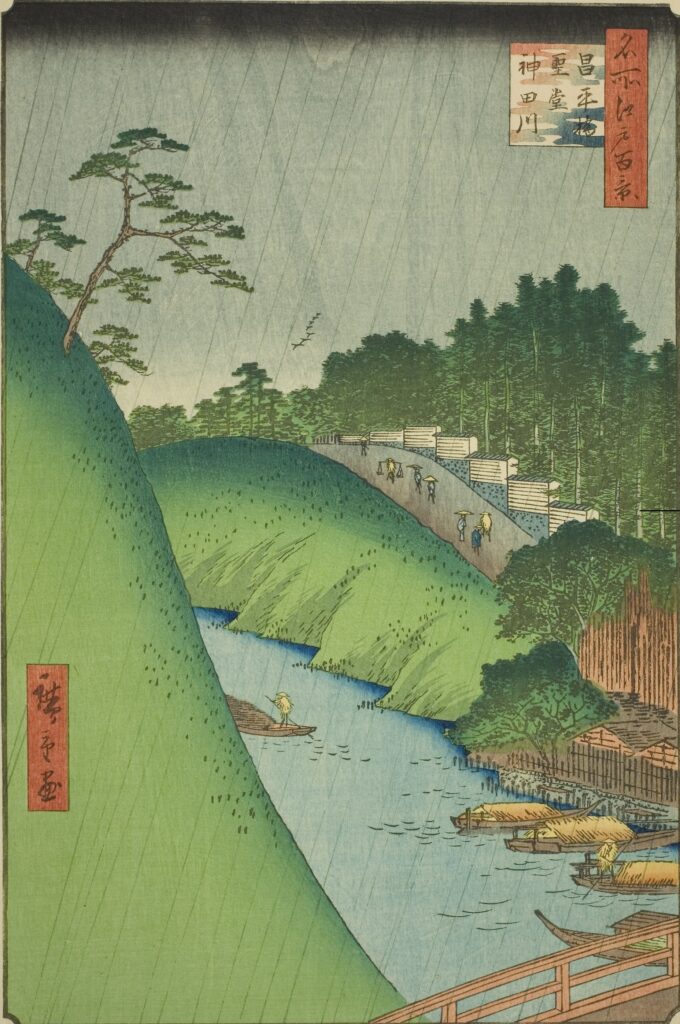
In the rain, several takase boats, covered with straw mats, are moored on the right bank of the river, and a large crowd is walking on Shoheizaka Hill on the opposite bank.
Behind them, a lush forest beyond the plaster wall represents the cathedral and the Shogunate’s academic institution, Shoheiko.
The term “seishou” (shrine) refers to a shrine dedicated to Confucius. It originated in 1630 when Confucian scholar Hayashi Doshun built the Kobunkan school and library in Shinobu-ga-oka, Ueno. In 1632, Owari Yoshinao installed statues of Confucius and four others at the Senseiden (Senseiden) temple.
In 1690, the fifth shogun, Tsunayoshi, moved the Kobunkan and Senseiden to Yushima, with the Senseiden becoming the Seido and the Kobunkan becoming the Shoheigaku.
The surrounding area’s name, “Shohei,” comes from Changping in Lu, Confucius’ hometown.
<4> Walking around the modern-day Shoheibashi Bridge and Seishou
Today, Shoheibashi Bridge connects Kanda Sudacho and Yushima, serving as a key transportation hub.
The nearby “Yushima Seishou” also remains and is open to the public as a mecca for scholarship and education.
Yushima Seido is a designated national historic site. Its tranquil grounds are home to the Taiseiden Hall and a statue of Confucius, and even today, visitors praying for academic success continue to visit.
With Tokyo Medical and Dental University and the Ochanomizu academic district nearby, the area has maintained its tradition as a “city of learning” from the Edo period to the present day.
From the promenade along the Kanda River, you can enjoy the dynamic scenery of the intersecting railways and bridges.
In particular, the view of Shoheibashi Bridge from Hijiribashi Bridge is a popular photo spot.
<5> Tourist Guide
1. Visiting Yushima Seido
Walking through the tranquil grounds and praying to the statue of Confucius will renew your academic commitment.
This is an especially popular spot for students and prospective students.
2. View from Shoheibashi Bridge
Viewing the Kanda River from the bridge, you can relive this important point in Edo’s water transportation.
Enjoy the view along with the railways and modern architecture.
3. Stroll through Ochanomizu, the city of learning and gourmet food. Nearby are the used bookstore district of Jimbocho and the musical instrument district of Ochanomizu, making for a great place to experience learning and culture. After your historical stroll, we recommend taking a break at a long-established curry restaurant or coffee shop.