Utagawa Hiroshige – One Hundred Famous Views of Edo – 20 – Spring – Me at the Kawaguchi, Zenkoji Temple – Commentary 歌川広重-名所江戸百景-20-春- 川口のわたし 善光寺 解説
Current Address: Shimo 5-chome, Kita-ku
Latitude and Longitude: Latitude 35.788040, Longitude 139.725392
Published: February 1857 Age: 61
Commentary
<1> Introduction
“Me at the Kawaguchi, Zenkoji Temple” combines the ferry crossing that served as Edo’s northern gateway with Zenkoji Temple, a center of religious worship for the common people.
The river, people’s lives, and the pilgrimage of faith intertwine to create a scene brimming with Edo charm.
<2> About the Kawaguchi Ferry and Zenkoji Temple
The Sumida River was called the Arakawa River upstream from Kanegafuchi.
The Kawaguchi Ferry was an important ferry crossing for crossing the Arakawa River.
This was a key point on the road connecting Edo with Nikko and Oshu, and many travelers and goods passed through here.
It could be considered a gateway to the north of Edo.
Many ferries passed by on the river, and there was a constant stream of people coming and going.
It was also an important point for the distribution of goods in Edo.
Kawaguchi Zenkoji Temple was built as a branch temple of Zenkoji Temple in Shinano.
For people living near Edo, it was a convenient sacred site where they could experience Zenkoji faith without having to travel all the way to Nagano.
It was a popular short trip from Edo, and many families and people combining their time with leisure travel visited.
<3> Highlights of the painting
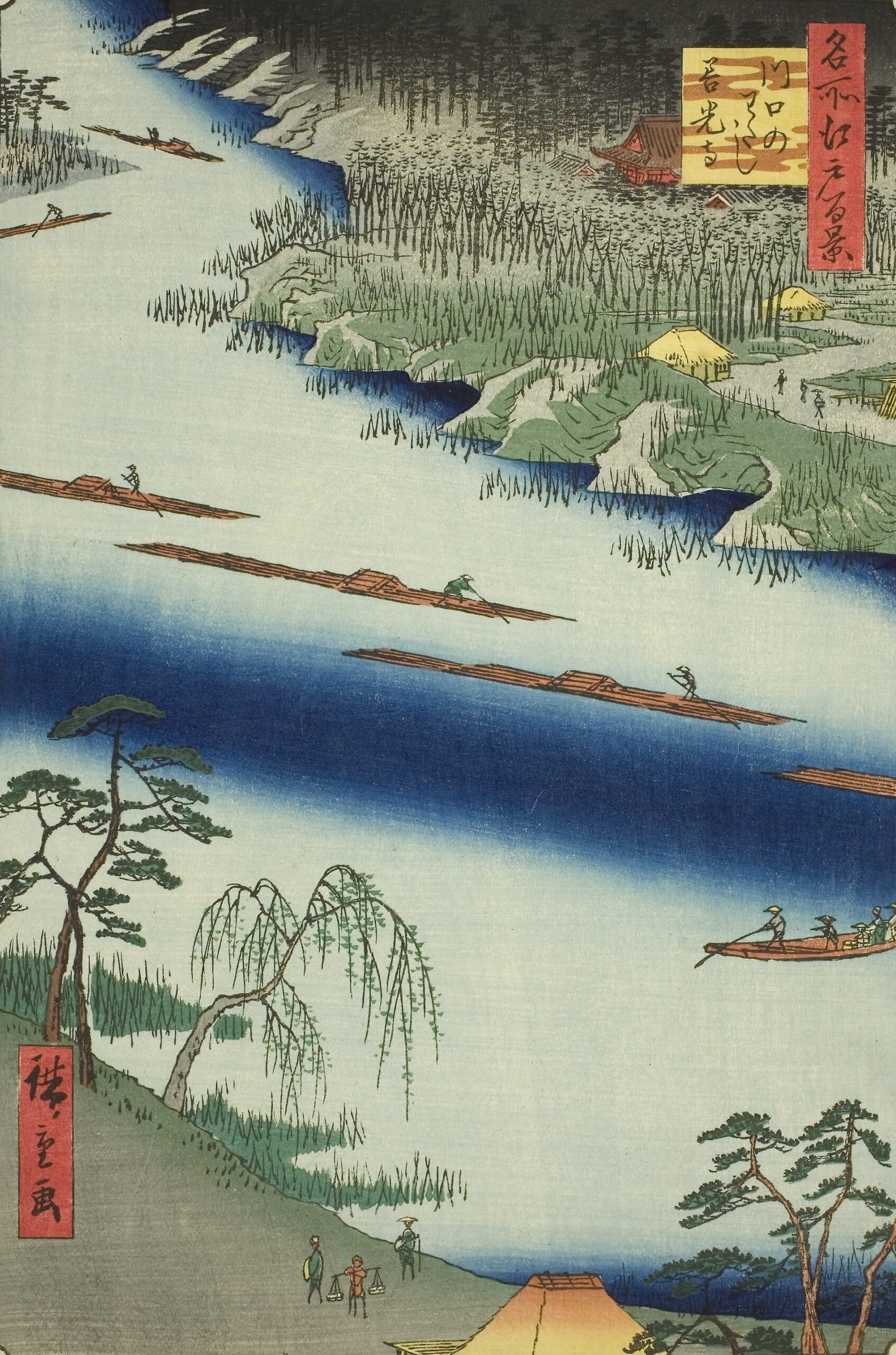
The river is depicted flowing, with ferries passing by on it.
The people on the boats convey the bustle of transportation connecting Edo with the provinces.
The Zenkoji temple building is depicted small on the hill on the opposite bank.
This indicates that the destination of the ferry is not simply transportation, but a destination for pilgrimage.
A vast expanse of water can be seen, with a temple towering across the river.
A notable feature of this painting is the combination of nature, which is closely connected to people’s lives, and faith, a source of spiritual support, all in one painting.
This painting depicts the ferry at Kawaguchi on the Arakawa River, the northernmost of the “One Hundred Famous Views of Edo” series.
The boat disappearing off the right edge is the ferryboat that departed from the foreground.
Three more people are waiting at the dock for the next boat.
The red building on the opposite bank is Kawaguchi Zenkoji Temple, which was built in 1195 based on the Zenkoji Temple in Shinano.
Like Shinano Zenkoji Temple, this temple also displayed its Amida Buddha statue during the Edo period.
Records show that in Shinano, a ferry was held every 33 years, while at Kawaguchi, it was held approximately every 17 years.
Since people could worship the Zenkoji Buddha without having to travel all the way to Shinano, many flocked to the area during the public viewing period.
Because the source of this river is in Chichibu, it was convenient for transporting timber from Chichibu on rafts to Edo.
Rafts line the river, symbolizing this.
<4> Feeling like a traveler in the Edo period
For common people of the time, crossing the Kawaguchi ferry to visit Zenkoji Temple was a short excursion.
Leaving the city of Edo and crossing the river was enough to feel like something out of the ordinary.
The boatmen’s calls and the view of the temple in the distance while being blown by the river breeze added to the exhilaration of the journey.
<5> Visiting the modern-day site of the Kawaguchi ferry
Large-scale flood control work has been carried out on the Arakawa River, and the ferry scene from that time has been lost.
Historical sites and explanatory plaques remain within Kawaguchi City.
A stroll along the Arakawa River embankment from around Kawaguchi Station allows you to imagine the scenery of the time and superimpose it onto the scenes depicted in Hiroshige’s ukiyo-e.
<6> Tourist Guide
1. Visiting Kawaguchi Zenkoji Temple
Zenkoji Temple still exists in modern-day Kawaguchi City, and you can visit it just as you did back then.
This is a great way to experience the feeling of a “trial visit” before heading to Zenkoji Temple in Nagano.
2. Strolling along the Arakawa River embankment
The modernized Arakawa riverbed is perfect for walking or cycling.
Gazing at the river surface at sunset will give you a glimpse of the scenery depicted in Hiroshige’s ukiyo-e.
3. Relive the Edo Journey
We also recommend visiting the “Kawaguchi Ferry Site” as part of a short trip along the Nikko Kaido.
Combining a walk along the embankment with viewing ukiyo-e prints will give you a taste of what it was like to be a traveler in the Edo period.