Utagawa Hiroshige – One Hundred Famous Views of Edo – 21 – Spring – Shiba Atagoyama – Commentary 歌川広重-名所江戸百景-21-春- 芝愛宕山 解説
Current Address: Atago Shrine, Atagoyama 1-chome, Minato Ward
Latitude and Longitude: Latitude 35.6639: Longitude 139.7483
Published: August 1857 Age: 61
Commentary
<1> Introduction
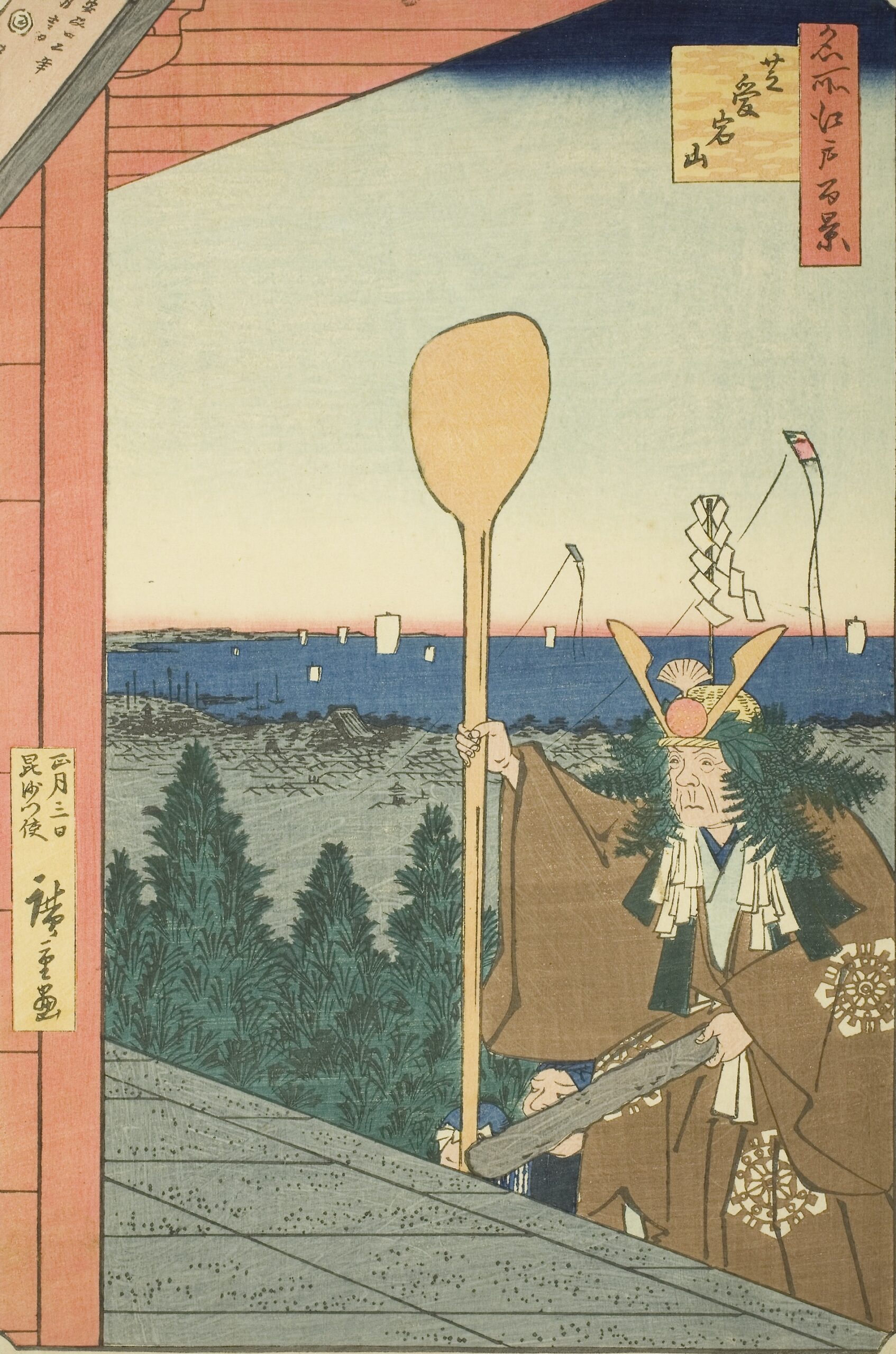
“Shiba Atagoyama” depicts the view from a high point overlooking the city of Edo and the sea.
Atagoyama, located almost in the center of Edo, was the highest natural mountain in the city, at 25.7 meters above sea level.
Atago Shrine, located at its peak, was worshipped as the god of fire prevention and warding off evil, and was a popular landmark beloved by Edo residents and samurai alike.
<2> About Atagoyama
It is located close to Shinbashi and Toranomon.
Atago Shrine was founded in 1603 by order of Tokugawa Ieyasu.
Enshrining Shogun Jizo, the god of fire prevention, the shrine was deeply revered by townspeople and samurai who feared a major fire in Edo.
From the summit, visitors can enjoy spectacular views of Edo city, Edo Bay, and even the Boso Peninsula.
It was also a popular spot for cherry blossom and moon viewing.
<3> Highlights of the Painting
From the summit of Mount Atago, the painting depicts the city of Edo spreading out below, with Edo Bay in the distance.
The composition makes the most of the expansive field of view.
The view continues from the rooftops in the foreground to the gradually expanding cityscape and out to the sea.
It clearly conveys the great city of Edo’s bounty.
A bird’s-eye view is used to exaggerate Mount Atago’s height.
While its actual height is only about 25.7 meters, it leaves a strong impression as “a mountain offering a panoramic view of Edo.”
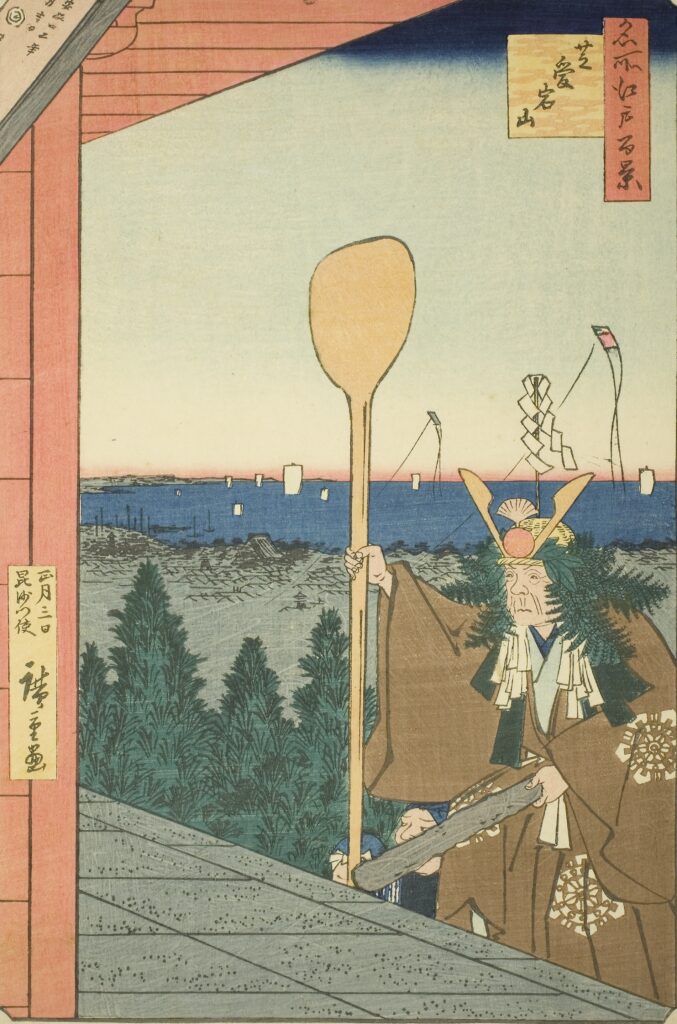
This painting depicts a messenger of Bishamonten at the Gohanshiki ceremony, held on January 3rd at Atago Gongen Shrine at the summit of Mt. Atago.
On this day, to worship Bishamonten, the local deity of Mt. Atago, the messenger, dressed in a plain sash, wearing a New Year’s decoration on his head, and carrying a pestle and ladle, accompanies his attendants to Enpuku-ji Temple, the temple’s head priest, to perform the ceremony.
After completing his service as Bishamonten, he is returning home, climbing Otokozaka.
Otokozaka is a steep staircase with a total of 86 steps.
To the right is the gentler Onnazaka, with 107 steps.
Once at the top of Otokozaka, one can look down on Edo city and the sea, as shown in this illustration.
The large roof slightly to the left of the ladle is the main hall of Tsukiji Honganji.
A kite is added to further emphasize the New Year’s atmosphere.
This painting neatly combines Mt. Atago’s unique New Year’s events with its reputation as a scenic spot.
<4> How to Enjoy Mt. Atago in the Edo Period
In spring, cherry blossoms bloomed, and common people would visit with bento boxes.
In autumn, moon-viewing parties were held, popular among literati and artists.
Worshippers from all over Edo came to pray for fire prevention.
<5> Modern-day Atago Shrine
Atago Shrine still remains in Atago, Minato Ward, and is open to the public.
The steep “Otokozaka” slope is known as the “Stone Steps of Success” after the anecdote that Heikuro Magaki rode up it on horseback at the command of the third shogun, Iemitsu.
Although surrounded by skyscrapers, the mountain’s summit is a popular spot for views of Tokyo Tower and Toranomon Hills.
You can still experience vestiges of its status as a “famous viewing spot” from the Edo period.
<6> Tourist Guide
1. Visit Atago Shrine
This shrine is still worshipped today as a place of protection against fires and good fortune in career advancement.
The “Stone Steps of Success” are particularly worth the challenge.
2. View Stroll
Hiroshige’s “View of Edo Town and the Sea,” painted during the Edo period, has been lost, but in its place you can enjoy a panoramic view of the modern Tokyo skyline.
3. A Historical Stroll
Historic place names such as Toranomon and Shimbashi remain in the surrounding area, allowing you to experience the transition between Edo and Tokyo firsthand.