Utagawa Hiroshige – One Hundred Famous Views of Edo – 25 – Spring – Meguro Motofuji – Commentary 歌川広重-名所江戸百景-25-春-目黒元不二 解説
Current Address: Near Kamimeguro 1-chome, Meguro-ku
Latitude and Longitude: Latitude 35.6330, Longitude 139.7059
Published: April 1857 Age: 61
Commentary
<1> Introduction
Meguro Motofuji symbolizes the “Fuji worship” and “Fujizuka culture” of Edo.
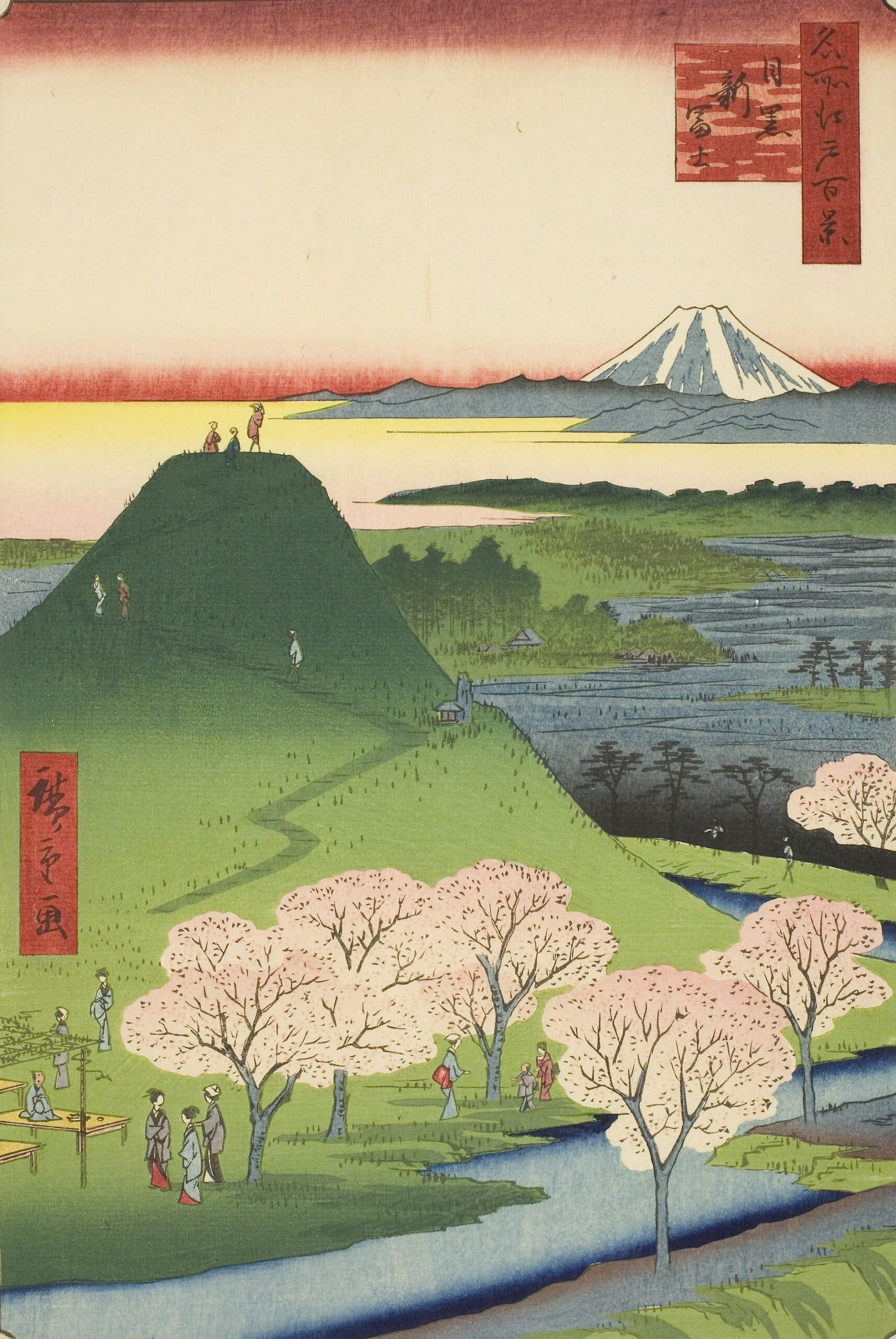
It is a counterpart to the previously introduced “Meguro Shinfuji,” and by comparing the two, we can see how familiar the people of Edo were with Mount Fuji.
<2> What is Meguro Motofuji?
“Motofuji” means “the original Fujizuka,” as opposed to the later-built “Shinfuji.”
This refers to Meguro Fuji, one of the earliest Fujizukas built in Edo.
Fujizuka, an artificial mountain built by Fuji-ko followers, was a sacred place where worshippers could visit in lieu of climbing the actual mountain.
For the common people of Edo, “climbing Mount Fuji” was a once-in-a-lifetime dream.
Instead, climbing a Fujizuka was said to bring blessings, so many people made the pilgrimage.
Records of Mount Fuji becoming an object of worship and climbing the mound date back to the Heian period.
Its peak was between 1830 and 1844, with as many as 808 Fuji-ko sects in Edo.
<3> Highlights of the painting
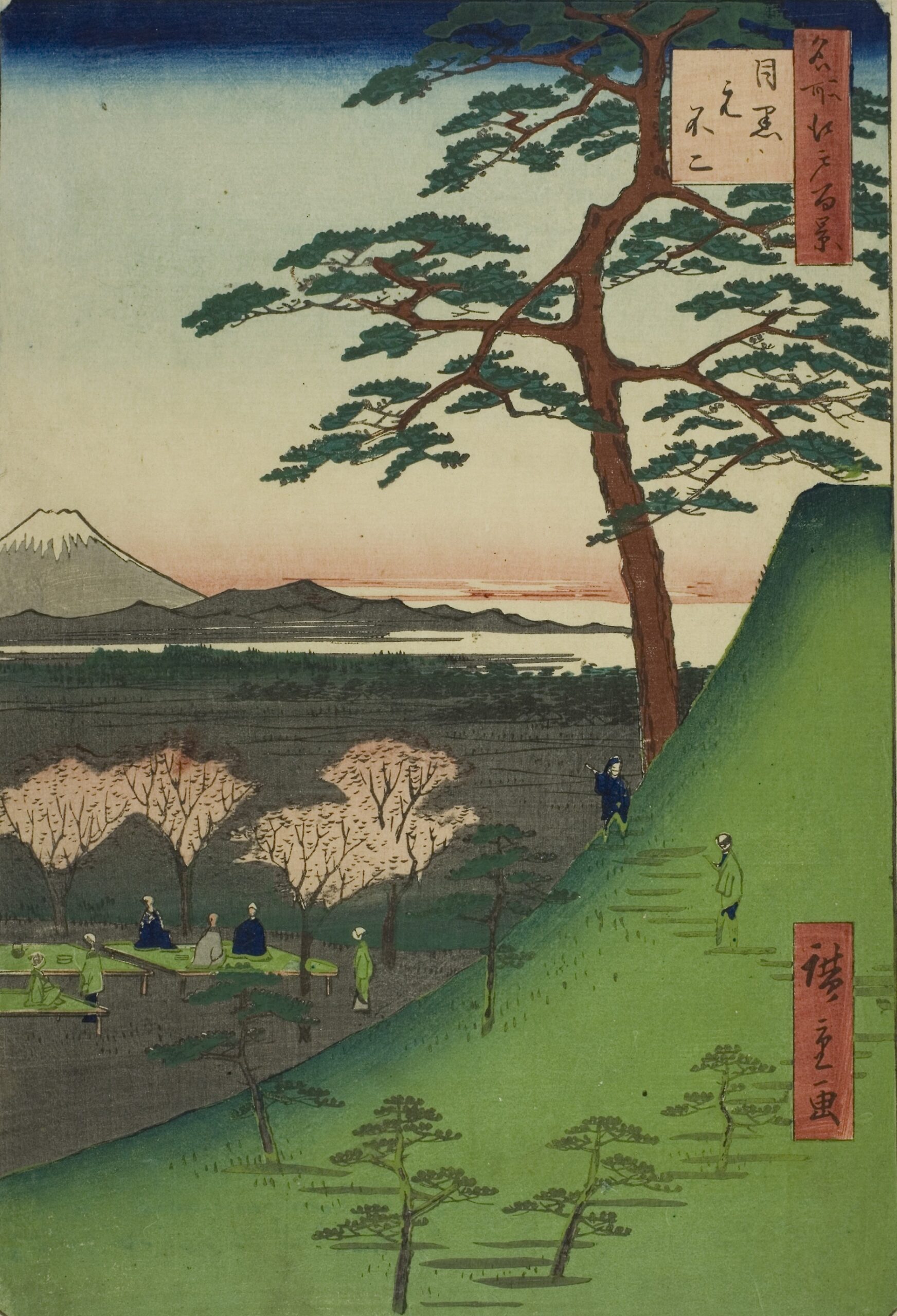
The large painting in the foreground is “Motofuji.”
Although it is an artificial mountain, its appearance is modeled after the real Mount Fuji, with stone steps leading up to the summit.
The tiny figures of people climbing the mountain are visible, conveying the joys of pilgrimages and sightseeing.
The original Mount Fuji is depicted large in the background.
The combination of the artificial Fuji and the real Fuji in one piece skillfully expresses the faith and aspirations of the Edo people. The painting also depicts idyllic scenery typical of the outskirts of Edo, illustrating the fascinating location of Meguro at the time, nestled “between nature and the city.”
Mount Fuji is usually climbed with the guidance of a mountain ascetic monk, but those unable to climb the mountain would instead visit a fujizuka, a structure modeled after Mount Fuji.
This mound was built in 1812 at the request of Iyemon.
Due to its beautiful appearance, people from all over Edo visited it.
In the foreground of the fujizuka is a single pine tree and a couple walking down a winding path.
Below is a person taking a break in a rest area surrounded by cherry trees.
<4> Edo’s fujizuka culture and the “new” and “original”
Moto Fuji is a place of worship with a long history. It is the “original fujizuka” beloved by the common people of Edo for many years.
Shin Fuji is a newer mound built later. It became a popular site, attracting even more worshippers.
Depicting the two separately conveys how much the people of Edo treasured their worship of Mount Fuji, yet also enjoyed it with a playful spirit.
<5> Connections to the Present
Unfortunately, Meguro Motofuji no longer exists.
Several fujizuka remain in Tokyo, allowing you to experience the atmosphere of the time.
Komagome Fuji Shrine (Bunkyo Ward), Sendagaya Fujizuka (Shibuya Ward), Oji Inari Shrine Fujizuka (Kita Ward)
Some locations offer actual worship, allowing you to experience the “Fuji Climbing” that Edo commoners enjoyed.
<6> Tourist Guide
1. Experience the Faith of the Edo People by Touring the Fujizuka
Although Shin-Fuji and Motofuji have disappeared, touring the remaining fujizuka allows you to relive the faith and playful spirit of the Edo period.
2. Combine with a Stroll in Meguro
Meguro is a town where nature and history remain. Strolling around Meguro Fudoson and the promenade along the Meguro River, while viewing Hiroshige’s ukiyo-e prints, will bring the Edo era back to life.
3. Be conscious of the “double Fuji”: The composition of the artificial “original Fuji” superimposed on the real Fuji expresses the dreams of Edo people. Even today, it’s interesting to imagine that feeling when looking at the real Fuji from the streets of Tokyo.