Utagawa Hiroshige – One Hundred Famous Views of Edo – 29 – Spring – Sunamura Motohachiman – Commentary 歌川広重-名所江戸百景-29-春-砂むら元八まん 解説
Current Address: Togaoka Hachiman Shrine, Minami-Sunamachi 7-chome, Koto Ward
Latitude and Longitude: Latitude 35.6660, Longitude 139.8280
Published: April 1856 Age: 60
Commentary
<1> Introduction
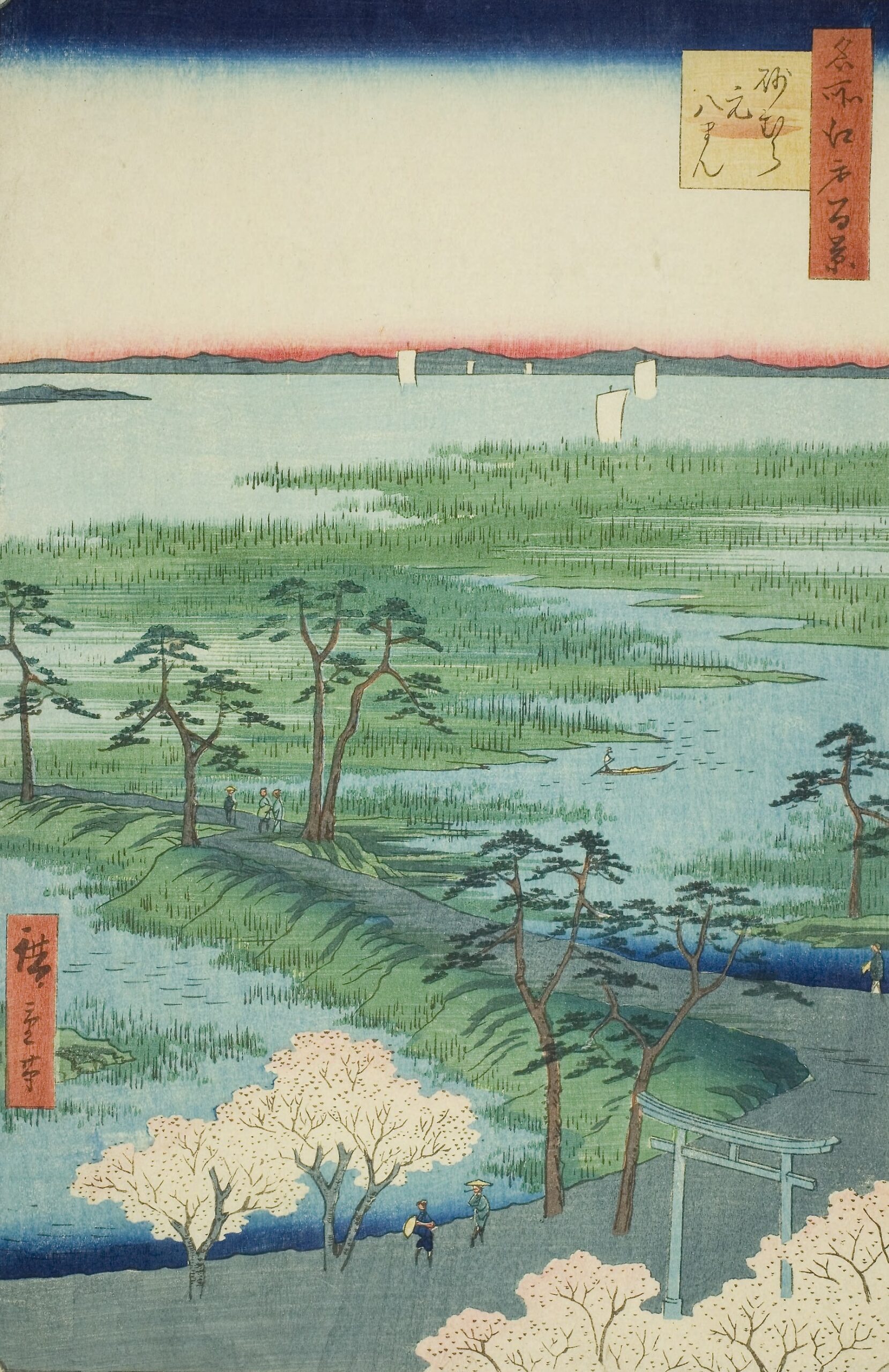
“Sunamura Motohachiman” is based on Sunamura Hachiman Shrine, commonly known as “Motohachiman,” located in Fukagawa.
Hiroshige skillfully portrays the faith and everyday life of the Edo common people through the shrine and its surrounding landscape.
<2> About Sunamura Motohachiman
Sunamura Hachiman Shrine is an ancient shrine located in Sunamura-cho, Fukagawa (near present-day Minami-Sunamachi, Koto Ward).
It is said to have been originally founded in the Kamakura period, and during the Edo period it was known as “Motohachiman” and attracted devout worshippers.
The place name “Sunamura” (Sunamura) comes from the fact that it was originally developed from a low-lying, sandy marshland.
The residents engaged in rice farming and river fishing, and cherished Hachiman Shrine as their guardian deity.
Pilgrims also came from throughout Edo, and the shrine was bustling with people seeking blessings in agriculture, fishing, and good fortune.
<3> Highlights of the painting
The imposing shrine building is depicted.
The curved roof and torii gate are powerfully depicted, conveying the grandeur of the shrine as a place of worship.
Commoners who have come to worship are scattered throughout the painting, indicating that the people of Edo were familiar with the shrine.
The clothing and behavior of the people walking along the approach convey a serene atmosphere of everyday life.
Lush trees can be seen behind the shrine building, and the surrounding landscape features waterside and fields.
The composition shows that the shrine was integrated into the local natural environment.
The Boso Peninsula can be seen in the distance.
Edo Bay can be seen below it.
Below that is a wetland.
The torii gate of Moto-Hachiman can be seen in the lower right.
<4> Edo Commoners and Moto-Hachiman
For the common people of Edo, visiting a shrine was both a religious and recreational event.
On New Year’s first visits and festival days, stalls lined the streets and people gathered.
The journey across the river to make the pilgrimage itself became a bit of an outing.
The name “Moto-Hachiman” was given to distinguish it from “Shin-Hachiman-gu (Tomioka Hachiman-gu),” which was later built nearby.
<5> Modern-day Moto-Hachiman
Sunamura Hachiman-gu Shrine still resides in Minami-Suna, Koto Ward, and is cherished as the local guardian deity.
The grounds have been well-maintained, quietly retaining traces of its past amidst a residential area.
The shrine is beloved by locals, and is still bustling with visitors for festivals and New Year’s visits.
<6> Tourist Guide
1. Strolling Around the Sunamachi Area
The Minami-Suna and Kita-Suna areas, where town names derived from the Edo period “Sunamura” still remain, offer a stroll through the town with a downtown atmosphere.
2. Comparative Pilgrimage with Tomioka Hachiman Shrine
Visiting both Sunamura Hachiman Shrine, known as “Moto-Hachiman,” and Fukagawa Tomioka Hachiman Shrine, known as “Shin-Hachiman,” allows you to truly appreciate the spread of Hachiman worship in the Edo period.
3. Strolling Along the Arakawa and Kyu-Nakagawa Rivers
The area around the shrine was once a low-lying marshland.
The river and waterfront scenery remains, making it a fun walking course.