(あづまのもり れんりのあずさ)
Utagawa Hiroshige – One Hundred Famous Views of Edo – 31 – Spring – “The Intertwined Azusa Trees of Azuma Forest” – Commentary 歌川広重-名所江戸百景-31-春- 吾嬬の森連理の梓 解説
あづまのもり れんりのあずさ)
Current Address: Azuma Shrine, Tachibana 1-chome, Sumida Ward
Latitude and Longitude: Latitude 35.7330, Longitude 139.8160
Published: July 1856 Age: 60
Commentary
<1> Introduction
“The Intertwined Azusa Trees of Azuma Forest” is based on the forest that spreads across the grounds of Azuma Shrine, located in what is now Azuma-cho, Sumida Ward.
This area, in particular, is home to a unique tree known as the “Intertwined Azusa Tree,” which attracted the faith of the common people of Edo.
<2> Azuma Forest and Azuma Shrine
Azuma Shrine is an ancient shrine dedicated to Emperor Yamato Takeru.
It is said to have been founded in the Heian period.
According to shrine legend, the shrine was originally built to enshrine the soul of Emperor Yamato Takeru’s wife, Ototachibana-hime, during his expedition to the east.
The area around the shrine is known as “Azuma Forest,” and a lush, sacred forest remained there during the Edo period.
“Renri” refers to the phenomenon in which two trees join together and grow as one.
The Azuma Shrine’s catalpa trees, which exhibit this intertwined shape, were revered as sacred trees for matchmaking and marital harmony. It is said that common people of Edo visited the shrine to pray for successful love and marital harmony.
<3> Highlights of the painting
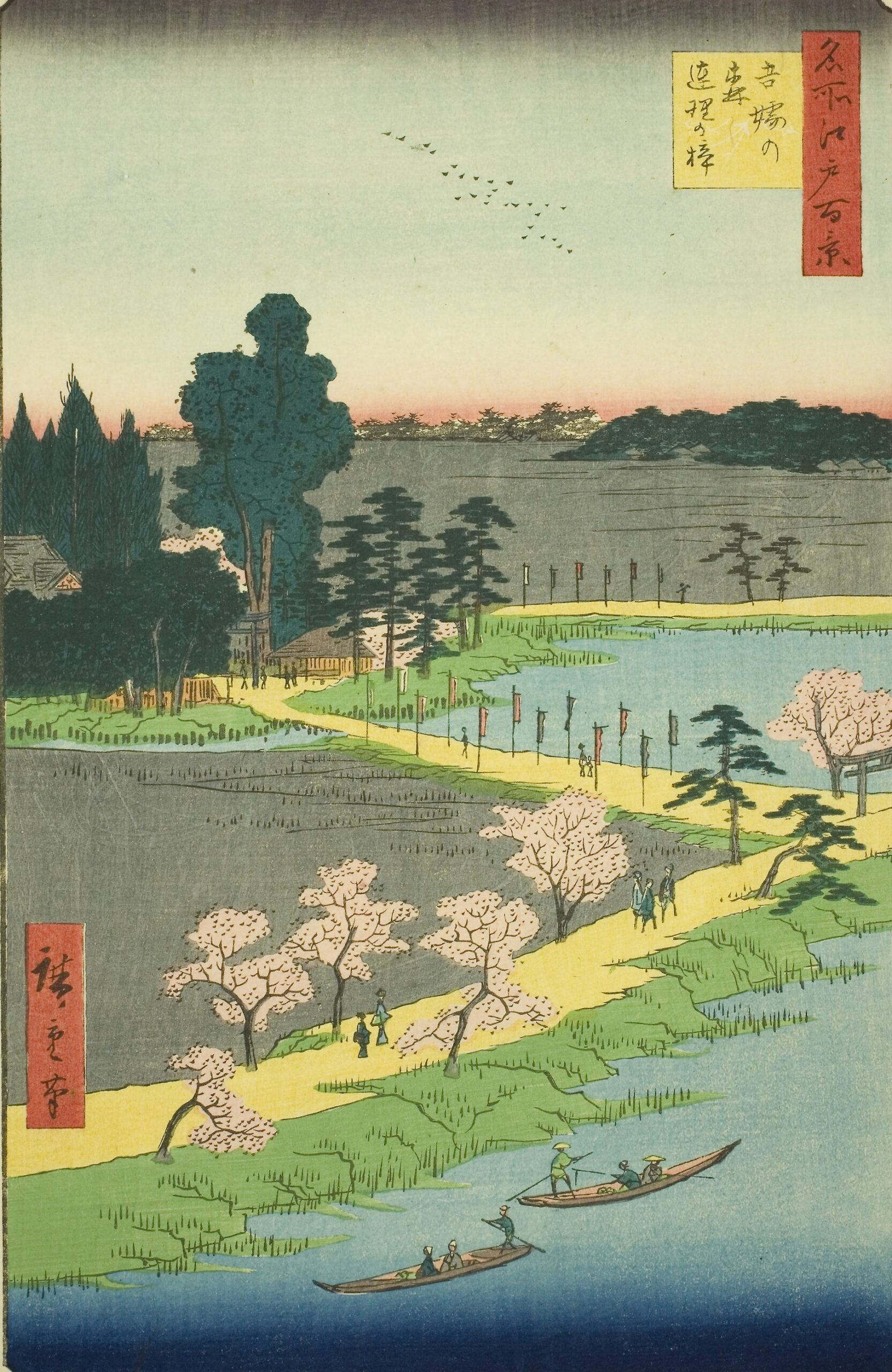
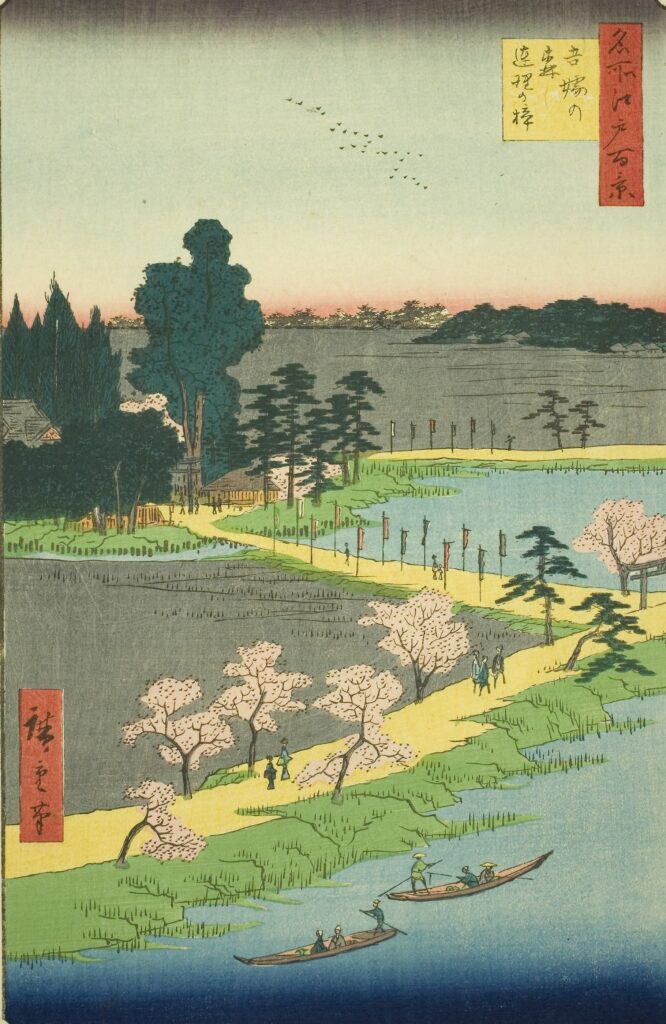
The “renri-no-azusa” (intertwined catalpa trees) are depicted in the center, with their branches symbolically intertwining and reaching into the sky.
Common people of Edo and travelers can be seen at the base of the tree, gazing at the sacred tree and offering prayers.
The deep green of the trees and the appearance of the shrine pavilion create the feeling of a mystical natural space in the middle of Edo.
North of Kameido, on the edge of the Jikken River, stands Azuma Gongen Shrine, dedicated to Ototachibanahime, the wife of Emperor Yamato Takeru.
The surrounding area was called Azuma Forest.
A camphor tree in the shrine grounds, with its trunk splitting into two halfway down, was considered a sacred tree.
The torii gate and shrine in the back left are Azuma Gongen Shrine.
The large tree behind the torii gate is a camphor tree, and there is the following legend surrounding this camphor tree and shrine:
When Ototachibanahime drowned herself to appease the sea god in an attempt to save Emperor Yamato Takeru, her kimono washed up nearby, and Emperor Yamato Takeru had a mausoleum built in Azuma Forest to house her kimono.
To appease the spirit of Ototachibanahime, two camphor chopsticks used for eating were thrust into the east side of the shrine. The chopsticks later grew and joined together to form a two-pronged camphor tree.
<4> Significance for the Common People of Edo
“Renri no Azusa” was a popular place for young men and women, as well as married couples, to pray for love and marital harmony.
For the people of Edo, a visit to the shrine was a short trip that also served as a form of entertainment.
Eating, drinking, and sightseeing within the shrine grounds were also part of the fun.
<5> Modern-day Azuma Shrine
While the Renri no Azusa itself no longer exists, Azuma Shrine still stands in Tachibana, Sumida Ward, and is beloved by local residents.
People still visit the shrine to pray for matchmaking, marital harmony, and family harmonies, and you can feel the continuation of faith that dates back to the Edo period.
We also recommend touring the shrine along with other sites that evoke the Edo atmosphere, such as Kameido Tenjin Shrine and Mukojima Hyakkaen Gardens.
<6> Tourist Guide
1. Visiting Azuma Shrine
In honor of the “Renri no Azusa” (linked azusa trees), love charms and votive plaques are popular. These votive plaques continue to convey the wishes of Edo commoners to the present day.
2. Comparison with Hiroshige’s Ukiyo-e
By touring the historical sites of Sumida Ward and comparing them with Hiroshige’s paintings, the image of Edo comes to life even more vividly.
3. Walking Route
After visiting Azuma Shrine, combine sightseeing with Kameido Tenjin Shrine and Tokyo Skytree to experience both Edo and modern Tokyo at the same time.