Utagawa Hiroshige – One Hundred Famous Views of Edo – 33 – Spring – Yotsugi-dori Water-Hitch Boat – Commentary 歌川広重-名所江戸百景-33-春-四ツ木通用水引ふね 解説
Current Address: Near Yotsugi-cho, Katsushika Ward
Latitude and Longitude: Latitude 35.7360, Longitude 139.8350
Published: February 1857 Age: 61
Commentary
<1> Introduction
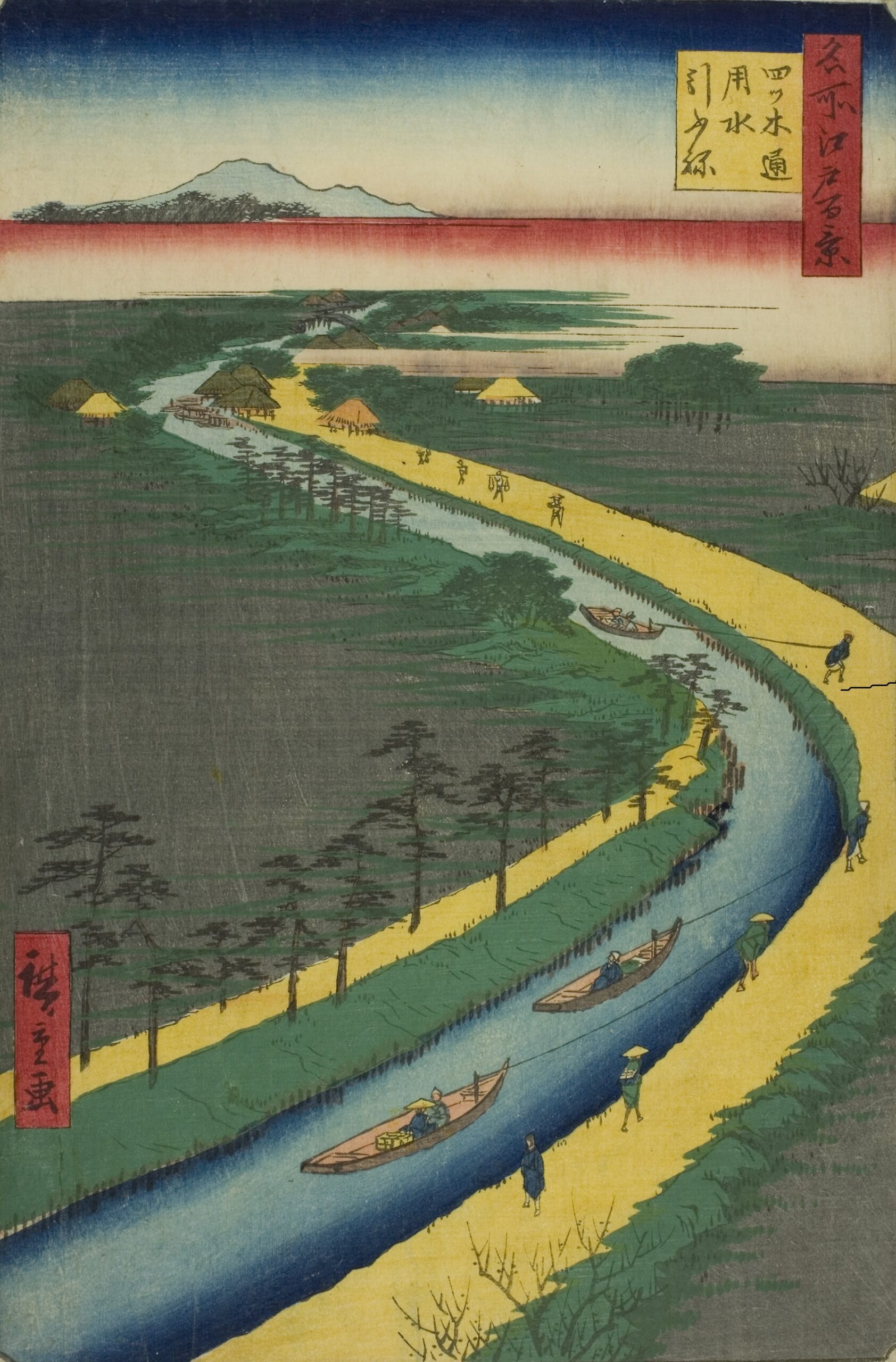
“Yotsugi-dori Water-Hitch Boat” highlights the importance of water transportation and irrigation canals that supported Edo’s infrastructure.
Yotsugi is an area in what is now Katsushika Ward, and depicts the irrigation canals that supplied water to the city of Edo, transporting water by boat. Hiroshige skillfully depicts this “waterway that supported life,” capturing the underlying mechanisms behind the lives of the Edo people in his ukiyo-e prints.
<2> About Yotsugi
Yotsugi is an area located on the east bank of the Sumida River in what is now Katsushika Ward, Tokyo.
During the Edo period, this area was a key waterway location, rich in nature and on the border between rural and urban areas.
Edo’s rapid population growth led to a sharp increase in demand for water. As a result, numerous waterworks were constructed, including the Tama River and Kanda Waterworks. Water was also drawn from the Yotsugi area, and materials and water were transported by boat.
Mizuhikibune (water-drawn boat) refers to the boating of Edo’s irrigation water and materials.
This area was also a logistics hub that supported Edo’s infrastructure behind the scenes.
<3> Highlights of the painting
In the center is a large boat used to draw irrigation water.
The image of a person steering the boat down the river conveys the importance of “water transportation” to support the city of Edo.
In the background, fields and thatched-roof houses can be seen, revealing the typical rural landscape of Yotsugi.
This clearly illustrates Yotsugi’s position as a junction between urban and rural areas.
The Yotsugi Canal, which divides the screen, is also known as the Kameari Canal, Honjo Canal, and Koume Canal.
It flows from a pond in what is now Koshigaya City, Saitama Prefecture, through Katsushika, and into the Gennomori River.
It supplied water to Honjo and Fukagawa. After ceasing its role as a canal in 1722, it was used for irrigation and as a canal.
As it was also a shortcut to Mito, four-person towboats were introduced to transport travelers.
Because the river was narrow, small boats were towed from the bank for the 7km journey to the Mito Kaido.
Three towboats carry passengers.
The roofs lining the river above are docks.
The bridge beyond is the terminus of the towboats, and leads to the Mito Kaido.
<4> The Relationship between Yotsugi and the Edo Commoners
The lives of Edo commoners relied heavily on the “canal.”
Securing clean water by boat was essential to maintaining quality of life.
The area around Yotsugi was also an agricultural region, serving as a base for supplying vegetables and fruits to the city of Edo.
River transport enriched Edo’s diet.
<5> Modern-day Yotsugi
The place name “Yotsugi” still remains, and Yotsugi Station is located on the Keisei Oshiage Line.
As in the Edo period, the area is filled with waterfront areas, and a stroll along the river offers a glimpse of the atmosphere of the past.
Today, the area is known as the birthplace of Yoichi Takahashi, the creator of the manga “Captain Tsubasa,” and statues of the character are scattered throughout the town.
<6> Tourist Guide
1. Stroll along the Sumida River Terrace
Walking along the river from Yotsugi toward Asakusa allows you to experience the flow of boat transport in the Edo period.
2. Walking around the town associated with Captain Tsubasa
Bronze statues of popular characters line the area around Yotsugi Station, making it a modern tourist attraction.
3. Combine sightseeing with Shibamata Taishakuten Temple
When you think of Katsushika, you think of Shibamata.
A short walk from Yotsugi awaits you at Taishakuten Temple’s approach, brimming with Edo-period atmosphere.