Utagawa Hiroshige – One Hundred Famous Views of Edo – 61 – Summer – Nakagawaguchi 歌川広重-名所江戸百景-61-夏- 中川口の解説
Current Address: Near the Mouth of the Nakagawa River, Edogawa Ward
Latitude and Longitude: Latitude: 35.6839, Longitude: 139.8744
Published: February 1857
Age: 61
Commentary
Tourist Guide-Style Commentary: “Nakagawaguchi”
■ Introduction
Utagawa Hiroshige’s “One Hundred Famous Views of Edo” is a series of ukiyo-e prints that vividly depict the seasons and the daily lives of Edo’s people.
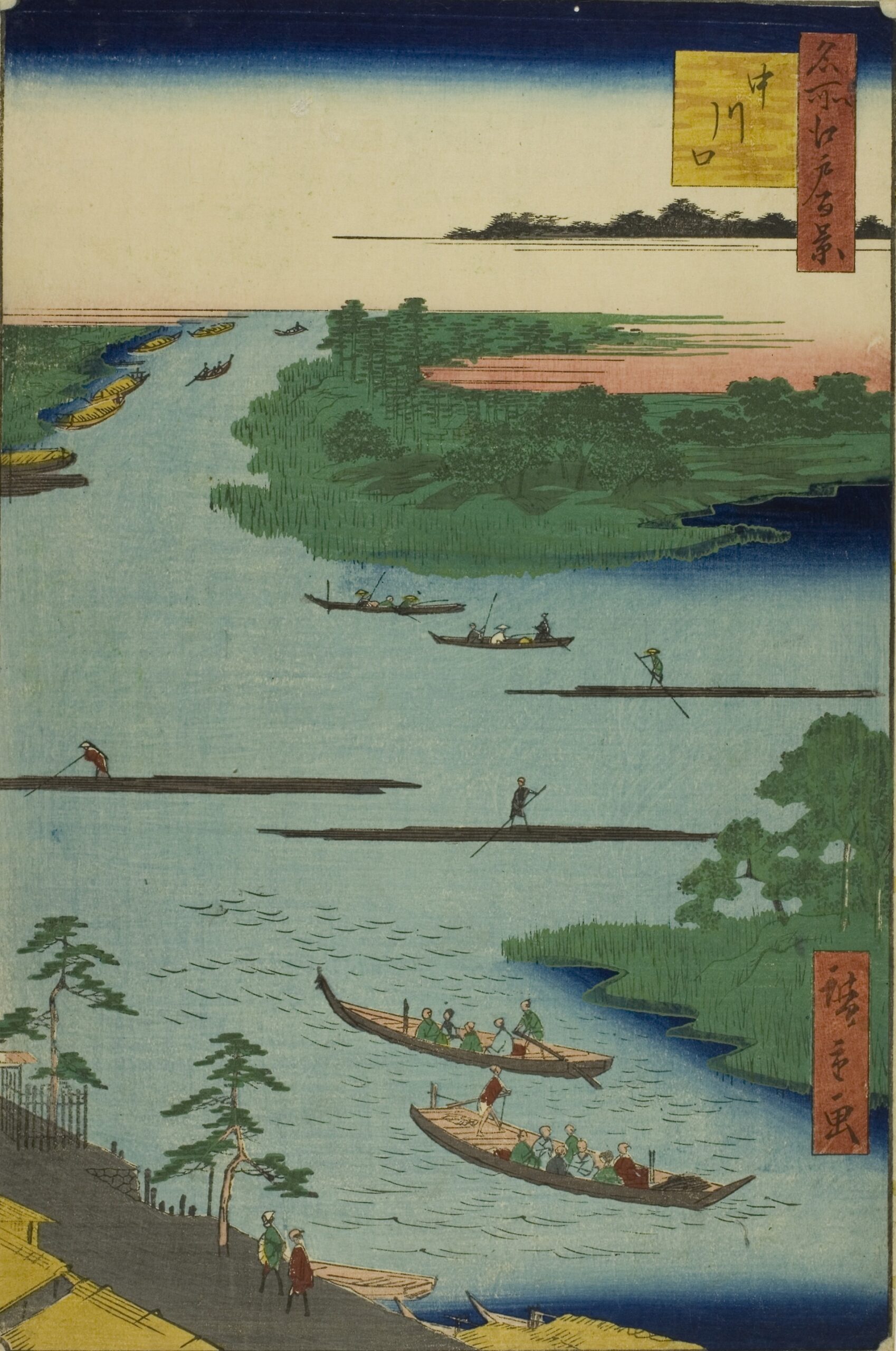
Among these works, “Nakagawaguchi” depicts the area near the confluence of the Sumida River and the Nakagawa River.
This corresponds to the area stretching from present-day Koto Ward to Sumida Ward.
At the time, this area was a key logistics hub and a place of beautiful riverside scenery.
The boats passing along the river and the people along the riverside depict Edo’s lifestyle, which was supported by water transportation, and the idyllic riverside scenery.
■ Nakagawaguchi
“Nakagawaguchi” refers to the area downstream of the Sumida River where it joins the Nakagawa River.
During the Edo period, this area served as Edo’s eastern gateway.
Edo flourished as a “water city,” transporting goods by boat.
Nakagawaguchi was a transportation hub connecting Edo Bay to the Sumida River and then to the Nakagawa and Arakawa Rivers.
Rice, lumber, and other goods passed through here.
Riverbanks were developed along the riverside, and the area developed as a collection point for goods.
Teahouses and rest areas were located nearby, and common people could be seen enjoying boating and strolling along the riverside.
■ Highlights of the painting
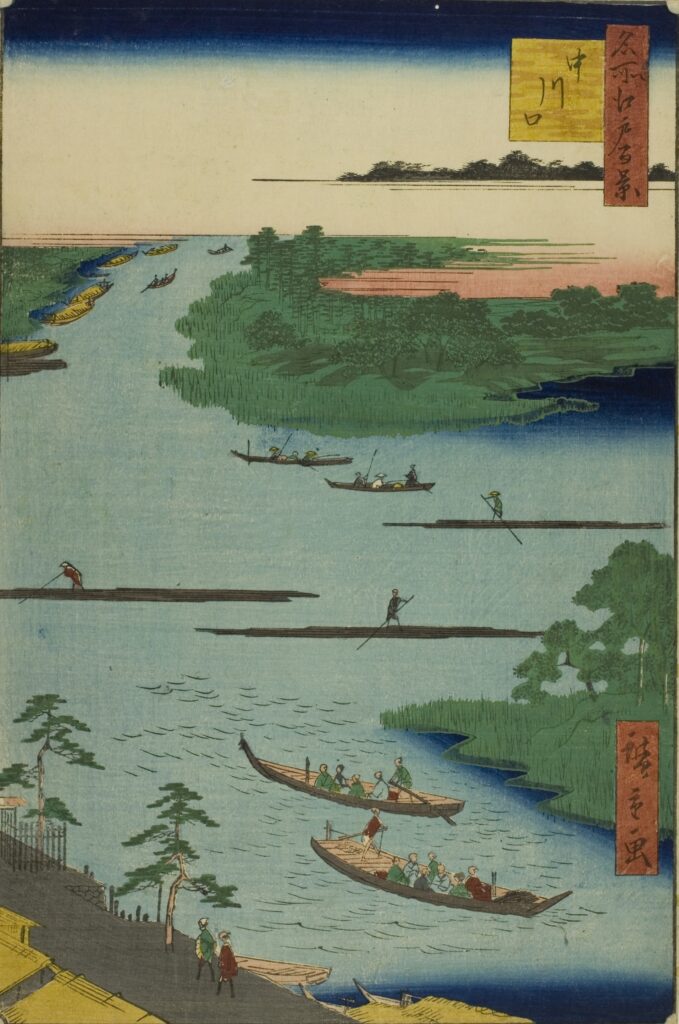
The Onagi River is in the foreground.
Flowing to the right is the Nakagawa River.
The Shinkawa River flows in the background.
This is a scene where three rivers converge.
Two long ferries connecting Edo and Gyotoku can be seen here.
Three rafts can be seen floating where the rivers converge, confirming that this was an important canal.
Two fishing boats can also be seen.
The excavation of the Onagi River, connecting the Sumida River and Nakagawa River, and the Shinkawa River, connecting the Nakagawa River and Tone River, was carried out by order of Ieyasu.
This made it possible to transport goods to Edo without going around Edo Bay.
The boat guardhouse in the lower left confirms the importance of this river.
It served as a waterway for transporting salt produced in Gyotoku to Edo.
■ The Nakagawaguchi for the Edo commoners
Rice, miso, soy sauce, lumber, and other daily necessities were transported to the city of Edo via this point.
It was an important location that supported Edo’s food and architectural culture.
Located in the lower reaches of the Sumida River, it was also a popular boating spot. Summer boat trips, especially for cherry blossom viewing and cooling off, were popular among the common people.
Located a little ways from the downtown area, visitors could enjoy the tranquil riverside scenery.
It’s a place where city and nature coexist in harmony.
■ Nakagawaguchi in Modern Times
The area currently known as Nakagawaguchi extends into Tokyo’s downtown areas of Koto and Sumida.
The role of canals and riverbanks has diminished since the period of rapid economic growth.
The Nakagawa-Arakawa River system plays an important role in disaster prevention and flood control, protecting the lives of the local community.
The riverside parks and promenades are popular jogging and walking trails, evoking vestiges of the boating past.
■ Tourist Guide Recommendations
① Stroll along the Sumida River Terrace
The promenade along the river is well-maintained and perfect for a leisurely stroll while enjoying the changing scenery of the seasons.
② Water Buses and Cruise Ships
Services from Asakusa to Odaiba and Toyosu are a tourist attraction that allow you to relive the old waterways.
③ Strolling Through the Old Town of Koto and Sumida Wards
Many spots retaining memories of the Edo period are scattered throughout the area, including Tomioka Hachimangu Shrine, Fukagawa Fudodo Temple, museums along the Sumida River, and shopping streets brimming with old-fashioned charm.