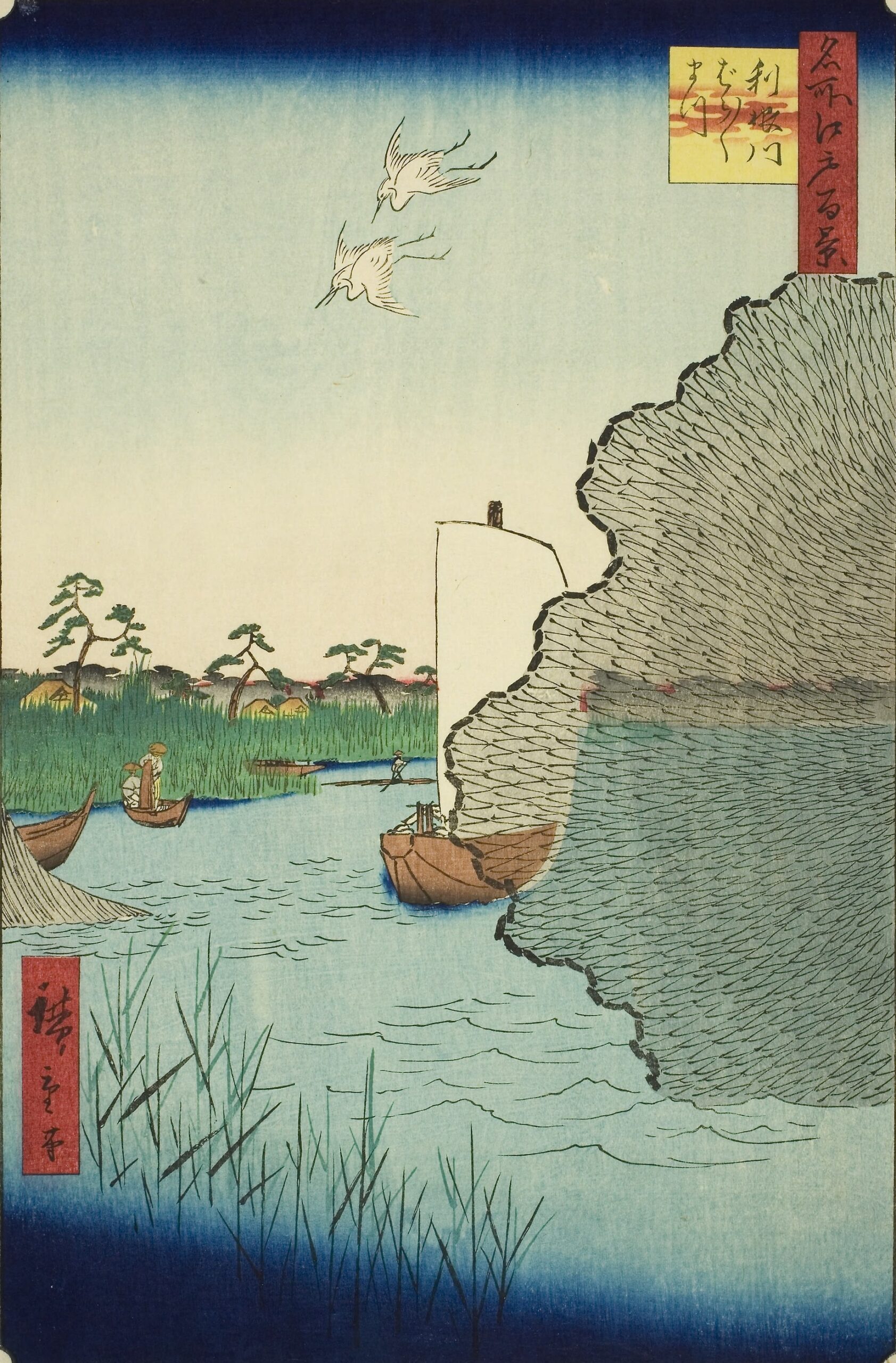
Utagawa Hiroshige – One Hundred Famous Views of Edo – 62 – Summer – Commentary on “The Scattered Pine Trees on the Tone River” 歌川広重-名所江戸百景-62-夏- 利根川ばらばらまつの解説
Current Address: Near Abiko to Matsudo, Chiba Prefecture
Latitude and Longitude: Latitude: 35.8720, Longitude: 140.0210
Published: August 1856 Age: 60
Commentary
Tourist Guide-Style Commentary: “The Scattered Pine Trees on the Tone River”
■Introduction
Utagawa Hiroshige’s “One Hundred Famous Views of Edo” is a series of paintings depicting scenic spots in Edo and its surrounding areas. These works simultaneously convey the charm of Edo’s people’s lives and nature. Among them, “The Scattered Pine Trees on the Tone River” is one of the few works depicting an area somewhat distant from Edo. The setting is the banks of the Tone River, a mighty river that irrigates the Kanto Plain, known for its distinctive rows of pine trees.
■Tone River and “Barabara Pine Trees”
About the Tone River
The Tone River, also known as “Bando Taro,” is one of Japan’s largest rivers. During the Edo period, it served as a major waterway, transporting rice and lumber to Edo (present-day Tokyo).
Origin of the “Barabara Pine Trees”
The pine trees growing along the riverbank in this area were called “Barabara Pine Trees” because of their irregular, widely spaced rows. Unlike rows of straight, aligned trees, their natural growth contributed to the landscape and made them a popular sightseeing spot.
Transportation and Scenic Spots
Many people passed through the area as a ferry crossing and a rest stop for boat traffic, and it eventually became featured in ukiyo-e prints and travelogues. It was also known as a short trip destination near Edo.
■Highlights of the Painting
The Tone River refers to the old Edogawa River.
The location is around Fujimi-cho, Urayasu City.
It’s possible that Hiroshige got the name of the river wrong, or that there was a similar place name on the Edogawa River.
Hiroshige also depicted the same place in “Ehon Edo Souvenir.”
Since it states, “As the greatest river in the Bando region, it is also known as Bando Taro,” it is likely a scene from the Tone River.
The rows of scattered pine trees stand in the center left.
Reeds grow thick in front of them.
Even more impressive than the pine trees is the large cast net on the left. It is used to catch river fish such as carp and crucian carp.
■Modern-day “Tone River Scattered Pine Trees”
It is difficult to pinpoint the exact location of the “Scattered Pine Trees” today.
Pine trees and the natural beauty of the riverside still remain along the Tone River, allowing us to recall the landscape of the past.
Promenades and parks have been developed along the river from Saitama to Chiba and Ibaraki prefectures.
You can enjoy the riverside scenery by cycling or strolling.
The Tone River area is dotted with post towns and historical sites that have existed since the Edo period.
This is an area where you can relive the scenery depicted in ukiyo-e.
Through bird watching, river swimming, and fishing, you can experience the blessings of the river up close even today.
■Tourist Guide Recommendations
- Tone River Cycling Road
This cycling course running along the vast river is a great spot to enjoy the natural beauty of the Tone River while feeling the river breeze. - Exploring Historic Post Towns
Touring post towns once connected to waterway transportation on the Tone River, such as Toride and Sekijuku, will make you feel as if you are actually walking through the backdrop of an ukiyo-e. - Search for Remnants of Pine Trees
Pine trees are still planted here and there along the river, and walking while imagining the scattered pine trees is a joy. - Learn about the History of Waterway Transportation
At museums and archives along the Tone River, you can learn about the role of waterways and shipping during the Edo period.