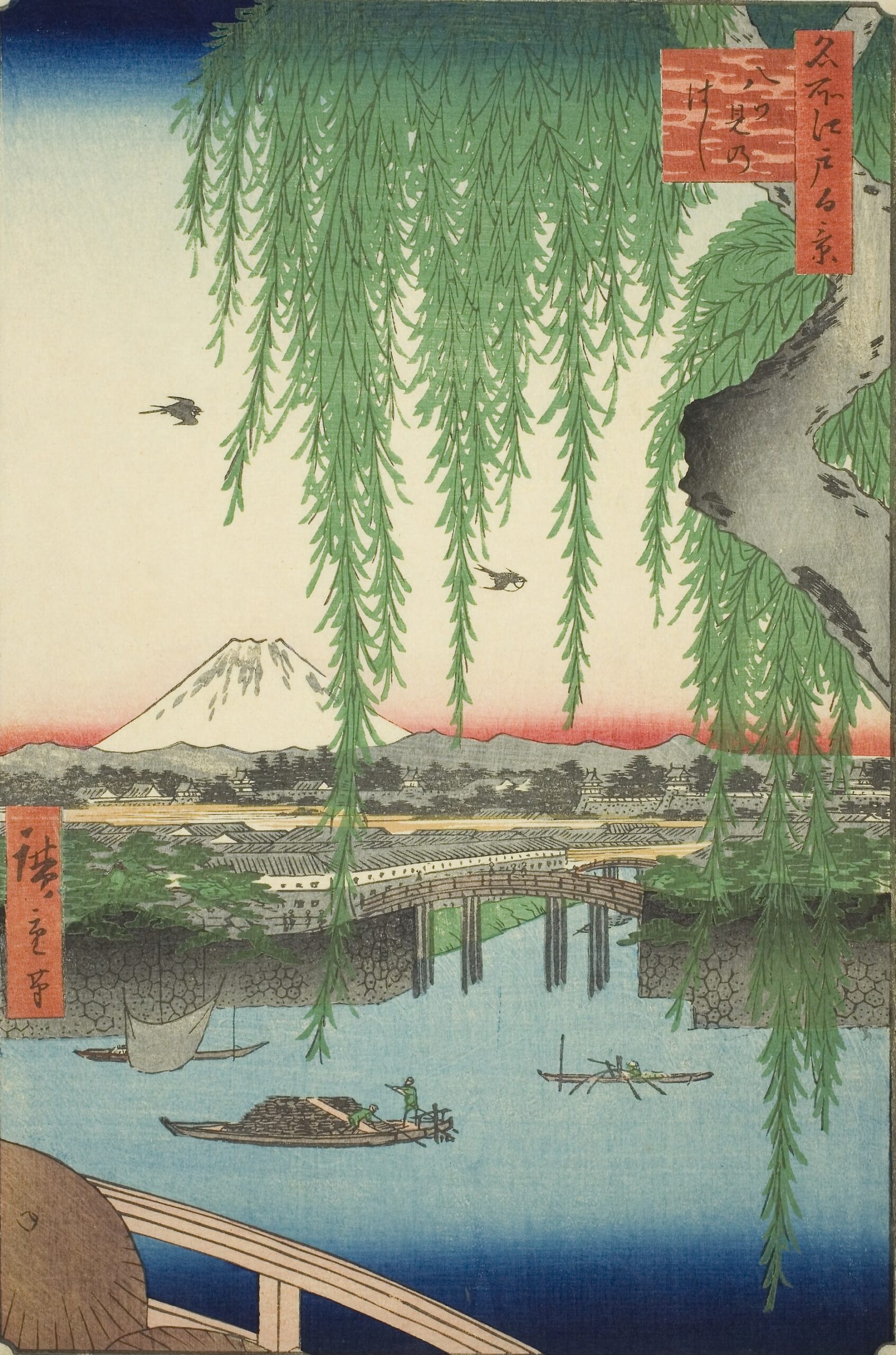
Utagawa Hiroshige – One Hundred Famous Views of Edo – 63 – Summer – Explanation of Yatsumi no Hashi 歌川広重-名所江戸百景-63-夏- 八ツ見のはし 解説
Current Address: Hatchobori, Chuo Ward (near Hatchobori Intersection, a bridge over the Kamejima River)
Latitude and Longitude: Latitude: 35.6748, Longitude: 139.7786
Published: May 1857
Age: 61
Explanation
Tourist Guide-Style Commentary: “Yatsumi no Hashi”
■ Introduction
Utagawa Hiroshige’s One Hundred Famous Views of Edo is a masterpiece of 119 illustrations depicting Edo’s famous places and people’s lives through the four seasons.
It is a valuable visual archive conveying the image of Edo to the present day.
“Yatsumi no Hashi” is included in the summer chapter.
The landscape depicted symbolizes Edo’s status as a “city of water.”
The name comes from the fact that one could see the “eight bridges” from this location.
This is a sight unique to Edo, where rivers intersect in complex ways.
People enjoyed it as a tourist attraction.
■ What is Yatsumi no Hashi?
Yatsumi no Hashi was a bridge located near the confluence of the Kanda River and Nihonbashi River.
It was a key logistics and transportation hub in Edo.
The rivers in this area are wide, and various bridges cross it, creating the unusual sight of standing on one bridge and seeing multiple bridges at once.
People in the Edo period enjoyed counting how many they could see, and it is said that the bridge came to be called “Yatsumi no Hashi” because, as the name suggests, eight bridges could be seen.
Bridges were not just transportation infrastructure, but also a stage for entertainment and recreation.
■ Highlights of the painting
The bridge’s official name is Ichikokubashi.
The bridge was named after the Goto goldsmith’s shop on the north side of the bridge, and the Goto kimono merchant’s shop on the south side.
The name is said to come from the fact that two Goto (five to) equal one koku.
This bridge, also known as Hatsumi Bridge, spans the east side of a river crossing.
Standing in the center, you can see seven bridges spanning the east and west rivers: Zenihei Bridge, Dosan Bridge, Tokiwa Bridge, Gofuku Bridge, Kaji Bridge, Nihon Bridge, and Edo Bridge.
This is because, including Isseki Bridge, a total of eight bridges can be seen.
The railings of Isseki Bridge and two umbrellas can be seen in the foreground.
The willow trees at the foot of the bridge are in lush green leaves.
Two swallows are depicted in the sky, giving a sense of summer.
Beyond that, Zenihei Bridge spans Dosan Moat.
The residence to the south is the upper residence of Akimoto Tajima-no-kami, the lord of Tatebayashi Domain.
In the center of the river, you can see fishing boats using four-hand nets and tea ships.
Edo Castle is depicted in the middle background, and Mount Fuji in the distance.
■ Walking along the Modern-Day Yatsumi Bridge
The area where Yatsumi Bridge once stood stretches from Iwamotocho in Chiyoda Ward to the Nihonbashi-Honkokucho area in Chuo Ward.
The original landscape has been lost due to redevelopment.
The confluence of the Kanda River and Nihonbashi River remains, and a walk along the river offers a glimpse into the aquatic life of Edo.
■ Recommended Points from the Tourist Guide
① Visit as an extension of your Nihonbashi sightseeing
It’s within walking distance of Nihonbashi, making it an ideal route connecting Edo’s water transportation hubs.
② Take a Bridge Cruise
Aboard this boat, you can experience why Yatsumi Bridge was such a famous landmark.
With a panoramic view of several bridges at once, you’ll feel like an Edokko (old Edo-period native).
③ Strolling Through Historical Sites and Dining
The area is dotted with long-established restaurants and the remains of merchant houses.
After a historical stroll along the river, we recommend enjoying the flavors of Edo.