Utagawa Hiroshige – One Hundred Famous Views of Edo – 64 – Summer – Suidobashi Surugadai 歌川広重-名所江戸百景-64-夏-水道橋駿河台
Current Address: Surugadai, Chiyoda Ward
Latitude and Longitude: Latitude: 35.6995, Longitude: 139.7630
Published: May 1857 Age: 61
Commentary
Tourist Guide-Style Commentary: “Suidobashi Surugadai”
■ Introduction
Utagawa Hiroshige’s “One Hundred Famous Views of Edo” is a series of masterpieces depicting the landscapes of Edo through the seasons.
It remains an essential resource for understanding Edo culture.
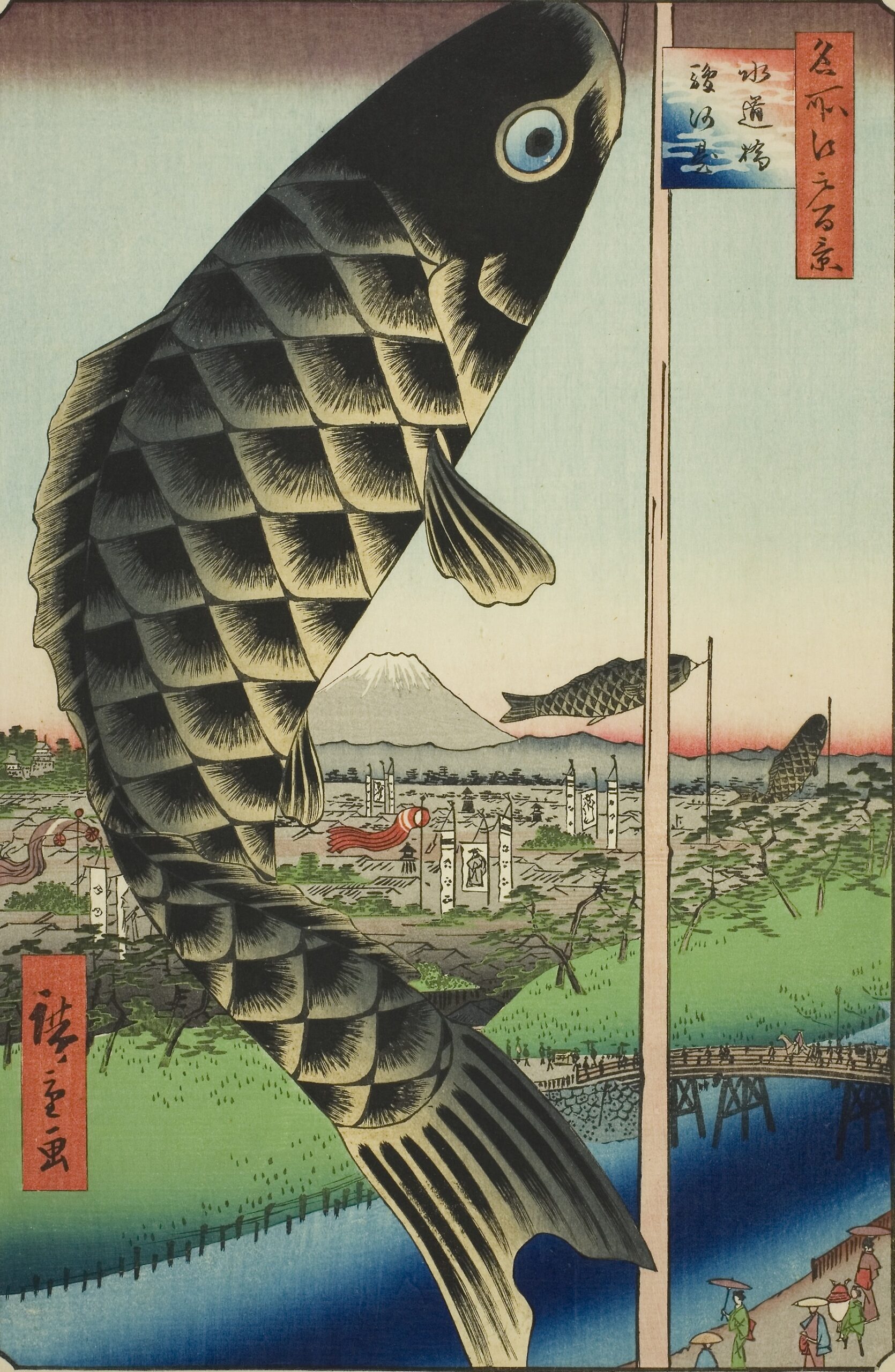
This work depicts the area around the Suidobashi Bridge over the Kanda River and the towering Surugadai Bridge behind it.
■ About the Suidobashi Bridge
As its name suggests, the Suidobashi Bridge is a bridge closely connected to Edo’s lifeline, the waterworks.
It was originally built in the early Edo period to support a wooden conduit spanning the Kanda River.
It was a facility that transported water from the Kanda Aqueduct throughout Edo, and was an important piece of infrastructure that supported people’s lives.
Over time, the bridge also played a role in supporting people’s traffic, becoming a key transportation hub connecting samurai residences and townspeople’s areas.
For the people of Edo, the aqueduct was essential both as a foundation for their lives and as a means of urban transportation.
■ About Surugadai
Surugadai is a plateau on the north bank of the Kanda River, and was the site of samurai residences located on the outskirts of Edo Castle.
It is a historic area where many daimyo residences have been located since the founding of Edo.
It is said that the name comes from the fact that Tokugawa Ieyasu called this plateau “Surugadai” when he entered Edo from Suruga.
From the end of the Edo period through the Meiji period, universities and academic institutions were established here, and in modern times it developed into a city of learning on a par with Ochanomizu.
Today, the area is home to Nihon University and Meiji University, giving it a student town atmosphere.
■ Highlights of the Painting
Surugadai was named after the water pipe that carried water to Edo Castle, which spanned the Kanda River.
Surugadai was originally a hilly area called “Kanda no Dai.”
The land here was cut down to reclaim Edo Bay, creating a gentle slope.
It was later the location where Tokugawa retainers from Suruga Province were relocated.
A large carp streamer, used to celebrate Boys’ Day at the samurai residences in Hongo-dai, appears in the foreground.
The aqueduct that spans the Kanda River is the aqueduct that gave the area its name; the bridge that housed the water pipe that gave the area its name is not visible.
It is located below the carp streamer.
Many samurai residences can be seen on Surugadai, across the river in the middle background, and Mount Fuji can be seen in the distance.
Edo Castle is depicted in the center left.
■ Walking around Modern-Day Suidobashi and Surugadai
Suidobashi is widely known as the name of a station on the JR Sobu Line and Mita Line.
Tokyo Dome City is located near the station, making it a bustling entertainment and tourist hub.
Meanwhile, a promenade has been built along the Kanda River, allowing visitors to enjoy the river and bridge scenery.
The Surugadai area developed as part of Ochanomizu, a famous academic and medical district.
The views from Hijiri Bridge and Ochanomizu Bridge are spectacular, allowing you to experience Hiroshige’s landscapes in modern times.
The Jimbocho used bookstore district and musical instrument district are also nearby, making it a great cultural stroll route.
This area, where learning, art, and entertainment coexist, continues the traditions of the Edo period.
■ Tourist Guide Recommendations
① Kanda River Cruise
Today, you can take a boat trip along the Kanda River, which supported Edo’s water transportation. The bridges and buildings seen from the river are a veritable reproduction of ukiyo-e prints.
② Stroll Around Jimbocho’s Antique Bookstore District
Jimbocho, the town of books, is a must-visit spot as an extension of your stroll around Surugadai.
The Edo period’s academic tradition continues to this day as a town of books.
③ Visit Yushima Seido and Kanda Myojin Shrine
With shrines and temples associated with scholarship and commerce thriving nearby, you can still experience the faith and culture of the Edo people.