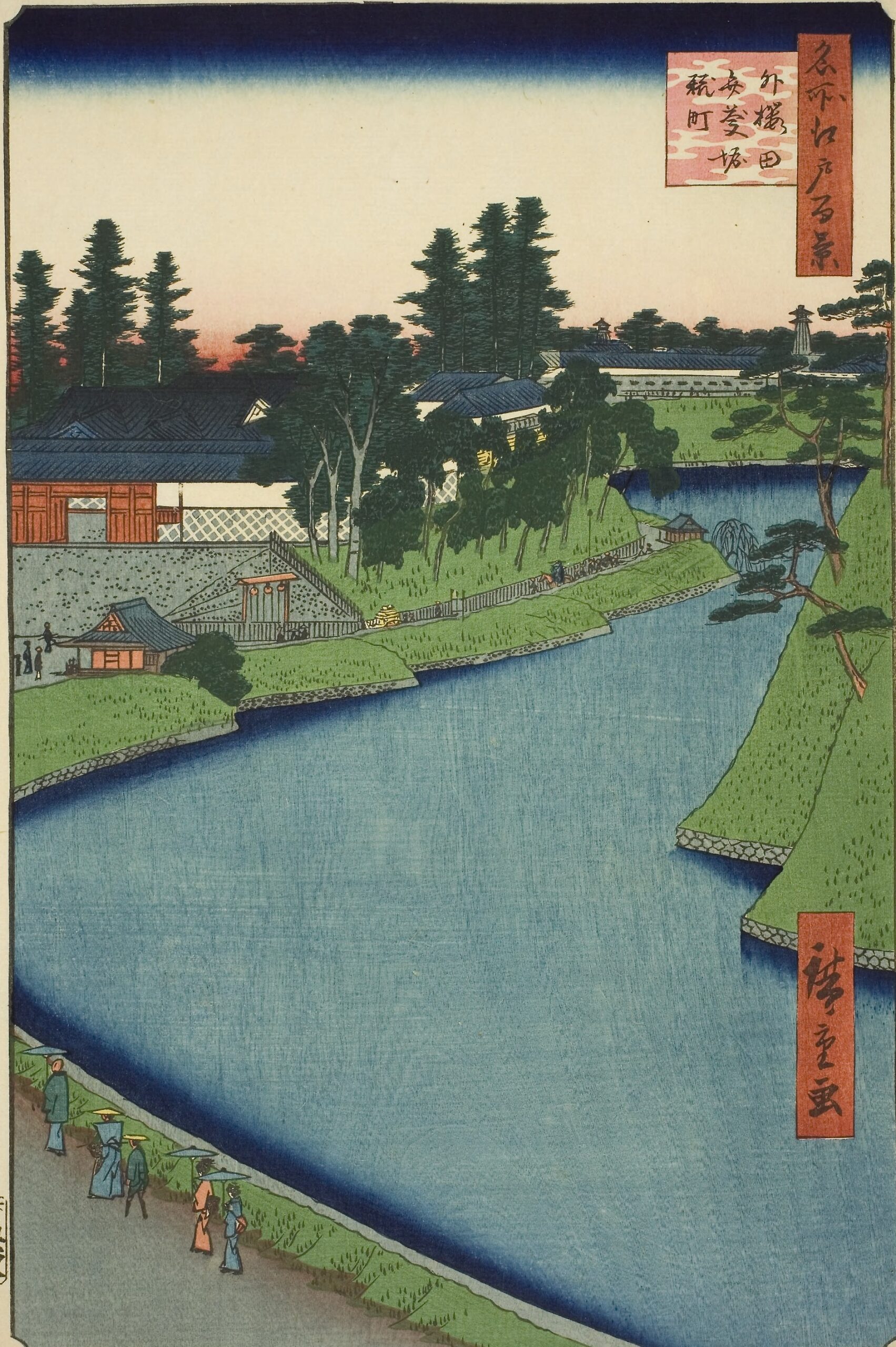
Utagawa Hiroshige – One Hundred Famous Views of Edo – 67 – Summer – Sotosakurada Benkei Hori Kojicho 歌川広重-名所江戸百景-67-夏-外桜田弁慶堀糀町
Current Address: Near Sotosakuradamon Gate, Chiyoda Ward
Latitude and Longitude: Latitude: 35.6760, Longitude: 139.7488
Published: May 1856 Age: 60
Tourist Guide-Style Commentary: “Sotosakurada Benkei Hori Kojicho”
■ Introduction
Utagawa Hiroshige’s “One Hundred Famous Views of Edo” is a large-scale series of 119 paintings depicting the seasonal beauty and scenic beauty of Edo.
Among these, “Sotosakurada Benkei Hori Kojicho” depicts a corner of the outer moat of Edo Castle.
This area, where samurai and commoners mixed together, was a spot filled with everyday scenery despite being close to the shogunate’s political center.
Hiroshige combined the Benkei Moat, which flows around Sotosakuradamon Gate, with the bustling area known as Koujicho to create a scene befitting the main entrance to Edo.
■ Sotosakurada and Benkei Moat
“Sotosakurada” refers to the area south of Edo Castle, outside Sakuradamon Gate.
Stretching from present-day Kasumigaseki in Chiyoda Ward to Toranomon in Minato Ward, this area was the heart of Edo, lined with shogunate government offices and samurai residences.
“Benkei Moat” irrigated Sotosakurada.
One of the moats built to protect Edo Castle, its deep waters, combined with the surrounding stone walls, created a dignified landscape.
In spring, the cherry blossoms bloomed in full bloom, and the reflection of the petals on the water’s surface is said to have been a popular viewing spot among commoners.
■ About Koujicho
“Kojicho” is the area that corresponds to present-day Kojicho in Chiyoda Ward (around Hanzomon and Yotsuya). During the Edo period, the area flourished as a residential area for townspeople, and the town’s name, derived from the brewing industry for products such as koji and miso, remains.
Although it was adjacent to the shogunate offices and samurai residences, it was a bustling, urban area where everyday life unfolded.
Hiroshige depicted in this illustration an area where politics and everyday life, samurai and townspeople, solemnity and hustle and bustle intersected, symbolizing the multifaceted nature of Edo.
■ Highlights of the Illustration
This illustration depicts Soto Sakurada, outside the Sakurada Gate of Edo Castle.
Famous daimyo residences line the area.
The red gate on the left is the Ii family’s residence, the lords of Hikone Domain. The fire watchtower in the background right is the main residence of the Miyake family, lords of Tahara Domain.
In front of the Ii family residence, a well known as “Sakuragai,” a renowned water bucket, is represented by three buckets.
There was another well in the area, located below the farthest of the two guardhouses along the moat.
As befits its name, “Willow Well,” willow trees sway along the bank below the guardhouse.
Hiroshige refers to this moat as Benkei Moat in his “Ehon Edo Souvenirs.”
The actual Benkei Moat was located west of here, between Akasaka Gate and Kichigai Moat.
■ Walking through the modern-day Sotosakurada and Benkei Moat
Vestiges of Benkei Moat remain around Sakuradamon and Hibiya Park.
Alongside Sakurada Moat and Hanzo Moat, it is a famous spot that evokes the history of Edo Castle’s outer moat.
In spring, cherry blossoms bloom, allowing you to enjoy a landscape unchanged since the Edo period.
The name of Kojicho still exists today as “Kojimachi,” and remains a part of Chiyoda Ward.
Even amidst the business district, you can still feel the vestiges of the townscape that dates back to the Edo period.
■ Tourist Guide Recommendations
① Sakuradamon Gate (Important Cultural Property)
One of Edo Castle’s most prestigious gates, its imposing stone walls and gate remain to this day.
This is the place where you can most vividly experience the scenery depicted in Hiroshige’s paintings.
② Benkei Moat Promenade
The area along the outer moat from Hanzomon to Sakuradamon is a popular walking course.
It blends seasonal nature with historical scenery.
③ Stroll Around Kojimachi
Although it is now an office district, it is dotted with historic monuments and historical sites.