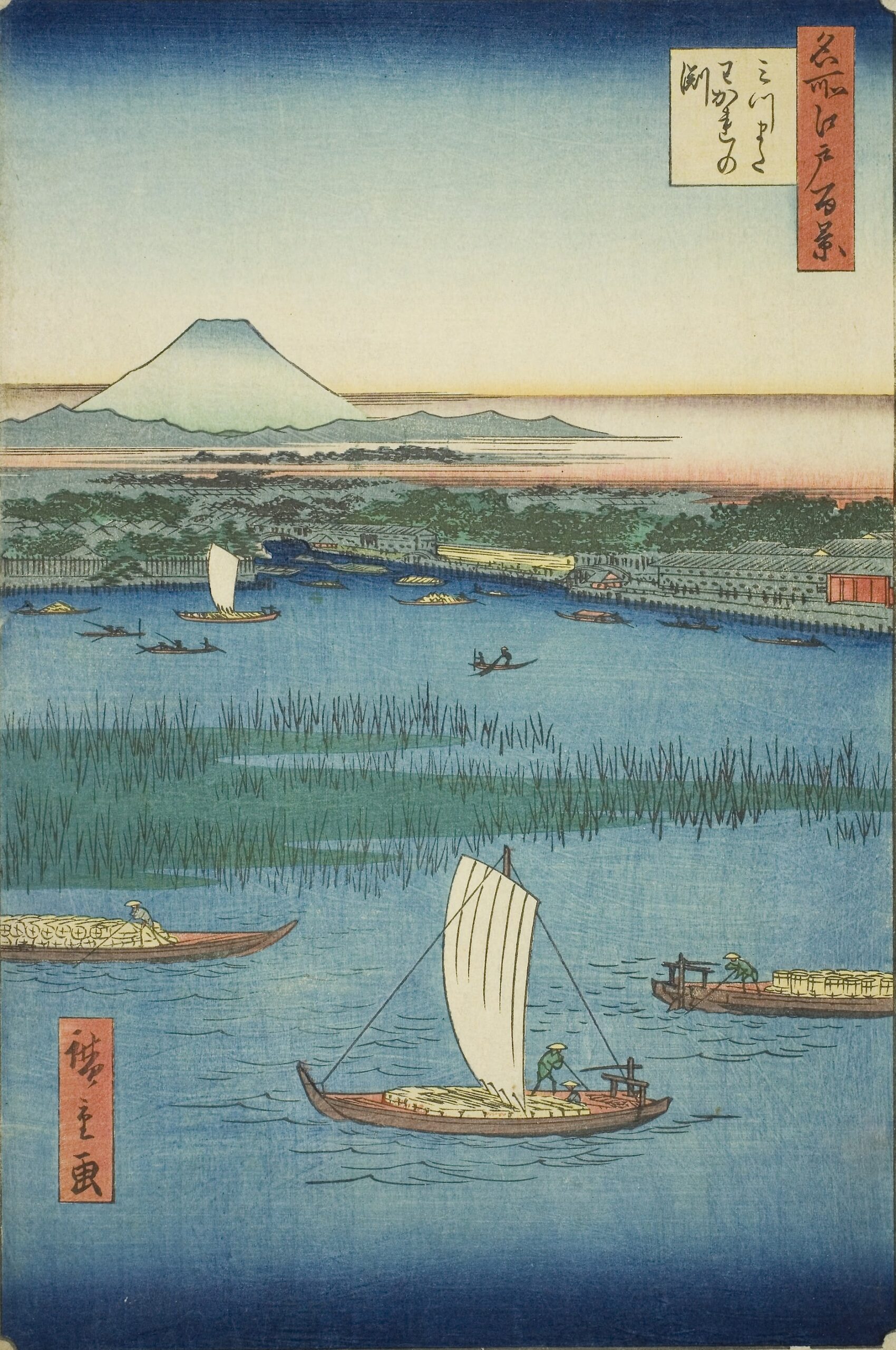
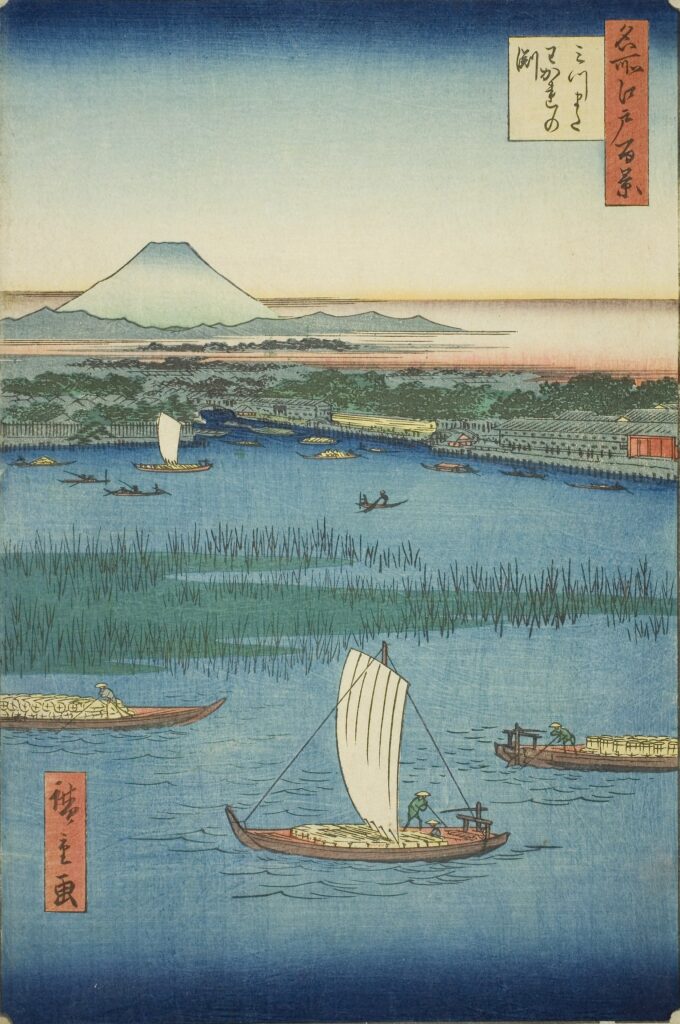
Utagawa Hiroshige – One Hundred Famous Views of Edo – 68 – Summer – Mitsumata Wakare-no-Fuchi 歌川広重-名所江戸百景-68-夏-みつまたわかれの渕
Current Address: Near Mukojima, Sumida Ward
Latitude and Longitude: Latitude: 35.7160, Longitude: 139.8130
Published: February 1857
Age: 61
Tourist Guide-Style Commentary: “Mitsumata Wakare-no-Fuchi”
■ Introduction
Utagawa Hiroshige’s “One Hundred Famous Views of Edo” is a large series of 119 prints that richly depict the seasons and townscape of Edo.
Among them, “Mitsumata Wakare-no-Fuchi” is a work that symbolizes Edo’s waterfront landscape.
Depicting the forking point of a complex, winding river, the work conveys the tranquil scenery unfolding on the river’s surface and the lives of the people who lived there.
Edo was known as the “City of Water” for its developed canals and rivers, and Mitsumata Wakare-no-Fuchi was one of its most symbolic locations.
■ What is Mitsumata Wakare-no-Fuchi?
As the name suggests, “Mitsumata” refers to the point where a river splits into three.
Located in the Koto area where a tributary of the Sumida River intersects with a canal, it played an important role in Edo’s logistics and human traffic.
During the Edo period, cities were more dependent on waterways than land routes, and goods such as lumber, rice, and seafood were transported by boat.
Mitsumata Wakare-no-Fuchi was a key waterway hub, with many ships passing through.
As a result, merchant houses lined the bridge and riverbanks, creating a lively atmosphere.
■ Highlights of the painting
At the end of the Edo period, this area was a reed-covered marshland, but it became a major entertainment district.
The reclamation of Nakasu Shinchi on the Okawa River was completed in 1771.
By 1775, in addition to the Tsukujusan-kenchaya teahouses, there were restaurants and bathhouses, and it was said that this had made the Ryogoku area deserted.
However, due to frequent flooding upstream the Sumida River, the shogunate demolished the area in 1789.
This is what the entertainment district looked like 68 years after its demolition.
The residence on the right is the upper residence of Ando Nagatonokami, lord of Iwakidaira Domain.
On the left is the lower residence of the Tayasu Tokugawa family.
Beyond that is the Nihonbashi River.
The boat in the foreground is a Takase-bune, and beyond that are two tea boats.
They are heading upstream after transferring cargo at Tsukudajima.
Beyond Mitsumata, fishing boats, summer boats, and cargo boats can be seen.
■ Walking along the modern-day “Mitsumata Wakare-no-Fuchi” (Three-way Fuchi)
Urban development has significantly altered the landscape, and the three-way fuchi of the past no longer remains.
However, waterways such as the Sumida River, Onagi River, and Oyoko River still exist and have been developed into promenades and waterside parks.
The walking path along the Onagi River in particular is known as the “Waterside Path,” and it evokes the area’s importance as a water transportation hub.
Viewing the river from the bridge, you can enjoy the superimposition of the flowing water depicted by Hiroshige.
■ Recommended Points from the Tourist Guide
① Sumida River Terrace
This riverside walking path stretches from Edo to Tokyo.
Enjoy the cherry blossom trees and riverside scenery, immersing you in the world of ukiyo-e.
② Onagi River Clover Bridge
This unique bridge is located where the Onagi River and Oyoko River converge.
You can experience the complex terrain of the branching waterways.
③ Fukagawa Edo Museum
This museum recreates the townscape of Fukagawa during the Edo period in full scale. You can experience the lifestyle of a boathouse and merchants, and it’s a great place to learn about the background of the Mitsumata Wakare-no-Fuchi.