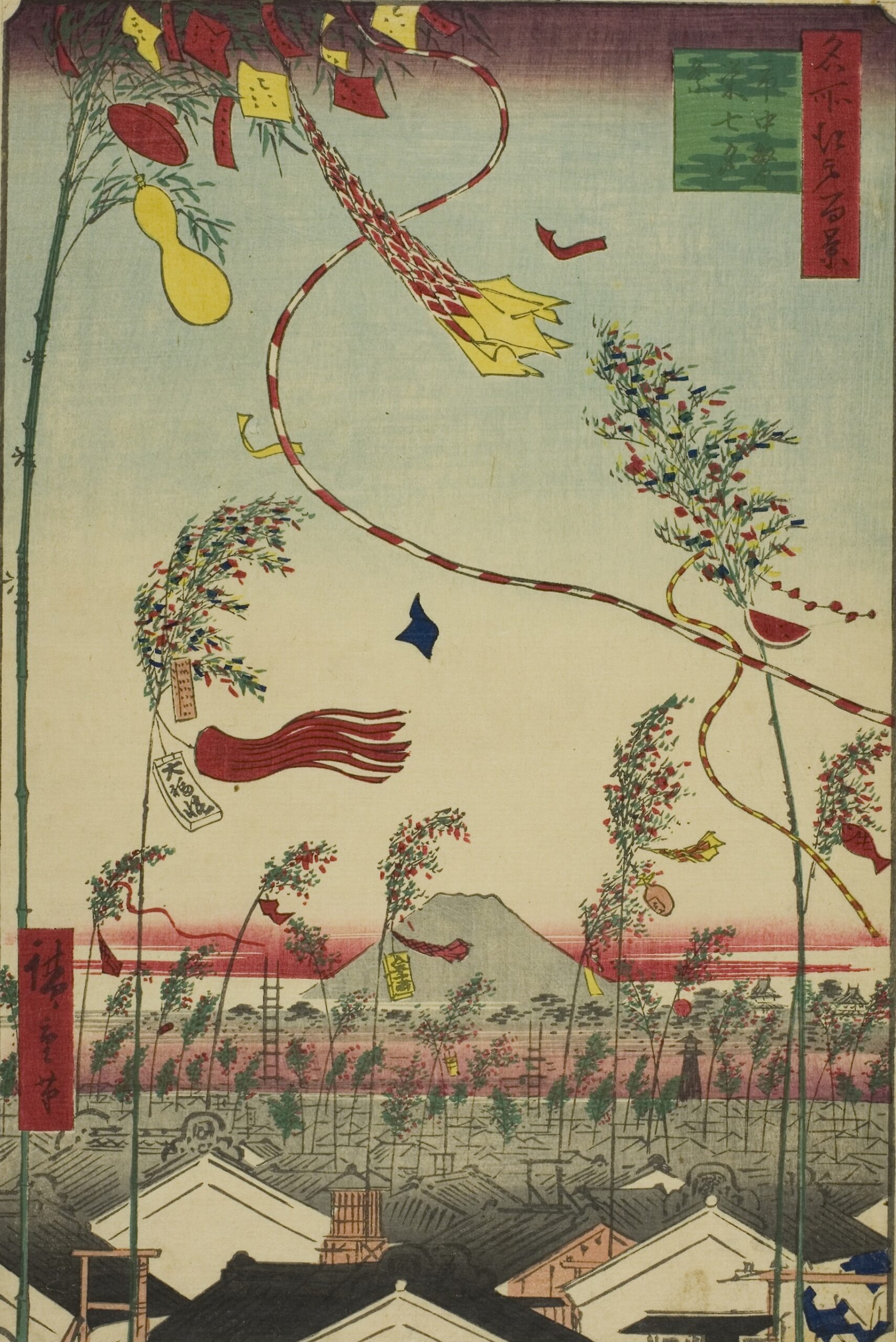
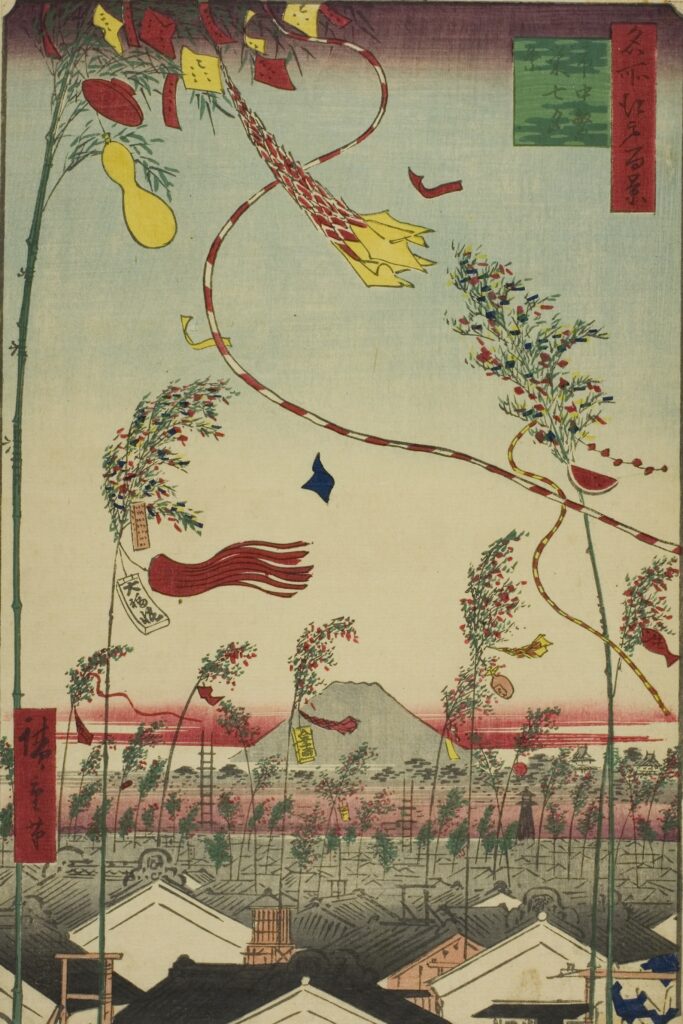
Utagawa Hiroshige- One Hundred Famous Views of Edo-74-automn-City Prosperity Tanabata Festival 歌川広重-名所江戸百景-74-秋-市中繁栄七夕祭
Current Address: Chuo Ward, Nihonbashi-Kyobashi Area
Latitude and Longitude: Latitude: 35.6805, Longitude: 139.7744
Published: July 1857 Age: 61
Tourist Guide-Style Commentary: “City Prosperity Tanabata Festival”
■ Introduction
Utagawa Hiroshige’s “One Hundred Famous Views of Edo” is a series of woodblock prints depicting Edo’s famous places and seasonal landscapes.
Among them, “City Prosperity Tanabata Festival” is a summer print that vividly conveys the culture of Edo’s townspeople.
This work depicts not the riverside or temples and shrines, but the very city of Edo itself as the center of attention.
Hiroshige placed large Tanabata decorations adorning the eaves of townhouses, vividly depicting the prosperity of merchants and the bustle of townspeople.
This is a valuable work that conveys the excitement and splendor of the Tanabata Festival, an annual event eagerly anticipated by the common people of Edo.
It offers a glimpse into the integration of festival and commerce at the time.
■ About the Tanabata Festival
Tanabata originates from the Chinese legend of Orihime and Hikoboshi, and is an event that was introduced to Japan during the Nara period.
During the Edo period, it became widely loved by common people as the “Tanabata Festival,” one of the five seasonal festivals.
In Edo, townspeople in particular were enthusiastic about decorating for Tanabata, and merchants would set up bamboo poles on their eaves and hang paper strips and ornaments from them.
These colorful decorations not only prayed for prosperous business, but also served as a way to show off the town’s prosperity.
In rural areas, the event was held to pray for bountiful harvests and improvement in weaving skills, but in Edo it took on the character of a “spectacular summer festival” and became a seasonal tradition enjoyed by families.
■ Highlights of the Painting
Tanabata is a legendary star festival introduced from China.
Hikoboshi and Orihime were married, but Orihime was caught by the Emperor of Heaven, who separated them after spending her time enjoying herself and neglecting her weaving.
After that, they were allowed to reunite once a year on July 7th at the Milky Way.
It was introduced to Japan during the Nara period, and during the Edo period it became one of the five seasonal festivals.
It spread from samurai society to the common people.
It is said to be a view from the drying area of Hiroshige’s home in Oga-cho, where he lived in his later years.
On Tanabata day, Edo homes are decorated with colored paper streamers tied to bamboo, gourds, cups, watermelons, ledgers, abacuses, and other decorations.
Mount Fuji is depicted in the center, and Edo Castle is to the right of center.
Edo Castle is depicted in the middle ground, with Mount Fuji in the background. There is a fire watchtower below Edo Castle.
In front of you can see clotheslines, chairs, and yukata. Beyond that are numerous storehouses.
■ Tanabata Festivals Remain Modern
Even today, Tanabata festivals are held in areas such as Asakusa and Kappabashi Hondori, where the shopping arcades are decorated with bamboo ornaments and paper lanterns.
Just like in Hiroshige’s ukiyo-e, the sight of pedestrians passing under them evokes a tradition that has continued from the Edo period to the present day.
While Sendai Tanabata in Tohoku is characterized by lavishly decorated bamboo ornaments, Edo Tanabata was characterized by the “liveliness of the town.”
More decorations were closely tied to everyday life rather than flashiness, making it a familiar event for the common people of Edo.
Tanabata customs are still alive and well today.
The act of writing wishes on strips of paper and hanging them on bamboo is essentially the same as what Edo people did.
■ Recommended Points as a Tourist Guide
- Ukiyo-e Exhibition at the Edo-Tokyo Museum and the National Museum
There is also an exhibition where you can see Hiroshige’s “Tanabata Festival of Prosperity in the City” in person.
Enjoy the colors and details of the time through the original painting. - Tanabata Festival Stroll in the Downtown Area
Tanabata events remain in places like Asakusa and Yanaka. - Tanzaku Workshop
During Tanabata season, tanzaku writing experiences are held in various places.