Utagawa Hiroshige – One Hundred Famous Views of Edo – 73 – Summer – “Watashi the Wanderer” – Benten Shrine 歌川広重-名所江戸百景-73-夏-はねたのわたし 辨天の社
Current Address: Tachibana, Sumida Ward (Around the former “Nadeshiko Ferry” area. North of Higashi-Azuma Station on the Tobu Kameido Line, along the Sumida River.
Latitude and Longitude: Latitude: 35.7107, Longitude: 139.8268
Published: August 1858 Age: 62
Tourist Guide-Style Commentary: “Watashi the Wanderer” – Benten Shrine
■ Introduction
Utagawa Hiroshige’s “One Hundred Famous Views of Edo” is a masterpiece of 119 illustrations depicting Edo’s famous places and seasonal landscapes.
Among them, “Haneta no Watashi: Benten no Yashiro” is a work that beautifully combines the lives and faith of people living in the Edo area with the waterside scenery.
The “Haneta no Watashi” depicted here is a ferry crossing used by people crossing the Sumida River from downtown Edo and heading northeast.
Furthermore, the Benten Shrine enshrined on the riverside is depicted as a place of worship for the common people, and Hiroshige depicts the waterside and the activities of the people with a soft touch.
■What is “Haneta no Watashi”?
The current name of the area would be the Adachi Ward of Tokyo. This ferry crossing was located in the midstream of the Sumida River, nearby.
It was used when traveling from Edo to northern Kanto, and was a familiar transportation route for common people.
At the time, there were many ferry crossings on the Sumida River and Arakawa River.
Because bridge construction was restricted, ferries were an essential part of the transportation infrastructure for people’s lives, commerce, and travel.
Haneda Ferry was one of these, and was a place where farmers, merchants, and pilgrims passed through.
The Benten Shrine, located nearby, is dedicated to Benzaiten, the goddess of music and water, and attracted many religious believers.
It is said to have been a popular place to pray for safety along the river, prosperity in business, and improvement in the arts.
■ Highlights of the painting
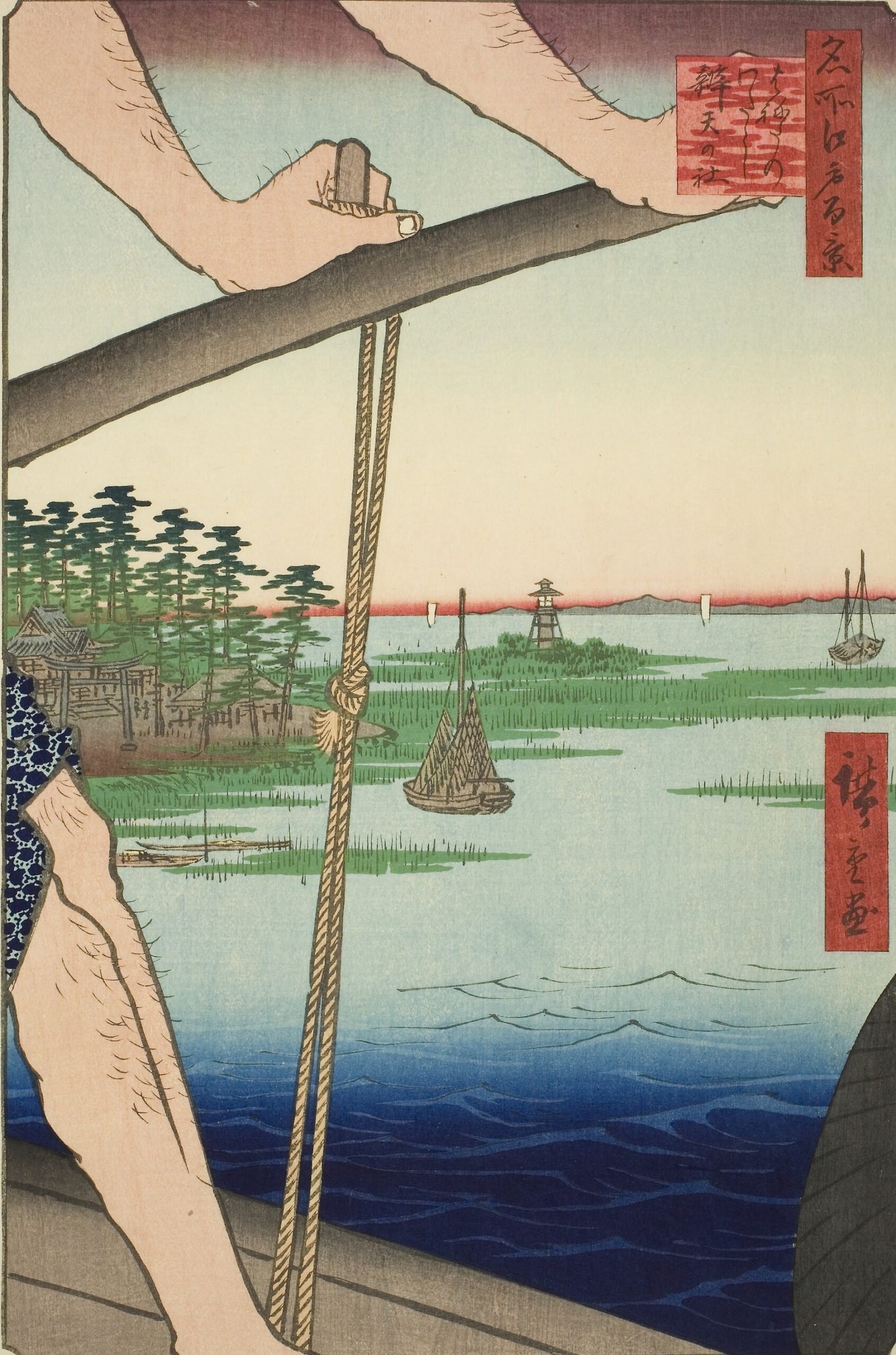
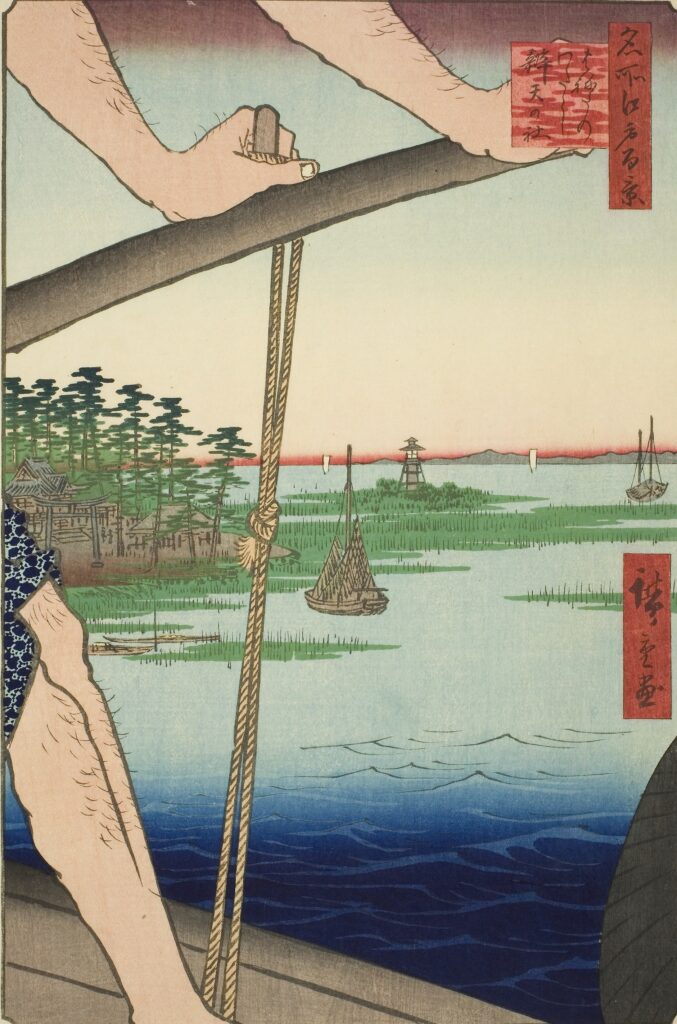
This is a view of Edo Bay from a ferryboat from Haneda to Kawasaki Daishi.
Benten Shrine is located in the woods beyond the triangle formed by the boatman’s feet and the boat’s oar.
Haneda Benzaiten is an island formed by sediment carried by the Tama River.
Because it is located on a key island in Ogigahama, it is also known as Kanameshima Benzaiten.
The sea surface, covered with pine forests and reeds, is where saltwater and freshwater mix and was called the Ebitori River.
Legend has it that Kanameshima was formed by piling up stones with the characters for “Hokke Karu” (“hokke karu”) written on them, with the hope of preventing disasters caused by wind and waves.
Originally, people traveled to the island by boat, but due to the large number of pilgrims, the surrounding area was reclaimed.
A path to the island was built, and the lighthouse, which was originally offshore, is now land.
Haneda Benzaiten Shrine can be seen on the left.
There is a lighthouse directly ahead, and in the foreground you can see a fishing boat used for casting a net.
The Tama River is in front of you, and the Haneda ferry boat is at your feet.
A large representation of the ferry boat’s oar is depicted.
■ Modern-day “Haneta no Watashi Benten Shrine”
Today, the exact site of the Haneda Ferry no longer exists.
Along the Sumida River around Adachi Ward, there are monuments and information boards marking the ferry crossings, allowing us to imagine what transportation was like back then.
Small shrines associated with Benten Shrine also remain in the area, evoking the landscape of the past.
The Sumida River is now maintained as a promenade and park, allowing visitors to imagine the scenery of the time while enjoying a walk or bike ride.
Even today, by taking a houseboat or pleasure boat, you can experience a riverscape similar to that seen by people in Edo.
Local history museums in Adachi Ward and Arakawa Ward display exhibits on ferries and water transportation from the Edo period.
■ Recommended Tourist Guide Points
- Stroll along the Sumida River Terrace
Stroll around the area said to be the site of the Haneda ferry crossing and enjoy the expansive riverside scenery. - Visit Small Shrines of Benzaiten
Shrines dedicated to Benzaiten are scattered throughout the area, allowing you to sense the connection between water and faith. - Learn at a Local History Museum
At places like the Adachi Ward Local History Museum, you can learn about the history of the ferry crossing.
You’ll gain a deeper understanding of what life was like at the ferry crossing, reflecting the scenery depicted in ukiyo-e.