Utagawa Hiroshige – One Hundred Famous Views of Edo – 75 – automn – Odenmacho Kofuku Shop 歌川広重-名所江戸百景-75-秋-大伝馬町こふく店
Current Address: Odenmacho, Nihonbashi, Chuo Ward (near Odenmacho Intersection)
Latitude and Longitude: Latitude: 35.6892, Longitude: 139.7806
Published: July 1858 Age: 62
Tourist Guide-Style Commentary: “Odenmacho Kofuku Shop”
■ Introduction
Utagawa Hiroshige’s “One Hundred Famous Views of Edo” is a series of prints that vividly depict Edo’s townscapes and famous places throughout the seasons.
Among these prints, “Odenmacho Kofuku Shop” is a work that symbolizes Edo’s commercial culture.
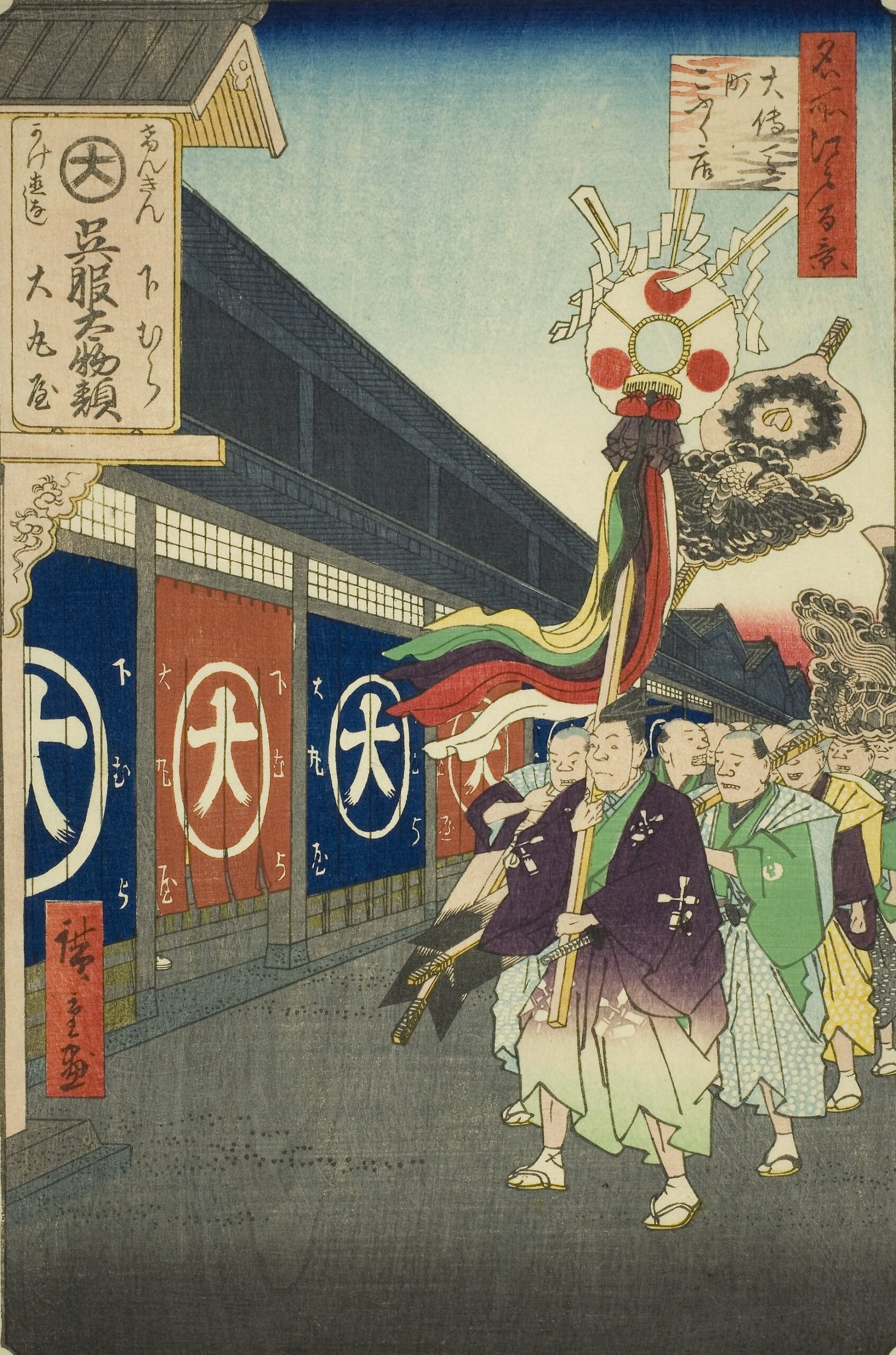
Rather than depicting temples, shrines, or riverside scenes, the subject is a main street lined with merchant houses, with meticulous depictions of the goods lined up in front of their eaves and the people passing by.
In this ukiyo-e, Hiroshige depicts the economic and consumer hubs that powered Edo.
Looking at this painting, one feels as if one is walking through Edo’s Ginza or Nihonbashi.
■About Odenmacho
Odenmacho, located east of Nihonbashi, was Edo’s premier commercial district.
The area was originally named after the “denma-yaku” (horse-transporting posts), the role played by horse handlers at post stations.
It was also an important highway junction and a transportation and logistics hub within Edo Castle.
Edo was home to a variety of “towns,” but Odenmacho in particular was home to many kimono shops.
It was Edo’s premier shopping street.
Rivaling Osaka’s Dotonbori and Kyoto’s Shijo Kawaramachi, Odenmacho was a bustling gathering place for merchants and shoppers.
Odenmacho is also famous for its “Dashi Festival.”
Each neighborhood would bring out its own colorful floats, showcasing the spirit of the Edoites. Odenmacho is where commerce and entertainment intersect.
■ Highlights of the painting
When Tokugawa Ieyasu entered Edo, Magome Kaneyu welcomed him with an army of laborers and horses.
Odenmacho was founded when he was appointed as a transport driver in recognition of his service.
Later, his subordinates began trading in Mikawa cotton, and the area developed into a cotton wholesale district.
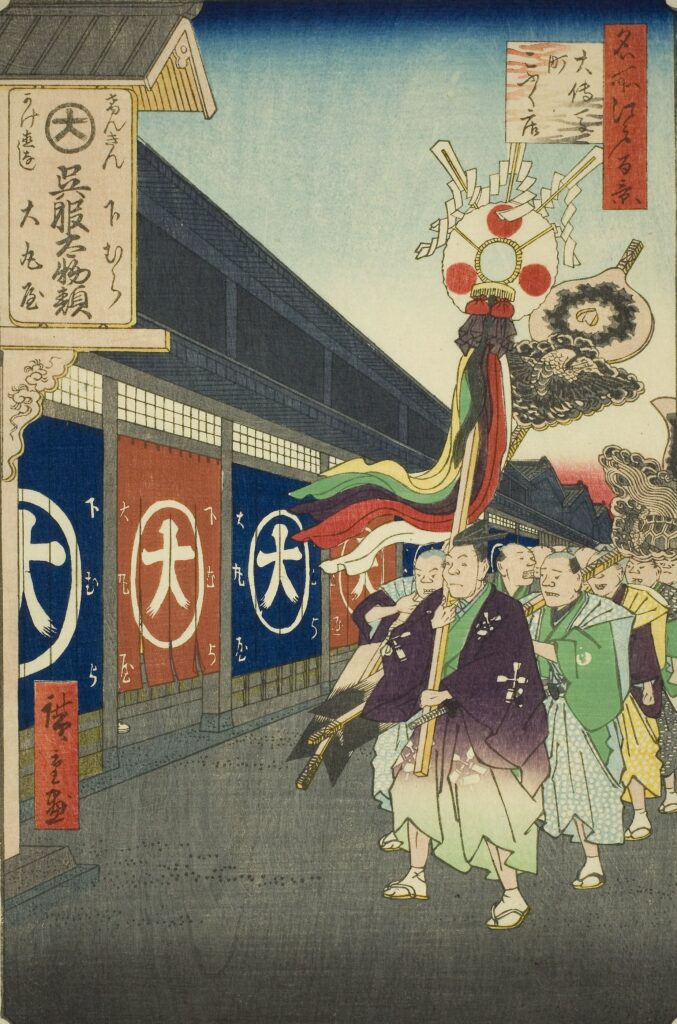
Daimaru, in the center, is a kimono store founded by Shimomura Hikoemon of Kyoto.
He mainly dealt in silk and cotton fabrics, and made his fortune by selling them at no markup.
The Daimaru sign in the upper left reads, “Drift Goods, Kimono, Shimomura, No Markup, Daimaruya.”
This is a sign of their cash-only sales at no markup.
On the street, a topping-out ceremony for a new building has just been held.
The procession is led by a master carpenter, all dressed in formal attire and carrying a sacred wand slinging a sacred offering over his shoulder.
Behind him are the craftsmen working on the construction.
Two large hamaya arrows can be seen behind the master carpenter.
■ Walking around modern-day Odenmacho
Odenmacho still retains its name today in Tokyo’s Chuo Ward, known as “Nihonbashi Odenmacho.”
Although there are fewer kimono shops than there were in the Edo period, vestiges of its past as a commercial district still remain.
Historic sites and attractions include the “Odenmacho Prison Site” and the “Around Kodenmacho Station.”
As you walk through Odenmacho, you can enjoy comparing signs pointing out the remains of old merchant houses and Edo-period maps with the modern-day streetscape.
■ Tourist Guide Recommendations
① Viewing Hiroshige’s Works
At the Edo-Tokyo Museum and the National Museum, you can view original ukiyo-e prints.
Enjoy Hiroshige’s brushwork, which depicts the splendor of Odenmacho.
② Kimono Culture Experience
Renting kimonos and trying on traditional Japanese clothing are popular these days.
We recommend strolling around town in a kimono while reminiscing about the kimono culture of the time.
③ Historical Walking Route
The walking route from Nihonbashi to Odenmacho and Kodenmacho is a great way to relive Edo’s commercial culture.
Along the way, you’ll also find long-established Japanese confectionery shops and traditional craft stores, allowing you to immerse yourself in the Edo atmosphere.