Utagawa Hiroshige-One Hundred Famous Views of Edo-81- Autumn-Kanasugibashi Shibaura 歌川広重-名所江戸百景-81-秋-金杉橋芝浦
Current Address: Near Kanasugibashi, Minato Ward
Latitude and Longitude: Latitude: 35.6559, Longitude: 139.7521
Published: July 1857 Age: 61
Tourist Guide-Style Commentary: “Kanasugibashi Shibaura”
■ Introduction
Utagawa Hiroshige’s “One Hundred Famous Views of Edo” is a masterpiece series that skillfully depicts the landscapes of Edo and the lives of ordinary people.
One of the paintings, “Kanasugibashi Shibaura,” depicts the port town of Shibaura, located at the southern end of Edo, and the Kanasugibashi Bridge that spans it.
Facing the sea, Shibaura was a hub for fishing and shipping, as well as a popular tourist spot where people could relax and enjoy the sea breeze. Hiroshige depicts the people of Edo enjoying the waterfront and the landscape where the city meets the sea.
This painting is a masterpiece that simultaneously conveys Shibaura’s role as Edo’s “gateway to the sea” and the lifestyle and culture of the common people.
■ About Kanasugi Bridge and Shibaura
Kanasugi Bridge was built where the Furukawa River (now the Furukawa/Shibuya River), which flows through Edo Castle’s outer moat, flows into Shibaura.
The bridge was a key transportation hub in southern Edo, serving as an important passageway connecting Shiba with central Edo.
Shibaura is a low-lying area facing Edo Bay, and flourished as a fishing port during the Edo period.
It became a popular recreational destination for commoners, offering activities such as clam digging and boating.
In the summer, the area bustled with people enjoying boating to cool off, making it a symbol of Edo’s “waterside culture.”
The combination of these two elements creates a typical Edo landscape in which water transportation, fishing, and recreation are integrated.
■ Highlights of the painting
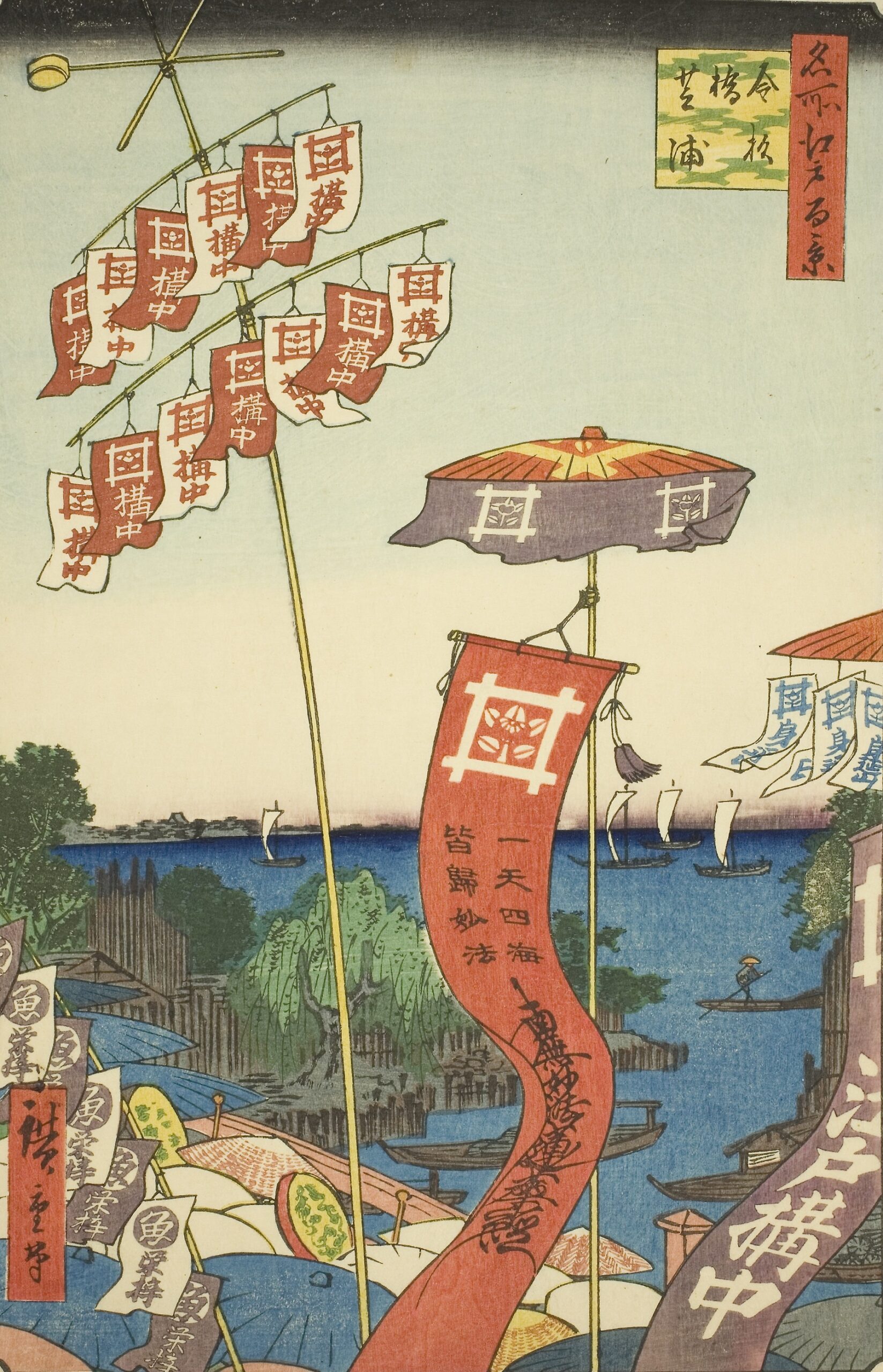
Shibaura refers to the coastline from the mouth of the Furukawa River to Mihama Palace.
The bridge that crosses the mouth of the Furukawa River from the Tokaido Road is called Kanasugi Bridge.
In the early Edo period, it served as the gateway to the city, and that atmosphere remained until the end of the Edo period.
The bridge is filled with a group of Nichiren sect followers.
According to the catalog for this illustration, this is a ceremony to celebrate Nichiren’s death in 1282, known as the Goei-shiki and Hoon-shiki, held around the time of the death anniversary.
They are heading to Ikegami Honmonji Temple.
The hand towels (13 kōchu tenugui on the left of the illustration) attached to the bamboo poles the group is carrying bear the crest of Nichiren, a tachibana (mandarin orange) crest with a diamond pattern, representing Nichiren.
The kōchu are a group of people who have practised faith and come on a pilgrimage, and the words “Mt. Minobu, where Kuon-ji Temple, the head temple of the Nichiren sect, is located, can be seen.
The maneki in the lower left is Uoei, the publisher of this series.
The sky is clear, but the people are holding umbrellas, suggesting that the rain has just stopped.
In front is Edo Bay.
■ Shibaura in the Edo Period
With the rich fishing grounds of Edo Bay as its backdrop, Shibaura was an important seafood supply center.
Fish landed here were transported to the fish market in Nihonbashi, providing sustenance for the common people of Edo.
Where sea routes and river routes intersect, Shibaura served as a loading and unloading point and a transit point for boats.
It was an essential part of the logistics network supporting the megalopolis of Edo.
Clam digging, fishing, and boating were popular pastimes for the common people.
In particular, in the summer, the area bustled with people seeking coolness, and teahouses were also opened, creating a bustling tourist destination.
■ Kanasugibashi and Shibaura Today
Today, the Kanasugibashi Intersection and Kanasugibashi Bridge remain in Shibaura, Minato Ward.
They are located close to Hamamatsucho Station and Tamachi Station on the Yamanote Line and Keihin-Tohoku Line.
As a bridge connecting Edo to Reiwa, they have witnessed the city’s transition.
In modern times, Shibaura developed as a warehouse and factory district, thanks to ongoing reclaiming land.
Currently, redevelopment is underway, with high-rise apartment buildings and offices lining the streets. New neighborhoods are also being developed, utilizing the waterfront, including canal-side promenades and restaurants.
You can still enjoy sweeping views of Tokyo Bay from Hama-rikyu Gardens, Takeshiba Pier, and Shibaura Wharf.
Hiroshige’s “intersection of the sea and Edo” is a contemporary interpretation of the area.
■ Recommended Tourist Guide Points
1. Stroll with Zojoji Temple and Shiba Daijingu Shrine
Kanasugibashi Bridge is close to the Shiba-Daimon and Shiba Park areas, so we recommend combining it with a historical walking course that includes Zojoji Temple and Shiba Daijingu Shrine.
2, Strolling the Shibaura Canal Area
Promenades have been developed along the canal, dotted with cafes and restaurants.
Enjoy a leisurely stroll while imagining what it was like to travel by boat during the Edo period.
- Shibaura as a night view spot: Modern Shibaura is a popular night view spot overlooking the Rainbow Bridge and Tokyo Bay.