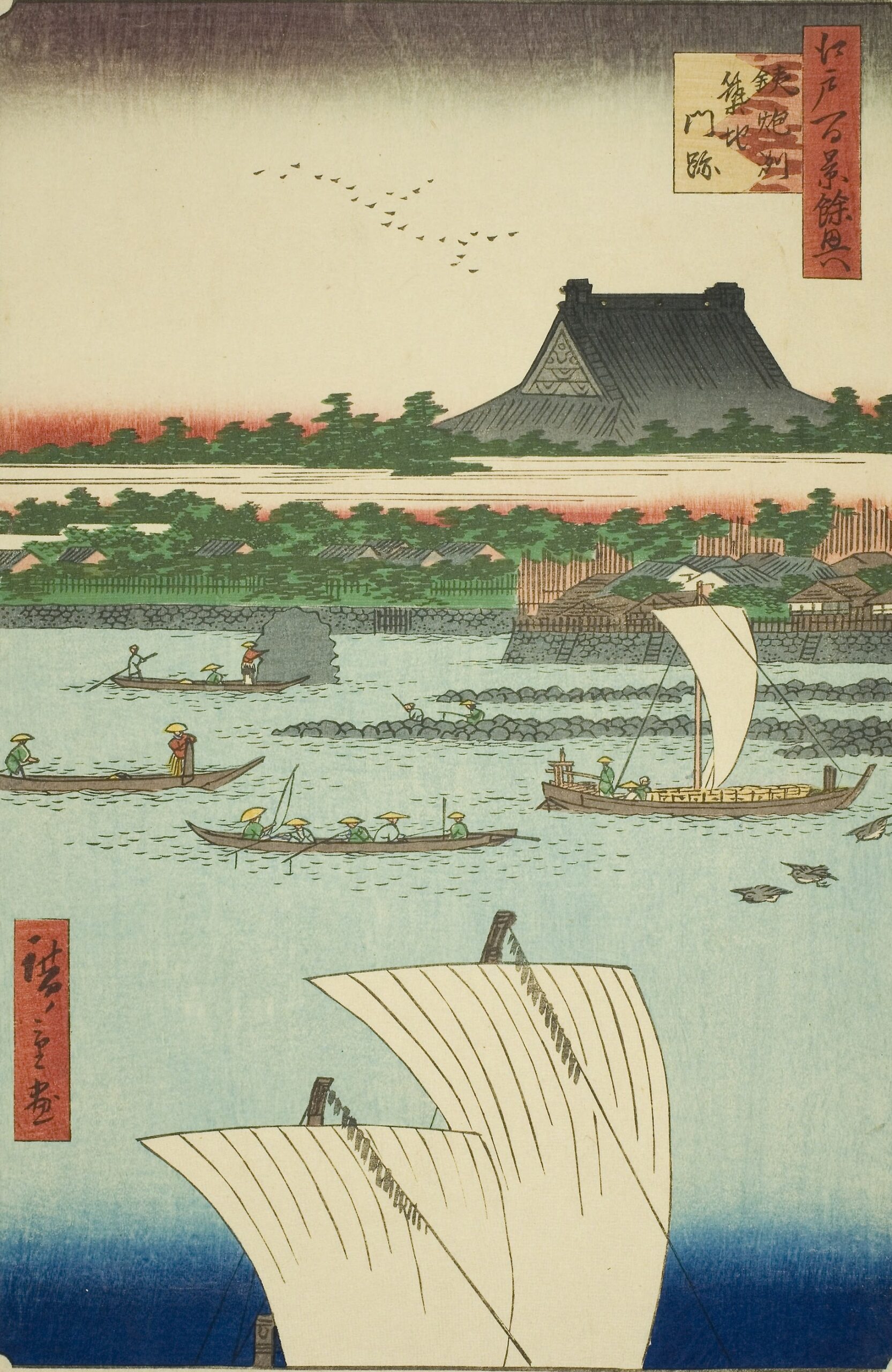
Utagawa Hiroshige-One Hundred Famous Views of Edo-79- Autumn-Teppozu Tsukiji Monastery 歌川広重-名所江戸百景-79-秋-鉄砲洲築地門跡
Current Address: Tsukiji, Chuo Ward
Latitude and Longitude: Latitude: 35.6650, Longitude: 139.7730
Published: July 1858 Age: 62
Tourist Guide-Style Commentary: “Teppozu Tsukiji Monastery”
■ Introduction
Utagawa Hiroshige’s “One Hundred Famous Views of Edo” is a large series of 119 prints depicting the famous sites that graced the city of Edo through the changing seasons.
Among these, “Teppozu Tsukiji Monastery” depicts the remains of a temple gate located in the Teppozu district along Edo Bay.
This is a tasteful work that blends Edo’s religious culture with waterfront scenery.
■ About Teppozu and Tsukiji Monzeki
Teppozu, located in what is now the Minato and Akashicho areas of Chuo Ward, was a reclaimed land facing Edo Bay near the mouth of the Sumida River.
Originally a low-lying marshland, the area was reclaimed in the early Edo period, and town houses and temples were built there.
Tsukiji Honganji Temple was built on this land, and its prestigious temple complex is known as a “monzeki temple.”
Established as a branch temple of Nishi Honganji Temple in the early 17th century, it became a base for Jodo Shinshu Buddhism in Edo.
To the common people of Edo, Tsukiji Honganji Temple was known as “Onishi-san,” and was a popular place for funerals and memorial services.
Furthermore, due to its location near the port city, it was an important place of worship for pilgrims from afar and those involved in the shipping industry.
■ Highlights of the Painting
This is a marshland facing Edo Bay, across from Tsukudajima.
The name comes from this spot where the Inoue and Inatomi families test-fired cannons during the Kan’ei era.
It is said that the area around Suzaki resembled the shape of a gun.
When Nishi Honganji Temple was relocated after being destroyed in the Meireki fire of 1657, believers from Tsukudajima took the lead in reclaiming this marshland and rebuilding the temple.
The huge main hall served as a landmark for ships sailing through Edo Bay.
Stone walls were built along the coastline to protect against waves, and the area became a habitat for fish.
In the foreground, you can see the sails of two benzai ships heading for Tsukudajima.
In the middle ground, there are fishing boats and boats using nets.
Further ahead is the quay of Minami-Iidamachi.
Behind it, the main hall of Nishi Honganji Temple looms large.
A flock of geese can be seen in the distance.
■ Modern-day Tsukiji and Teppozu
The current Tsukiji Honganji Temple was rebuilt after the Great Kanto Earthquake and is known for its unique architecture incorporating Indian elements. The appearance is different from the Edo-period temple buildings depicted by Hiroshige.
With the nearby Teppozu Inari Shrine remaining, this area offers a unique experience of Edo-period waterfront worship and temple culture.
While Tsukiji is known today for its markets and food culture, a visit to Tsukiji Honganji Temple and the surrounding temple complex reveals Edo’s religious side as a city.
■ Tourist Guide Recommendations
- Visit Tsukiji Honganji Temple
The current Tsukiji Honganji Temple features majestic Indian-style architecture. - Stroll around Teppozu Inari Shrine
A visit to Teppozu Inari Shrine, the guardian deity of Teppozu, will give you a more holistic understanding of the faith and waterfront culture of the Edo commoners. - Combining Tsukiji Gourmet Food with a Historical Stroll
After your stroll, we recommend enjoying a meal at the Tsukiji Outer Market.
The true joy of this area is being able to experience both Edo’s temple town and modern-day food culture at the same time.