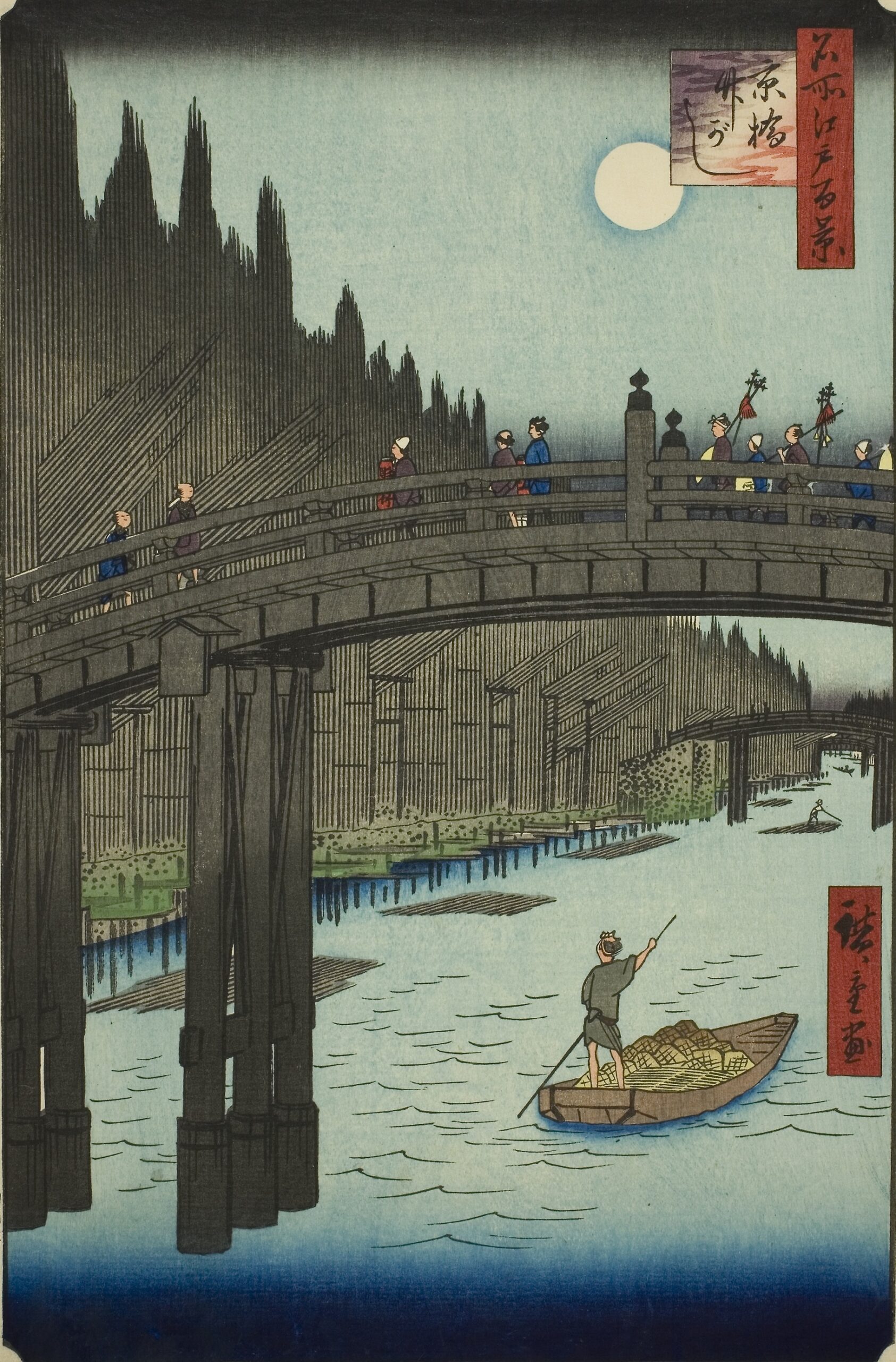
Utagawa Hiroshige-One Hundred Famous Views of Edo-77-Autumn Kyobashi Bamboo Grove 歌川広重-名所江戸百景-77-秋-京橋竹がし
Current Address: Kyobashi, Chuo Ward
Latitude and Longitude: 35.6735, Longitude: 139.7748
Published: December 1857 Age: 61
Tourist Guide-Style Commentary: “Kyobashi Bamboo Grove”
■ Introduction
Utagawa Hiroshige’s “One Hundred Famous Views of Edo” is a masterpiece of ukiyo-e, depicting the city and nature of Edo through the seasons.
One of the works, “Kyobashi Bamboo Grove,” is set along the Kyobashi River, located in Edo’s bustling commercial district.
This work simultaneously conveys the vitality of Edo’s urban life, the boat traffic that supported logistics, and the unique riverside scenery.
Amidst the glamour, there is a touch of commoner charm, demonstrating the importance Hiroshige placed on the relationship between the city and its waterfront.
■ About Kyobashi Bamboo
Kyobashi, along with Nihonbashi, was one of Edo’s central bridges, located near present-day Kyobashi in Chuo Ward, Tokyo.
The area south of the bridge, along the river, was known as “Takegashi.”
As its name suggests, this riverbank was a market specializing in bamboo.
In Edo, bamboo was in high demand for everything from building materials and daily necessities to fuel, making it an essential material for daily life.
Kyobashi Bamboo Market was a bustling hub for transporting and trading bamboo by riverboat.
The riverbank was not just a place for logistics; it was also a social gathering place for merchants and craftsmen.
The bustling market symbolized Edo’s economic power itself.
■ Highlights of the Painting
Kyobashi is the first bridge you cross after leaving Nihonbashi on the Tokaido.
It is a historic bridge, built at the same time as Nihonbashi.
The balustrades on the railings, which are only found on prestigious bridges, attest to this fact.
Bamboo wholesalers are concentrated in Sumicho, the area on the northern bank from Kyobashi Bridge to Sumiyabashi Bridge and further on to Shirauobashi Bridge.
This area is known as Takeyacho, Takecho, Takeyacho, or Takemachi.
It is said that bamboo once grew tall and was stored here, but this depiction exaggerates it greatly.
The bamboo is depicted in perspective, gradually becoming shorter as you move to the right of the painting.
Further elements such as the bamboo floating on the river and the cargo boats carrying bamboo crafts further emphasize the sense of distance.
A variety of people are passing by at Kyobashi Bridge in the foreground.
Some men are drawn to the magnificent full moon in the summer night sky.
There is also a group returning from a pilgrimage to Mt. Oyama.
Of particular note is the lantern held by the man walking across the center of the bridge.
The name of the carver who carved this piece, “Hochiku,” is inscribed on the piece.
The boat in the foreground is a cargo boat.
■ Edo Bamboo Culture
Bamboo was used in all aspects of architecture, including fences, alcove pillars, tea rooms, and gutters.
Light, strong, and easy to process, bamboo was widely used in everything from commoner homes to samurai residences.
Many essential daily tools, such as chopsticks, strainers, baskets, and fans, were made from bamboo.
Bamboo crafts were not only practical items, but also beloved as beautiful art pieces.
Bamboo was also used as kindling and charcoal, making it an important resource supporting urban life.
The Kyobashi Bamboo Riverbank supported the city of Edo as a source of these daily necessities.
■ Kyobashi Bamboo Riverbank in Modern Times
The place name “Kyobashi” still remains in Chuo Ward.
Its function as a bamboo riverbank has been lost.
Today, the area has developed into an office and commercial district, creating a landscape completely different from that of the Edo period.
Although hidden beneath the highway and buildings, stone monuments marking the remains of the Kyobashi River and its riverbank are scattered throughout the area.
The Kyobashi area is home to many art museums and galleries, preserving the region’s historic blend of commerce and culture.
Hiroshige’s “Working Townscape” has been reborn as a “City of Art and Business.”
■ Recommended Tourist Guide Points
- Strolling Around Kyobashi Area
As you walk around Kyobashi Station, you’ll find old stone monuments and information boards, where you can learn about the history of the bamboo riverbank. - Exploring the History of the Bridge and River
Visiting the remains of bridges in Nihonbashi and Ginza will give you a real sense of how deeply rooted Edo riverbank culture was in people’s lives. - Experiencing Contemporary Culture
Kyobashi is also known as an art district.
Enjoy spaces where history and contemporary culture blend, such as galleries and Kyobashi Edogrand. - Encountering Bamboo Crafts
You can still experience the beauty of bamboo crafts at traditional craft shops and workshops throughout Tokyo.
After viewing Hiroshige’s “Kyobashi Bamboo Baskets,” handling actual bamboo crafts will further deepen your understanding of the works.