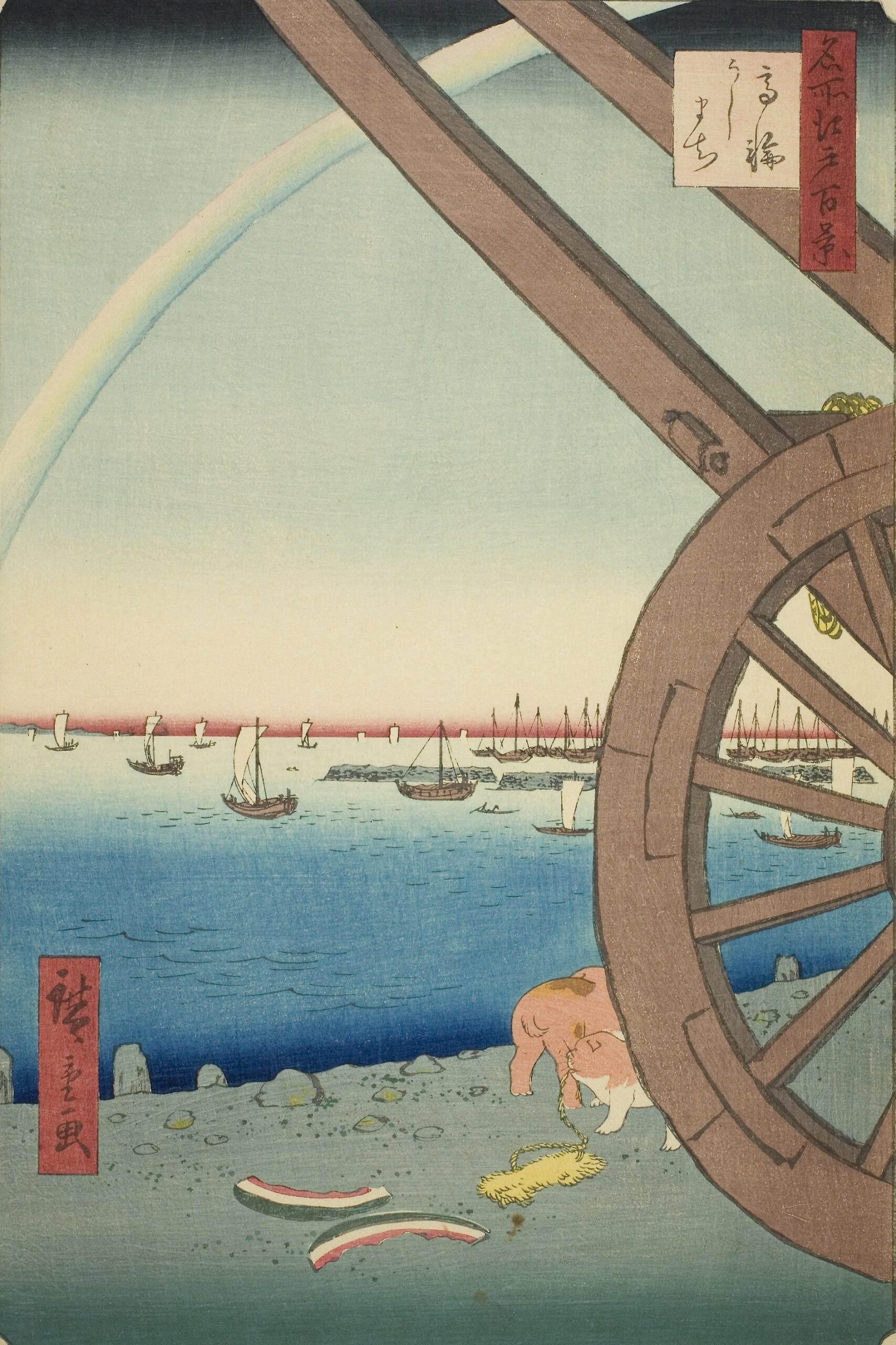
Utagawa Hiroshige-One Hundred Famous Views of Edo-82- Autumn-Takanawa Ushimachi 歌川広重-名所江戸百景-82-秋-高輪うしまち
Current Address: Takanawa, Minato Ward
Latitude and Longitude: Latitude: 35.6280, Longitude: 139.7370
Published: April 1857 Age: 61
Tourist Guide-Style Commentary: “Takanawa Ushimachi”
■ Introduction
Utagawa Hiroshige’s “One Hundred Famous Views of Edo” is a large series of ukiyo-e prints depicting Edo’s famous places and seasonal landscapes.
Among these, “Takanawa Ushimachi” is a work depicting the cattle town of Takanawa, located south of Edo.
To the people of Edo, Takanawa was a scenic spot overlooking the sea, along the Tokaido highway leading to Shinagawa.
“Ushimachi,” located in one corner of the area, was a collection of facilities related to the buying, selling, and raising of cattle and horses.
Hiroshige has depicted a unique landscape where a market for cattle and horses that supported the livelihoods of the common people coexists with a tranquil seaside setting.
■ What is Takanawa Ushimachi?
“Ushimachi” refers to markets and breeding farms for cattle and horses.
In urban life in Edo, cattle and horses were essential for transporting luggage, farm work, and building materials.
For this reason, Takanawa was home to a collection of facilities for buying and selling cattle and horses, and functioned as a market.
Takanawa faces Edo Bay, and this seaside scenery was the first thing travelers on the Tokaido road saw upon leaving Edo.
With the sea and the highway side by side, it was a lively place with a constant flow of people and goods.
■ Highlights of the painting
Ushimachi was a town facing Edo Bay, and its original name was Kurumamachi (Shiba Kurumamachi).
Ushimachi was a common name.
In 1634, when the Ankokuden Hall of Zojoji Temple was being built, oxcarts and ox-pullers were called in from Kyoto, and in 1639, they settled in Takanawa.
Later, this town gave rise to the development of the Daihachiguruma, a cart pulled by eight people instead of oxen.
Hiroshige placed a large Daihachiguruma representing Oshimachi, and painted a scene of Edo Bay with the Shinagawa Battery floating beyond it.
Numerous Takase-bune and Benzai-bune boats are moored in Edo Bay.
Watermelon scraps and a puppy holding a remnant of straw sandals give the air a subtle sense of fatigue after a rain.
The repetition of the Daihachiguruma wheel and the arc of a rainbow in the sky after the rain also suggest a calculated approach to Hiroshige’s composition.
Just north of this Cart Town is Takanawa’s Okido, a gateway to the Tokaido Highway where teahouses lined the streets and prospered as travelers and the people who drove them there.
■ Walking in Modern Takanawa
Today, Takanawa is undergoing redevelopment. Close to Takanawa Gateway Station and Shinagawa Station on the JR Yamanote Line, it has become a key business and transportation hub. The area formerly known as “Ushimachi” has been transformed into a modern streetscape.
The alleyways and place names, which retain a roadside atmosphere, offer a glimpse into the past.
The former coastline from Shibaura to Takanawa has been lost due to land reclamation.
Many temples and shrines dating back to the Edo period remain in the Takanawa area, including Tozenji Temple and Sengakuji Temple.
Visiting these historic sites allows you to reflect on Edo life and road culture.
■ Tourist Guide Recommendations
- Visit Sengakuji Temple
Sengakuji Temple, associated with the Ako Roshi, is a highlight of a stroll through Takanawa.
The people who passed through Ushimachi back then would no doubt have been aware of this temple. - Stroll around the Takanawa Gateway Station Area
Redevelopment is resulting in the creation of new landmarks one after another.
You’ll experience the mysterious overlap between the cow town of the Edo period and a modern-day futuristic city. - Walk along the road toward Shinagawa
By following the route down the Tokaido from Edo to Shinagawa, you can relive the scenery as travelers saw it.