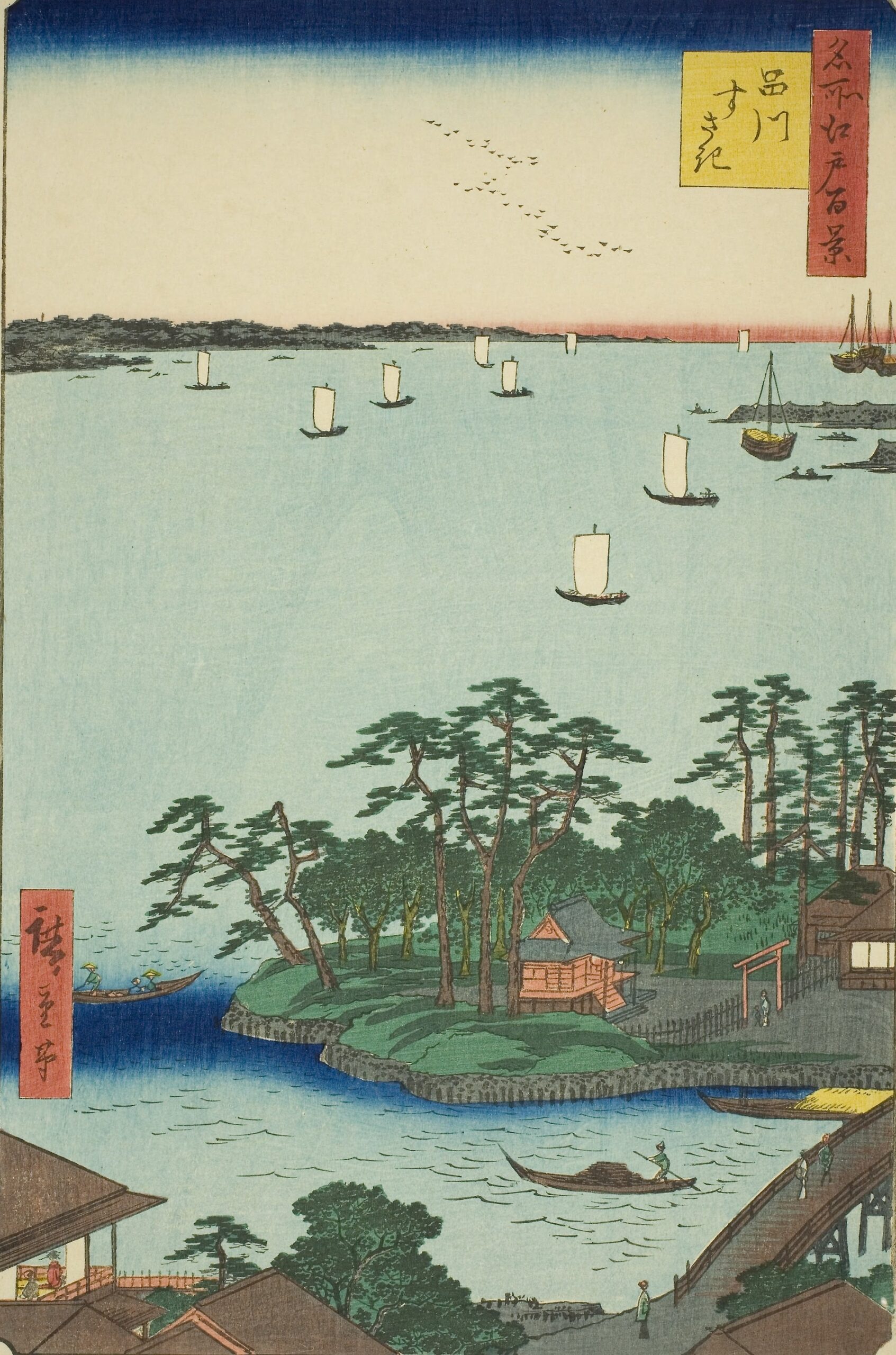
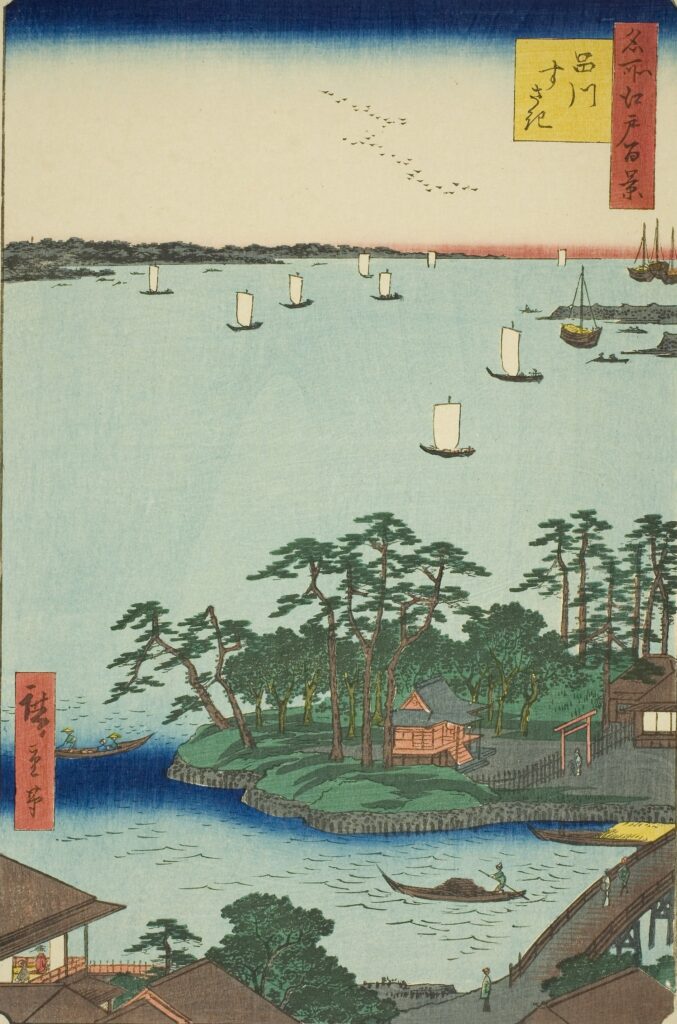
Utagawa Hiroshige-One Hundred Famous Views of Edo-84-Autumn-Shinagawa Susaki 歌川広重-名所江戸百景-84-秋-品川すさき
Current Address: Around Susaki, Shinagawa Ward
Latitude and Longitude: Latitude: 35.6170, Longitude: 139.7370
Published: April 1856 Age: 60
Tourist Guide-Style Commentary: “Shinagawa Susaki”
■ Introduction
Utagawa Hiroshige’s “One Hundred Famous Views of Edo” is a series of ukiyo-e prints that vividly depict the scenery and seasons of Edo, providing insight into the city’s famous sites and the lives of its common people.
One of the prints, “Shinagawa Susaki (Susaki),” is set on a cape jutting out from the Shinagawa coast.
During the Edo period, Shinagawa flourished as the first post town on the Tokaido Road and was also popular as a scenic spot facing Edo Bay (Tokyo Bay).
Hiroshige captivatingly depicts the landscape and the people relaxing on the shore.
■ What is Shinagawa Susaki?
“Susaki” refers to a small cape located south of Shinagawa-juku.
The landform jutting out into Edo Bay was called “su” (shore) or “saki” (cape).
The area corresponds to what is now the Takanawa and Shinagawa area of Minato Ward, Tokyo, and was once known as a popular spot for clam digging and seaside activities.
While the Shinagawa area bustled with travelers as a post town, it was also a popular seaside resort for the common people of Edo.
Susaki offers a panoramic view of the sea and sky, and was a particularly popular spot to view the spectacle at sunset and under the full moon.
■ What’s Notable About the Painting
Shinagawa was the first post town on the Tokaido Road, and was bustling with people visiting inns and restaurants. Its proximity to the coast meant that fishing was also thriving.
Susaki Benten was enshrined at the mouth of the Meguro River.
It was originally founded in 1626 when the monk Takuan enshrined Benzaiten.
In front of you is Susaki Benten Shrine.
Many Benzaibune boats can be seen in Edo Bay.
Torimimi Bridge, used for pilgrimages to Benzaiten, is located over the Meguro River in the foreground.
The shrine is surrounded by pine trees to protect from the wind and waves.
Odaiba can be seen small to the right of Edo Bay. Fukagawa can be seen on the left.
However, in 1854, the Gotenyamashita Artillery Battery was completed in front of Susaki, where Benzaiten is located, completely changing the view from here.
However, the painting appears to depict the Odaiba as if it were not there.
■ Walking around Modern-Day Shinagawa
Hiroshige’s “Susaki” painting has disappeared due to land reclamation and port development since the Meiji period.
Today, the area is lined with wharves and skyscrapers, making it impossible to see the original topography.
However, vestiges of the time remain in Shinagawa Shrine and the streets along the old Tokaido road.
In particular, strolling through the shopping districts of Kita-Shinagawa and Minami-Shinagawa allows you to experience the atmosphere of an Edo-period post town.
Today, Shinagawa Seaside, Tennozu Isle, and even the Odaiba area have become seaside strolling spots that could be described as “modern-day Susaki.”
■ Tourist Guide Recommendations
① Strolling Through Shinagawa Post Town on the Former Tokaido
The Kita-Shinagawa and Minami-Shinagawa areas retain the atmosphere of an Edo-period post town.
With teahouse-style cafes and historical site information boards, it’s perfect for walking while comparing the scenery with ukiyo-e prints.
② Shinagawa Shrine
From the elevated Shinagawa Shrine, you can enjoy a panoramic view of the former Shinagawa Post Town and Tokyo Bay.
Travelers during the Edo period are said to have prayed here for safe travels.
③ Tennozu Isle and Shinagawa Seaside
This modern waterfront offers views of Tokyo Bay from the promenade along the waterfront.