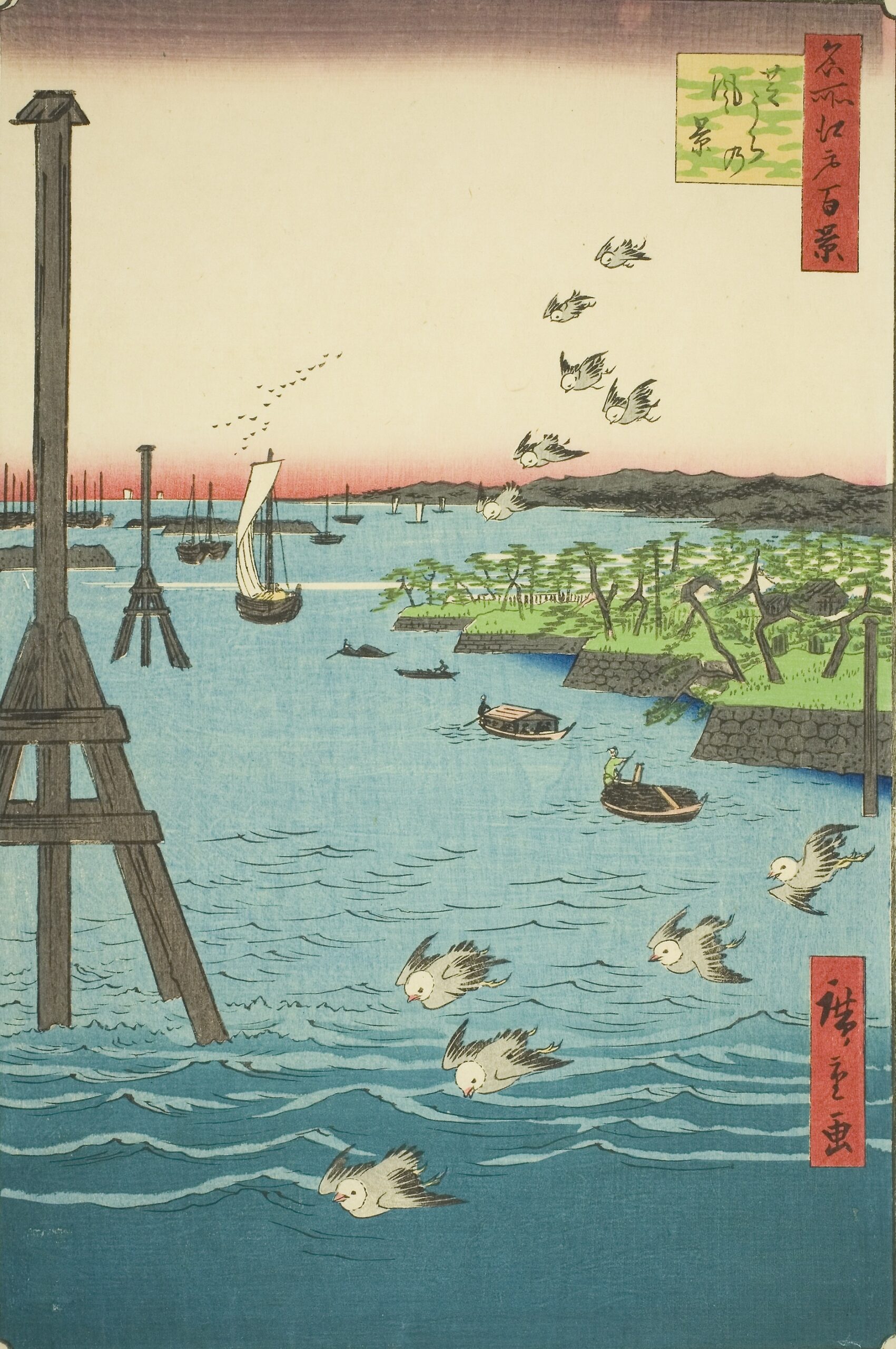
Utagawa Hiroshige – One Hundred Famous Views of Edo – 109 – Winter – Shibaura Landscape 歌川広重-名所江戸百景-109-冬-芝うらの風景
Current Address: Shibaura, Minato Ward
Latitude and Longitude: Latitude: 35.6444, Longitude: 139.7479
Published: February 1856 Age: 60
Tourist Guide-Style Commentary: “Shibaura Landscape”
■ Introduction
Utagawa Hiroshige’s “One Hundred Famous Views of Edo” is a large series that vividly depicts the four seasons of Edo.
One of these paintings, “Shibaura Landscape,” is a depiction of the Shibaura area facing Edo Bay.
This area was a perfect place to relax for Edo’s townspeople and samurai, and a famous spot offering panoramic views of the ocean and Mount Fuji.
Hiroshige conveys the charm of Edo’s seaside through the tranquil seaside scenery and the people passing by.
■What is Shibaura?
Shibaura is a low-lying area facing Tokyo Bay, in what is now the Shibaura area of Minato Ward, Tokyo.
During the Edo period, reclamation was still incomplete, and the area’s proximity to the water’s edge allowed it to retain its fishing village atmosphere, while also becoming increasingly popular as a leisure destination.
It served as part of the port’s functions and was a hub for fishing and logistics.
Furthermore, as the name “Shibaura” suggests, the grassy area along the waterfront served as a popular resting spot, bustling with people strolling along the beach and enjoying boat rides.
It appears in many ukiyo-e prints and travelogues as a place with spectacular views of Mount Fuji across Edo Bay.
■Highlights of the Painting
The stone wall with pine trees planted on the right is Hamagoten.
Originally a falconry ground for the shogun, it was acquired by Matsudaira Tsunashige (the younger brother of the fourth shogun, Ietsuna) and built a villa there.
It was originally called Kofu Hamayashiki or Kaiteyashiki.
Later, when Tsunashige’s son, Ienobu, became the sixth shogun, the area came to be known as Hamagoten.
The sea from around Hamagoten to Tamachi and just before Takanawa Ushimachi was collectively known as Shibaura.
The fish caught here were called shibazakana and were a favorite food in Edo.
On the left, there are two miotsukushi (channel markers) that inform passing ships of the water level.
Hiroshige often depicts miotsukushi as a symbol of Shibaura.
The three black platforms seen in the distance are actually the O-bachi (battery) off the coast of Shinagawa, which is located much further away.
The numerous birds flying are miyakodori (birds of the capital).
■ Shibaura Today
With ongoing land reclamation, Shibaura has been transformed into a waterfront lined with office buildings and high-rise apartment buildings.
The original “grassland and sea” landscape has been lost.
The place name “Shibaura” evokes memories of the past, and a stroll around the Tokyo Bay area allows you to feel the sea breeze and imagine those days.
From Rainbow Bridge, a modern-day Shibaura landmark, you can see the expansive sea as the people of Edo would have gazed upon it.
■Recommended Points from the Tourist Guide
- Shibaura Pier Park
This open park evokes the feeling of standing on the Edo seaside.
The evening and night views are beautiful, and it’s fascinating to compare them with Hiroshige’s paintings. - Rainbow Bridge Promenade
Enjoy a magnificent panorama of Edo Bay.
On clear days, you can even see Mount Fuji, reminiscent of ukiyo-e. - Shiba Daijingu Shrine
Shiba Daijingu Shrine, within walking distance from Shibaura, is an ancient shrine that has been a center of worship since the Edo period.