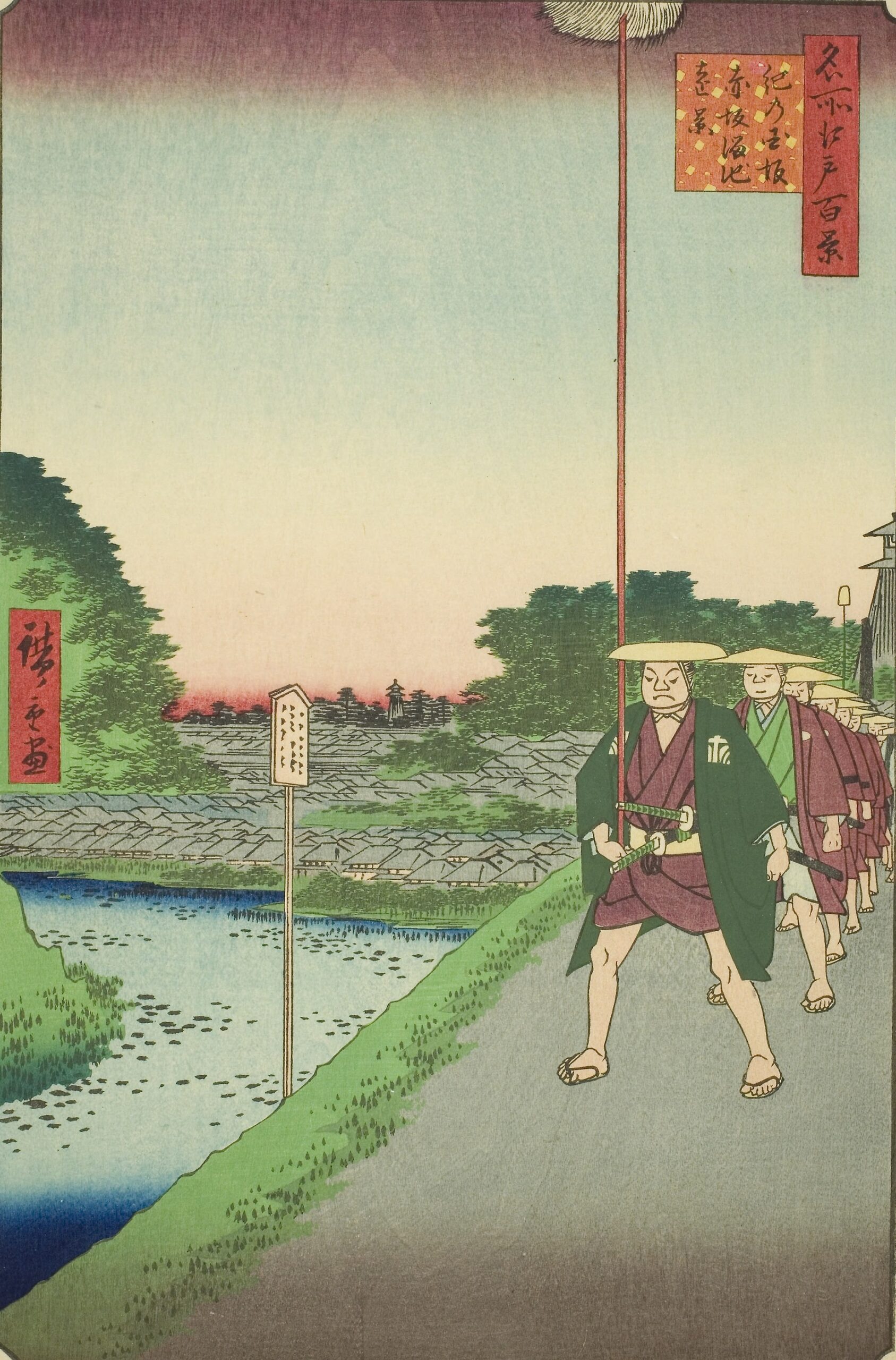
Utagawa Hiroshige-One Hundred Famous Views of Edo-86-Autumn-Distant View of Kinokunizaka, Akasaka, and Tameike 歌川広重-名所江戸百景-86-秋-紀乃国坂赤坂溜池遠景
Current Address: Kioicho, Tameike, Minato Ward
Latitude and Longitude: Latitude: 35.6780, Longitude: 139.7376
Published: September 1857 Age: 61
Tourist Guide-Style Commentary: “Distant View of Kinokunizaka, Akasaka, and Tameike”
■ Introduction
Utagawa Hiroshige’s “One Hundred Famous Views of Edo” is a series of large-scale ukiyo-e prints depicting Edo’s famous places and the lives of ordinary people throughout the seasons.
Among these, “Distant View of Kinokunizaka, Akasaka, and Tameike” is a work that blends the urban landscape of Edo with the natural beauty of the suburbs.
This painting, depicting the Tameike-Sanno area, around present-day Akasaka in Minato Ward, Tokyo, effectively conveys the image of Edo, where city and nature coexisted.
Hiroshige overlooked Akasaka Tameike from the top of the hill and captured the mountains and townscape beyond in his composition.
The streetscape, where people traveled at the time, and the expansive nature in the background create a landscape unique to Edo.
■ About Kinokuni Hill and Akasaka Tameike
“Kinokuni Hill” refers to the slope leading from Akasaka to the Edo residence of the Kishu Tokugawa clan.
It was named after the location of the Kishu domain’s residence.
The slope continues from Akasaka Gomon Gate toward the pond, and was a key transportation hub during the Edo period.
Akasaka Tameike is a huge artificial pond built as part of Edo Castle’s outer moat.
It was surrounded by fields and samurai residences.
The name “Tameike-sanno” remains today, but the pond itself has since been filled in.
Once a place where people enjoyed boating and cooling off, the landscape Hiroshige painted at the time was a symbol of Edo’s “urban waterfront landscape.”
■ Highlights of the Painting
The name Kinokuni-zaka comes from the residence of the Kishu Tokugawa family, which was located to the left of the slope.
There are various theories about the origin of Akasaka: 1) Because madder flowers grew abundantly here; 2) Because the land here was red; 3) Because dyer Jinzo hung his red dyed fabrics to dry on the slope in this area.
The painting does not depict a reservoir, but Benkei Moat.
This artificial pond was built by Benkei Kozaemon during the Kan’ei era (1624-1644) to defend Edo Castle.
Benkei Moat is on the left, and on the right, across Kinokuni-zaka, is the residence of the Kishu Tokugawa family.
Although only one line of the procession is depicted, there is another line just off-screen.
At the front are foot soldiers carrying spears, and behind them is a spear-bearer with a decorative sheath.
A sign prohibiting fishing can be seen in Benkei Moat.
In the distance, the streets of Akasaka line the streets.
Fire watchtowers can be seen in the center and to the right.
■ Walking through the modern-day Kinokuni-zaka/Akasaka area
The area around Tameike-sanno Station is now lined with high-rise buildings and has developed into a government and business district.
While no trace of the former Akasaka Tameike Pond remains, the place name conveys its history.
The Kishu Domain residence, from which Kinokuni-zaka takes its name, is now the Akasaka Imperial Palace.
The lush green landscape of the outer garden evokes the dignity of samurai residences of the past.
Although today it is blocked by buildings, back then, walking down the slope from Akasaka-mitsuke offered a view of the expansive waters and distant mountains.
■ Tourist Guide Recommendations
① Strolling around Akasaka-mitsuke/Tameike-sanno
This is a spot where you can experience the history of Edo Castle’s outer moat and the pond.
Traces of Edo can be found in the surrounding stone walls and topography.
② Akasaka Hikawa Shrine
This ancient shrine is the central focus of the Akasaka area, and has been worshipped by commoners and samurai alike since the Edo period.
Combining a visit with a stroll around the Tameike Pond area will give you a deeper experience of Edo culture.
③ Explore Historical Monuments and Place Names
Place names such as “Tameike-sanno” and “Akasaka-mitsuke” convey the history of Edo to the present day.
We also recommend exploring the information boards and historical site markers scattered throughout the building district.