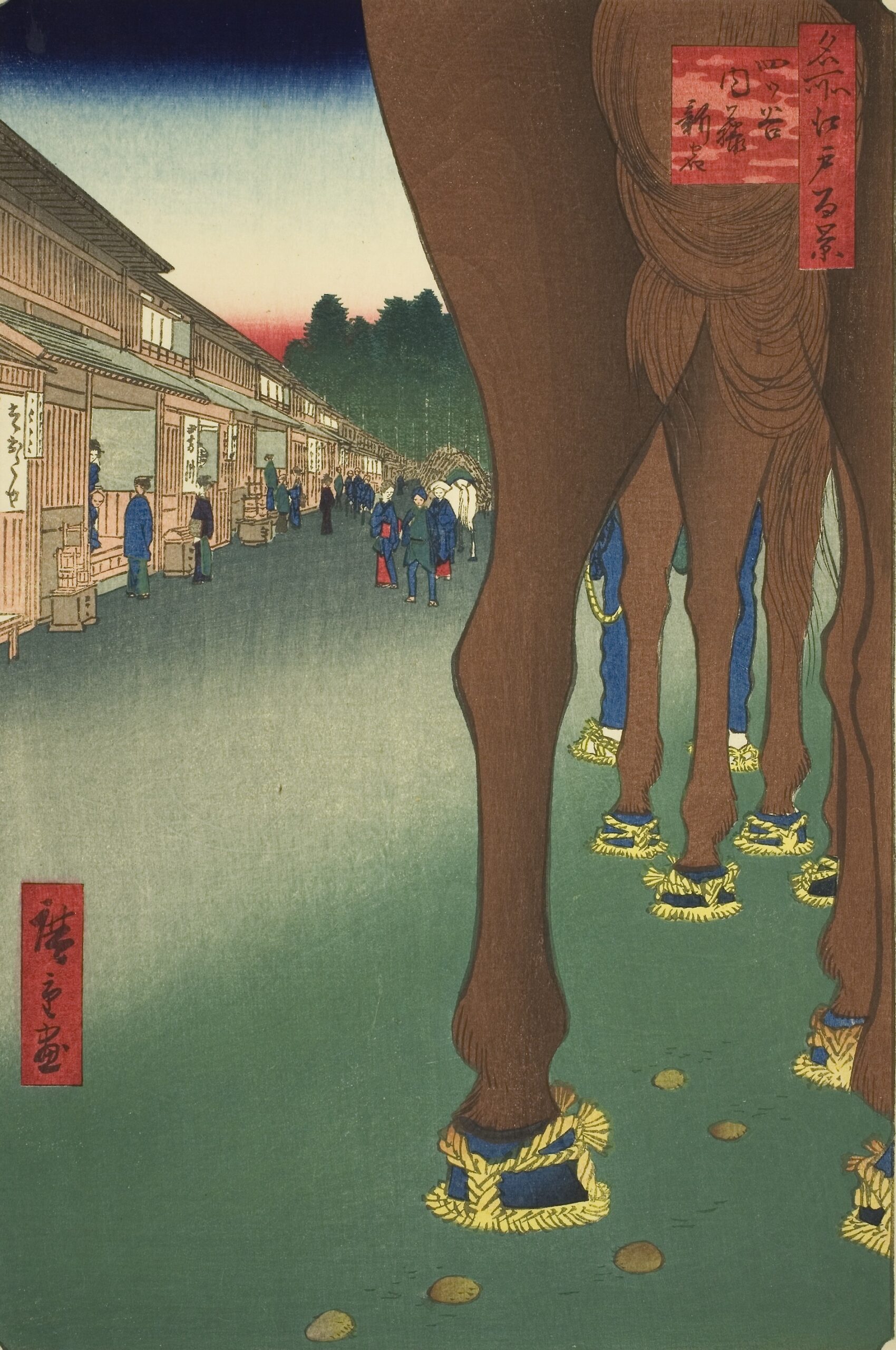
Utagawa Hiroshige-One Hundred Famous Views of Edo-87-Autumn-Yotsuya Naito Shinjuku 歌川広重-名所江戸百景-87-秋-四ッ谷内藤新宿
Current Address: Yotsuya Area, Shinjuku Ward
Latitude and Longitude: Latitude: 35.6895, Longitude: 139.7100
Published: November 1857 Age: 61
Tourist Guide-Style Commentary: “Yotsuya Naito Shinjuku”
■ Introduction
Utagawa Hiroshige’s “One Hundred Famous Views of Edo” is a large series of 119 prints vividly depicting the town, nature, and lives of ordinary people in Edo.
One of these prints, “Yotsuya Naito Shinjuku,” depicts Naito Shinjuku, a post town connecting Edo and the Koshu Dochu (now the Koshu Kaido).
This work depicts the first post town from Nihonbashi, the center of Edo, bustling with travelers and merchants along the road.
Here, Hiroshige skillfully contrasts Shinjuku’s role as the gateway to Edo with the surrounding rural landscape, rich in nature.
■ About Yotsuya and Naito Shinjuku
Naito Shinjuku was the first post town on the Koshu Kaido road, which ran from Edo to Kofu and Shimo-Suwa.
The name comes from the fact that the post town was established on the site of the Naito family’s former residence, which once stood in the area.
Although located only a few kilometers from Nihonbashi, it is an officially recognized post town on the outskirts of Edo.
It served as the first resting place for travelers departing from Edo.
In addition to providing lodging, Naito Shinjuku also had a strong presence as a pleasure district, with many prostitutes employed there, making it one of the entertainment districts for the Edo commoners.
■ Highlights of the Painting
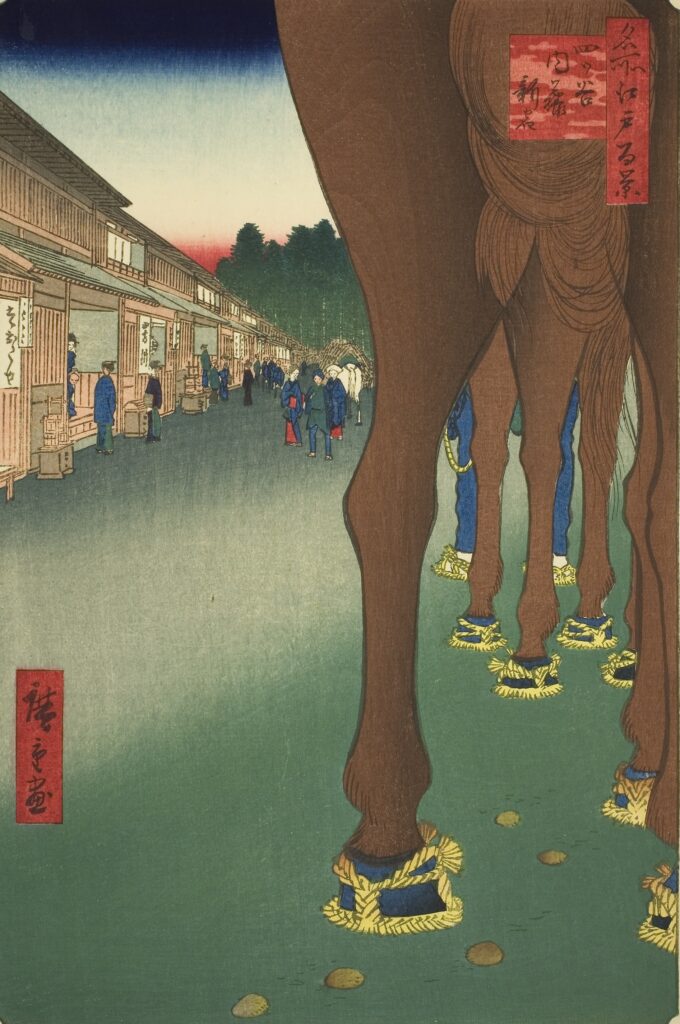
The back view of a horse, which takes up half of the painting, creates a striking composition.
The round object rolling on the road is horse manure.
Numerous inns are depicted on the left.
This composition symbolizes the area.
The first post town on the Koshu Kaido was called Naito Shinjuku.
It had long been the property of the Naito family, but some of the land given to their retainers became town houses.
A post town was established here in 1689.
Very few feudal lords passed through here. Because there were many women who were prostitutes, it flourished as a brothel, along with other Edo post towns (Shinagawa, Senju, and Itabashi).
■ Strolling through modern-day Yotsuya and Shinjuku
Shinjuku Gyoen National Garden is the site of the Naito family’s mansion during the Edo period.
It is now open to the public as a vast garden.
It is particularly famous for its cherry blossoms in spring and autumn foliage, allowing you to feel the vestiges of nature that have continued since the Edo period.
The area around Shinjuku Station is now one of the world’s busiest shopping districts.
The remains of Yotsuya Mitsuke were the gate to the outer moat that defended Edo Castle.
Parts of the stone walls still remain, allowing you to imagine what the castle town looked like at the time.
■ Tourist Guide Recommendations
- Stroll Through Shinjuku Gyoen
Shinjuku Gyoen, a former feudal lord’s garden from the Edo period, offers beautiful scenery throughout the seasons. - Koshu Kaido Walk
Even a short walk along the Koshu Kaido, which runs from Shinjuku toward Takao, will evoke the atmosphere of the journey from Edo. - Visit the Historical Information Boards
Around Shinjuku, you’ll find information boards about the remains of Naito Shinjuku and the Koshu Kaido.