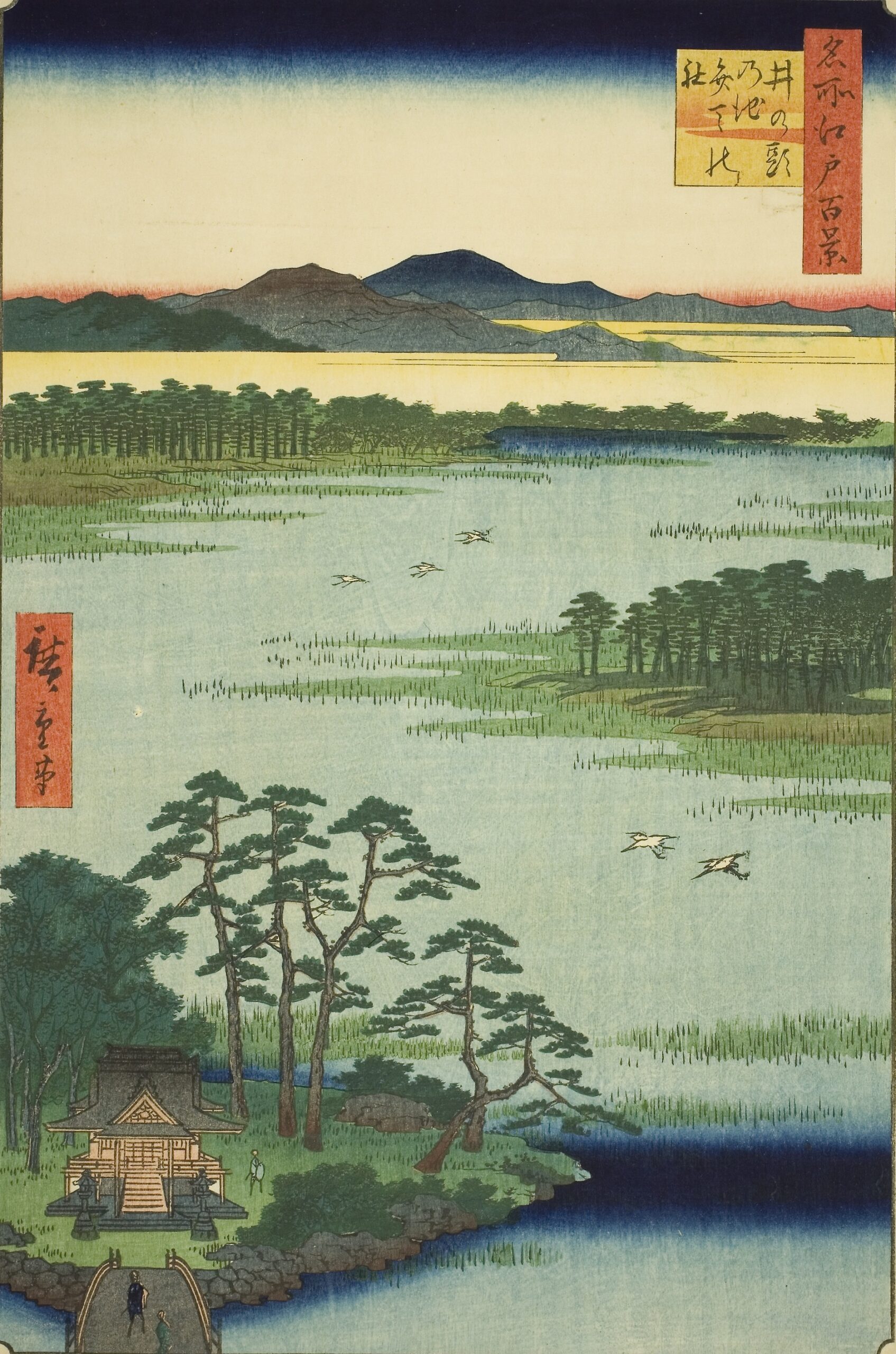
Utagawa Hiroshige-One Hundred Famous Views of Edo-88-Autumn-Inokashira Pond, Benten Shrine 歌川広重-名所江戸百景-88-秋-井の頭の池 弁天の社
Current Address: Inokashira Park, Musashino City
Latitude and Longitude: Latitude: 35.7033, Longitude: 139.5795
Published: April 1856 Age: 60
Tourist Guide-Style Commentary: “Inokashira Pond, Benten Shrine”
■ Introduction
Utagawa Hiroshige’s “One Hundred Famous Views of Edo” is a series of ukiyo-e prints that vividly depict the natural scenery and famous places of Edo throughout the seasons.
One of these prints, “Inokashira Pond, Benten Shrine,” is set at Inokashira Pond, which stretches from Mitaka to Musashino City in Tokyo today.
For the people of Edo, Inokashira Pond was a sacred water source, as well as a popular recreational spot where visitors could enjoy cherry blossoms and fresh greenery.
Hiroshige’s paintings of the pure waterside and people relaxing, centered around the Benzaiten Shrine that stood here, became popular as paintings of famous Edo landmarks.
■ About Inokashira Pond
Inokashira Pond is the source of the Kanda Aqueduct, which supplied drinking water to the city of Edo.
After Tokugawa Ieyasu entered Edo, the canal was developed during the Keicho era to irrigate the castle town, which was suffering from water shortages.
The canal’s starting point is Inokashira Pond, the source of “Edo’s life-giving water.”
The name “Inokashira” comes from “the beginning of a well (i no kashira).”
Another theory is that the name comes from Tokugawa Iemitsu, who, while hunting here, praised it as “the best spring in the world.”
For the common people of Edo, Inokashira Pond was a popular destination for cherry blossom viewing, boating, and temple and shrine visits.
The nature surrounding the pond and the waterside scenery made it a destination for “short trips” that were hard to find in the city.
■ About the Benten Shrine
Inokashira Benzaiten, enshrined on the shores of the pond, was widely worshipped as the goddess of water and performing arts.
The statue of Benten holding a biwa (Japanese lute) is said to bestow blessings on music and performing arts, and is said to have been particularly popular with women and entertainers.
Inokashira Benzaiten is said to have been enshrined by Minamoto no Yoritomo when he constructed Tsurugaoka Hachimangu Shrine.
Since ancient times, it has been a center of faith, along with the pond.
During the Edo period, it was constantly visited by worshippers, and became a famous spot where entertainment for the common people and faith blended.
■ Highlights of the Painting
Inokashira Pond has seven springs, earning it the nickname Nanai no Ike (Pond of Seven Wells).
It is said that the water source never dried up, even during droughts.
In the early Edo period, this water supply was diverted to the center of Edo, and became the Kanda Aqueduct.
In the center of the pond is Bentendo Hall, said to have been built by Minamoto no Yoritomo, where a statue of a celestial maiden believed to have been created by Dengyo Daishi is enshrined as the principal image.
Benzaiten was known in ancient India as a river goddess, and in Japan, she is confused with Kisshoten and is one of the Seven Gods of Fortune.
In the foreground of this painting, Bentendo Hall on Nakanoshima Island is surrounded by rocks and pine trees.
A pilgrim is depicted on the bridge, about to depart.
In the center is the vast Inokashira Pond and wetlands, with five white herons soaring.
■ Walking around Inokashira Pond Today
Inokashira Pond is located in the center of Inokashira Park, which stretches across the Musashino and Mitaka areas.
During the Meiji period, the pond was converted from Imperial land into a park and opened to the public in 1917.
The shrine building of Inokashira Benzaiten (Daisei-ji Temple) still remains on the pond’s shore, welcoming visitors.
Just as in the Edo period, the temple is bustling with worshippers praying for success in the arts, academics, and romance.
Today, the temple offers the same enjoyment as the Edo period, with spring cherry blossoms, autumn foliage, and boating.
■ Tourist Guide Recommendations
- Visit Inokashira Benzaiten
Said to grant blessings for the arts and academics, the temple is popular with people of all ages.
The dragon god statue and stonework within the temple grounds are also worth seeing. - Boating on the Pond
The boating experience is a famous experience that allows you to experience Edo-era boating in a modern style.
The spring cherry blossom season is a must-see. - Nature and the Zoo
Inokashira Park, which spreads out around the pond, is home to Inokashira Park Zoo, Japan’s oldest suburban zoo.