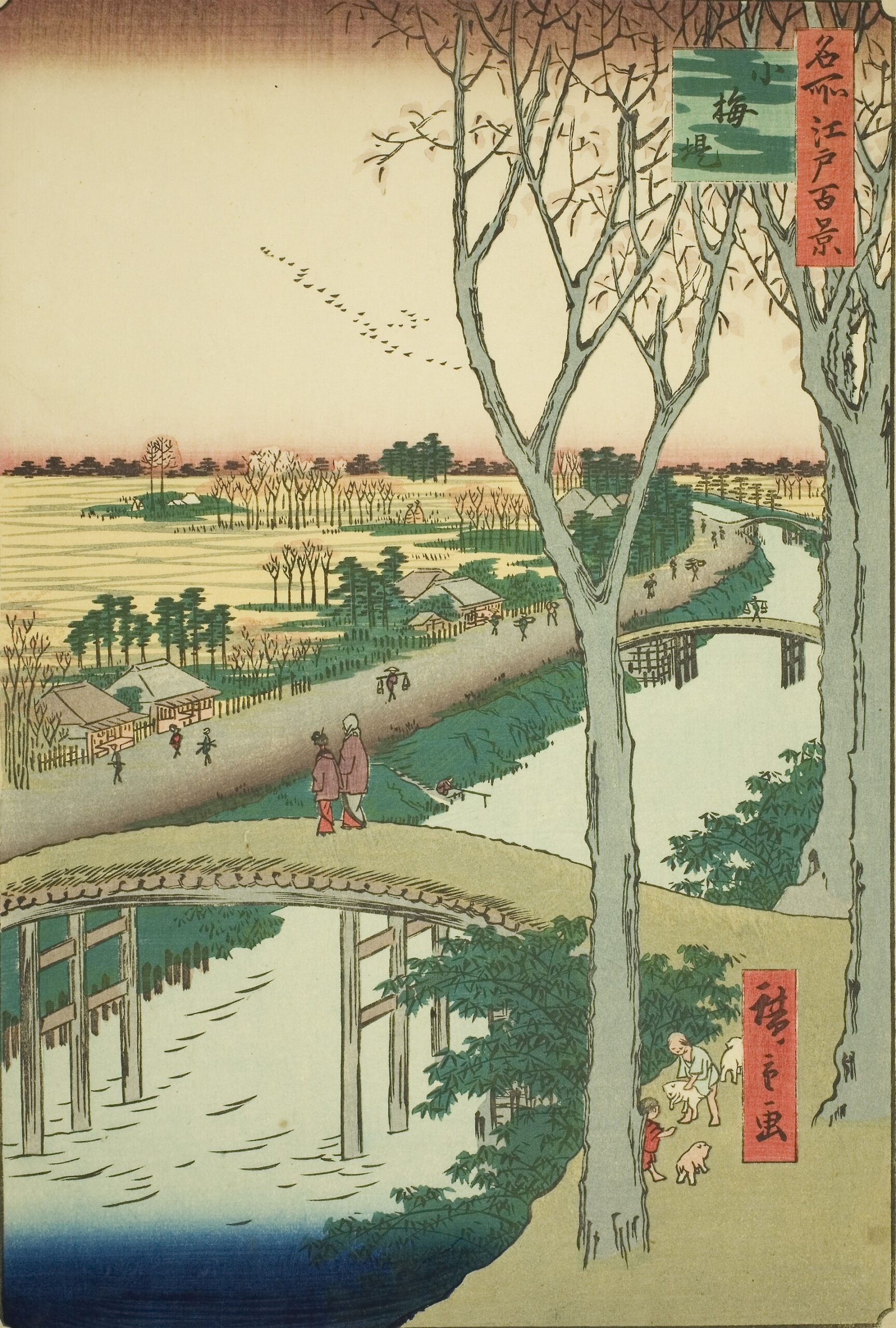
Utagawa Hiroshige – One Hundred Famous Views of Edo – 105 – Winter – Koume Embankment 歌川広重-名所江戸百景-105-冬-小梅堤
Current Address: Near Koume, Mukojima, Sumida Ward
Latitude and Longitude: Latitude: 35.7105, Longitude: 139.8110
Published: February 1857 Age: 61
Tourist Guide-Style Commentary: “Koume Embankment”
■ Introduction
Utagawa Hiroshige’s “One Hundred Famous Views of Edo” is a series of ukiyo-e prints vividly depicting Edo’s famous sites throughout the seasons.
One of these, “Koume Embankment,” is a painting depicting a famous plum blossom spot on the east bank of the Sumida River.
Plum viewing was a major springtime pleasure for the Edo commoners, and this area was known as a popular cherry blossom viewing spot.
Hiroshige depicts the refined atmosphere of Edo with a riverside landscape against the backdrop of a plum grove in full bloom.
■About Koume-tsutsumi
Koume-tsutsumi is a famous plum blossom spot that stretched along the east bank of the Sumida River, near present-day Mukojima in Sumida Ward.
It is located near areas still closely associated with plum blossoms, such as Mukojima Hyakkaen and Umewaka Shrine.
During the Edo period, this area was home to many plum groves, drawing crowds of cherry blossom viewers in the spring.
Koume-tsutsumi, in particular, was beloved by many ukiyo-e artists and writers for its beautiful landscape of blooming plum trees lined along the bank.
The place name “Koume” comes from the many plum trees planted here.
In Edo, it was known as “Koume no Ume” (Plum of Koume), alongside the “Cherry Blossoms of Asukayama” and the “Wisteria of Kameido Tenjin.”
■Highlights of the Painting
Koume Village, located on the east bank of the Sumida River, behind the Mukojima embankment, is located along the irrigation canal that runs from the central Narihira River to Ukeji and Terajima.
It was also called the “Eight-Tiered Plum Blossoms” because the area covered by the plum trees spanned eight tiers.
The name of the nearest bridge, Hattanme Bridge, is derived from this.
Continuing on from Koshin Bridge and Shichihonmatsu Bridge, we head towards Akiha Gongen Shrine.
The three large trees on the right are hazel tree.
hazel tree protect the bank from erosion and are used to make racks for drying rice.
hazel tree are deciduous trees of the birch family that are found over a wide area, from Hokkaido to northern Kyushu.
They are tolerant of wetlands and riverbanks, and in their native habitats, several trees often stand together to form forests.
Outside of Japan, they are found natively in northeastern Asia and the Korean Peninsula.
■The Area Around Koume-tsutsumi Today
The place name “Koume-tsutsumi” no longer exists.
Mukojima Hyakkaen Garden, a garden established by the intellectual Sahara Kiku, is a famous spot where you can enjoy plum blossoms and seasonal flowers.
It carries on the tradition of Koume-tsutsumi to the present day.
Umewaka Shrine, a shrine steeped in legends related to plum blossoms, brightens the region’s spring.
Even today, a promenade runs along the Sumida River, allowing visitors to enjoy strolls admiring the cherry blossoms in spring and the plum blossoms in early spring.
■ Recommended Tourist Guide Points
- Spring Plum Festival
The plum blossoms at Mukojima Hyakkaen Gardens reach their peak from late February to March.
You can enjoy plum blossom viewing while immersing yourself in the Edo atmosphere. - Sumida River Cruise
As depicted in Hiroshige’s ukiyo-e prints, the riverscape viewed from a boat is exceptional.
We also recommend enjoying the spring Sumida River on a modern pleasure boat. - Cherry Blossom Viewing and Downtown Cuisine
After plum viewing, enjoying Edomae cuisine and sweets in Mukojima or Asakusa is a charming way to spend the day.