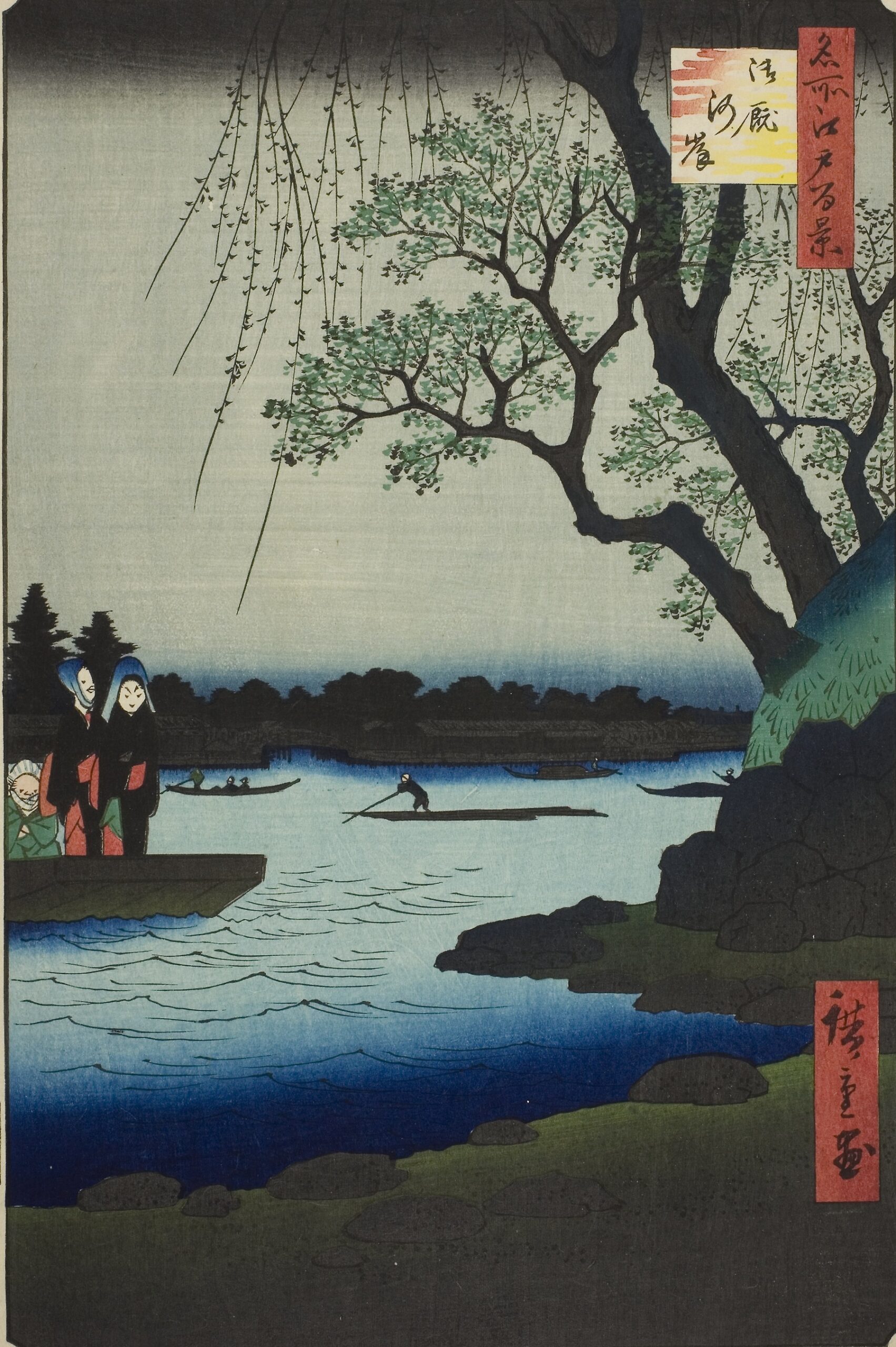
Utagawa Hiroshige – One Hundred Famous Views of Edo – 106 – Winter – Onmayagashi 歌川広重-名所江戸百景-106-冬-御厩河岸
Current Address: Near Onmayagashi, Taito Ward
Latitude and Longitude: Latitude: 35.7090, Longitude: 139.7980
Published: December 1857 Age: 61
Onmayagashi (Onmayagashi) Tourist Guide-Style Commentary: “Onmayagashi”
■ Introduction
Utagawa Hiroshige’s “One Hundred Famous Views of Edo” is a large series of 119 prints vividly depicting the seasons and scenery of Edo.
One of these prints, “Onmayagashi,” depicts the riverside area along the Sumida River near Asakusa.
This area facing the river was a key logistics hub in Edo, yet its idyllic riverside scenery is impressively captured in ukiyo-e prints.
Hiroshige depicted a landscape in which the river and people’s activities harmonize, symbolizing both Edo’s “working riverbank” and “playing riverbank.”
■What is Onmayagashi?
Onmayagashi was a riverbank located on the west bank of the Sumida River in Asakusa.
It corresponds to what is now the Hanakawado and Komagata area in Taito Ward, Tokyo.
It is located close to Komagatado and Azumabashi Bridge.
The name “Onmaya” comes from the fact that the Edo Shogunate’s stables were located nearby.
The Shogunate’s horses were an important transportation and military resource, and facilities related to the stables were established near Asakusa.
During the Edo period, “riverbanks” functioned as both docks and markets.
Onmayagashi was also a hub for Sumida River shipping, bustling with people loading and unloading goods.
■Highlights of the Painting
This name comes from the fact that the Shogun’s “Oumaya” (horse stables) were located here until the Genroku period.
Visible in the distance is the Miyoshi-cho Riverbank, closest to the Shogunate’s rice storehouse.
This is where rice brought by boat from areas directly under the Shogunate’s control was unloaded and stored.
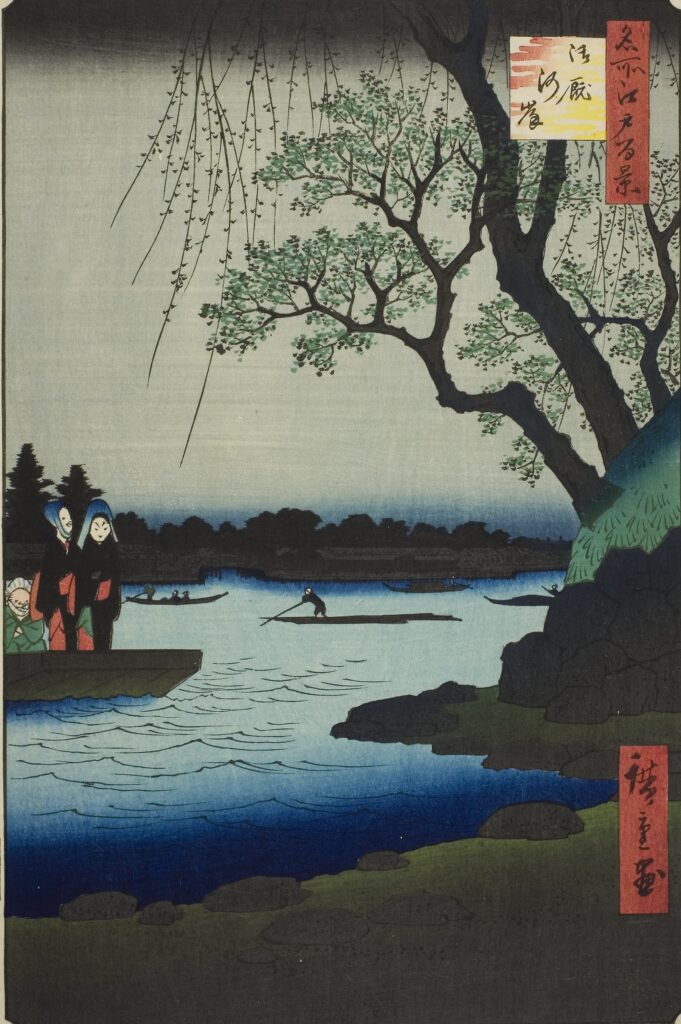
The two people on the boat, dressed in red sashes and indigo-dyed handkerchiefs, are nighthawks who lived around Honjo Yoshida Yotaka-cho.
Nighthawks were the lowest-ranking prostitutes.
It is said that there were 4,000 of them by the end of the Edo period.
They painted their faces completely white to hide their faces, and even on cold nights they would carry a robe and solicit customers on the streets.
Their male attendants, known as gifu/gyu (prostitute husbands), stayed with the nighthawks and served as their guards and soliciters.
As the sun set, they were heading off to work on a ferry connecting Honjo and Asakusa.
In front of you is the Onmayagashi ferry, a view of the Sumida River at dusk.
The tree in the foreground on the right is a willow, and the tree in the background is an evergreen oak.
■Modern Onmayagashi Area
Today, the name “Onmayagashi” no longer officially exists.
The area around Komagatabashi Bridge in Asakusa is considered to be its former site.
Komagatado is a small chapel along the Sumida River and serves as a landmark along the riverbank.
It is often depicted in ukiyo-e prints.
Azumabashi Bridge and Komagatabashi Bridge are bridges over the Sumida River, and many people still travel between them today.
The water bus terminal now serves as a departure and arrival point for tourist water buses, allowing you to experience remnants of Edo’s water transport era.
■Recommended Points from the Tourist Guide
① Combine with a Sightseeing Trip to Asakusa
After strolling around the former Gomayagashi area, we recommend visiting the nearby Sensoji Temple and Nakamise Street. You’ll be able to experience the Edo atmosphere firsthand.
② Sumida River Cruise
If you want to experience the river scenery reminiscent of Hiroshige’s paintings, try a water bus or a houseboat.
③ Komagata Loach Cuisine
In honor of riverside culture, we recommend savoring Edo-style flavors at the long-established nearby restaurant, Komagata Dojo.