Utagawa Hiroshige – One Hundred Famous Views of Edo – 48 – Summer – Akasaka Paulownia Fields 歌川広重-名所江戸百景-48-夏-赤坂桐畑 解説
Current Address: Near Akasaka 3-chome, Minato Ward
Latitude and Longitude: Latitude 35.6765, Longitude 139.7376
Published: April 1856 Age: 60
Explanation
<1> Introduction
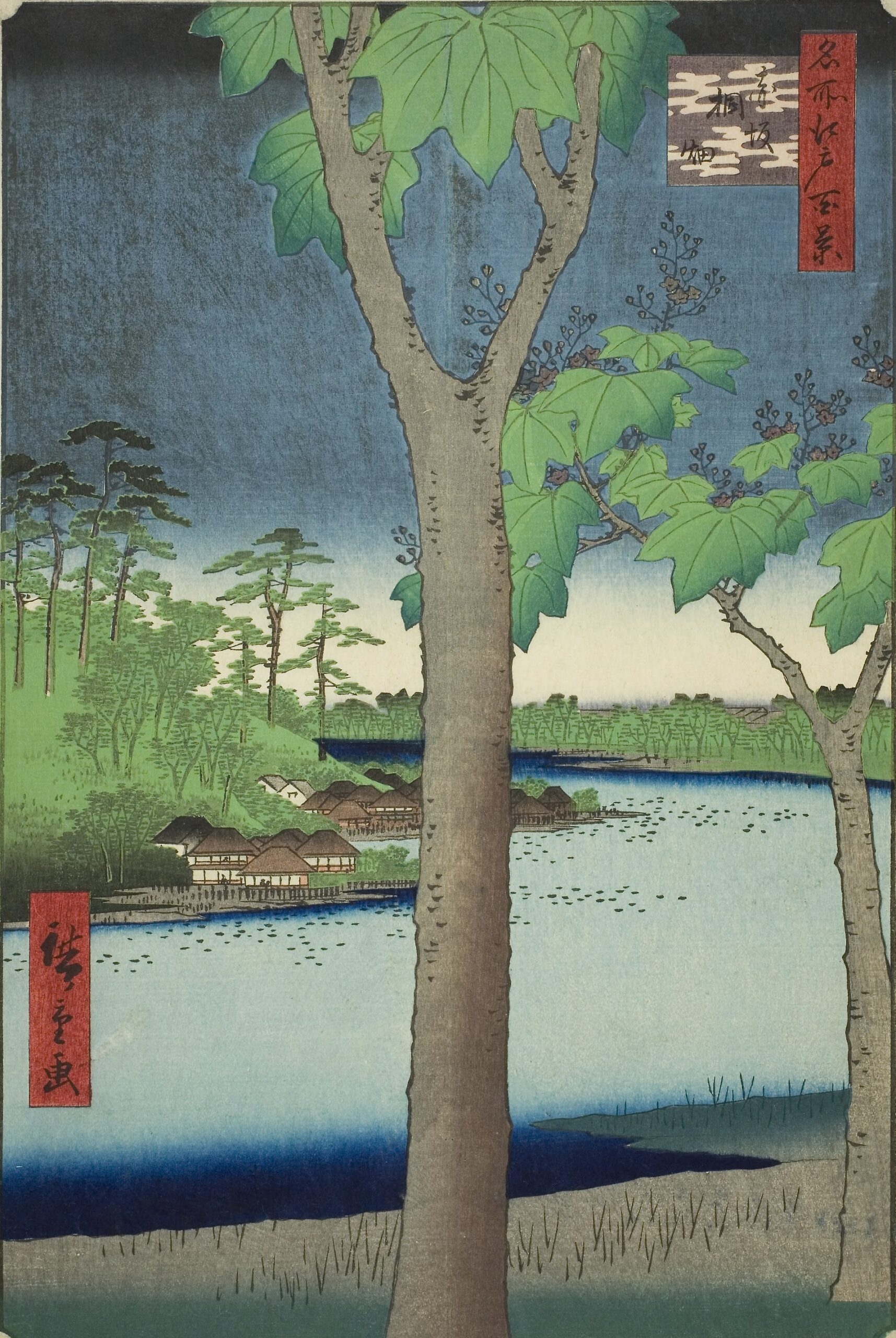
“Akasaka Paulownia Fields” is based on the area around Akasaka, where paulownia trees grew in abundance.
Paulownia has long been considered a noble tree in Japan, used in family crests and designs, and popular as a material for furniture and musical instruments.
Hiroshige captures a corner of Akasaka, a place in the heart of Edo that exudes a natural atmosphere, conveying the joys of Edo residents’ strolls.
<2> Akasaka and the Paulownia Fields
Akasaka was located west of Edo Castle, and was home to many samurai residences and temples and shrines, but it also contained a mix of townspeople’s neighborhoods and farmland.
In particular, the area known as “Paulownia Fields” (Kiribatake) became a famous spot for its large number of paulownia trees, and was well-known among the common people of Edo.
The paulownia tree was introduced from China as an auspicious tree, believed to be the tree on which the phoenix perches.
It was also a symbol of authority in Japan, being used as the crest of the imperial family and government.
For the common people of Edo, the season when paulownia blossoms bloom was a time to enjoy the seasons and was an object of admiration.
<3> Highlights of the Painting
The slender rows of paulownia trees fill the canvas, highlighting their unique leaves and flowers. It is early summer, and one can imagine the pale purple flowers swaying in the breeze.
People are depicted walking through the paulownia fields, indicating that they were a popular spot for cherry blossom viewing and strolling.
While paulownia trees are not as flashy as cherry blossoms or autumn leaves, the people of Edo enjoyed the colorful changes of the seasons.
In the distance, the streets of Akasaka and its samurai residences spread out, expressing the unique Edo landscape of urban and natural harmony.
A natural pond formed when water from the high ground around Akasaka collected in a depression.
In 1606, this pond was expanded and converted into a “tameike” (reservoir) by Asano Yukinaga of the Wakayama domain to supply water to Edo Castle’s outer moat.
This water was used as drinking water until the construction of the Tamagawa Aqueduct.
To reinforce the moat banks, paulownia trees were planted on the south side of the pond between 1716 and 1736, and the area came to be known as the “Kiribata” (Paulownia Field).
The small hill visible on the left is where Sannoji Temple is located, and there is a back alley accessible on foot.
From this point, you had to cross by boat.
Lotus flowers dot the pond.
<4> Modern-day Akasaka and Paulownia Fields
Today, Akasaka is a bustling downtown area lined with government offices, luxury hotels, and buildings.
Unfortunately, the famous “Kirihata” (Paulownia Fields) have disappeared, but the name remains in some neighborhood names and historical sites.
Meanwhile, vestiges of the past can be found at Akasaka’s Hie Shrine and Hikawa Shrine, as well as in the green spaces and slopes.
Walking around with ukiyo-e as a guide, you can relive memories of Edo people appreciating paulownia blossoms.
<5> Tourist Guide
1. Hie Shrine: Akasaka’s guardian shrine, famous for the Sanno Festival.
Located in the same area as the paulownia fields, this shrine offers a glimpse of Edo’s faith and festival culture.
2. Strolling the Slopes of Akasaka
Slopes like “Kirihata-zaka” (Paulownia Fields) are scattered throughout Akasaka, retaining traces of the Edo period.
Even their names evoke a sense of the past.
3. Akasaka Hikawa Shrine: One of the Seven Hikawa Shrines of Edo, this shrine grounds is lush with greenery.
Like the natural beauty of the paulownia fields, it offers a moment of tranquility in the city.