Utagawa Hiroshige – One Hundred Famous Views of Edo – 53 – Summer – Shower on the Great Bridge and Atake Bridge 歌川広重-名所江戸百景-53-夏-大はしあたけの夕立 解説
Current Address: Shin-Ohashi Bridge, 2-chome, Nihonbashi-Hamacho, Chuo-ku
Latitude and Longitude: Latitude: 35.685497, Longitude: 139.792238
Published: September 1857 Age: 61
Explanation
<1> Introduction
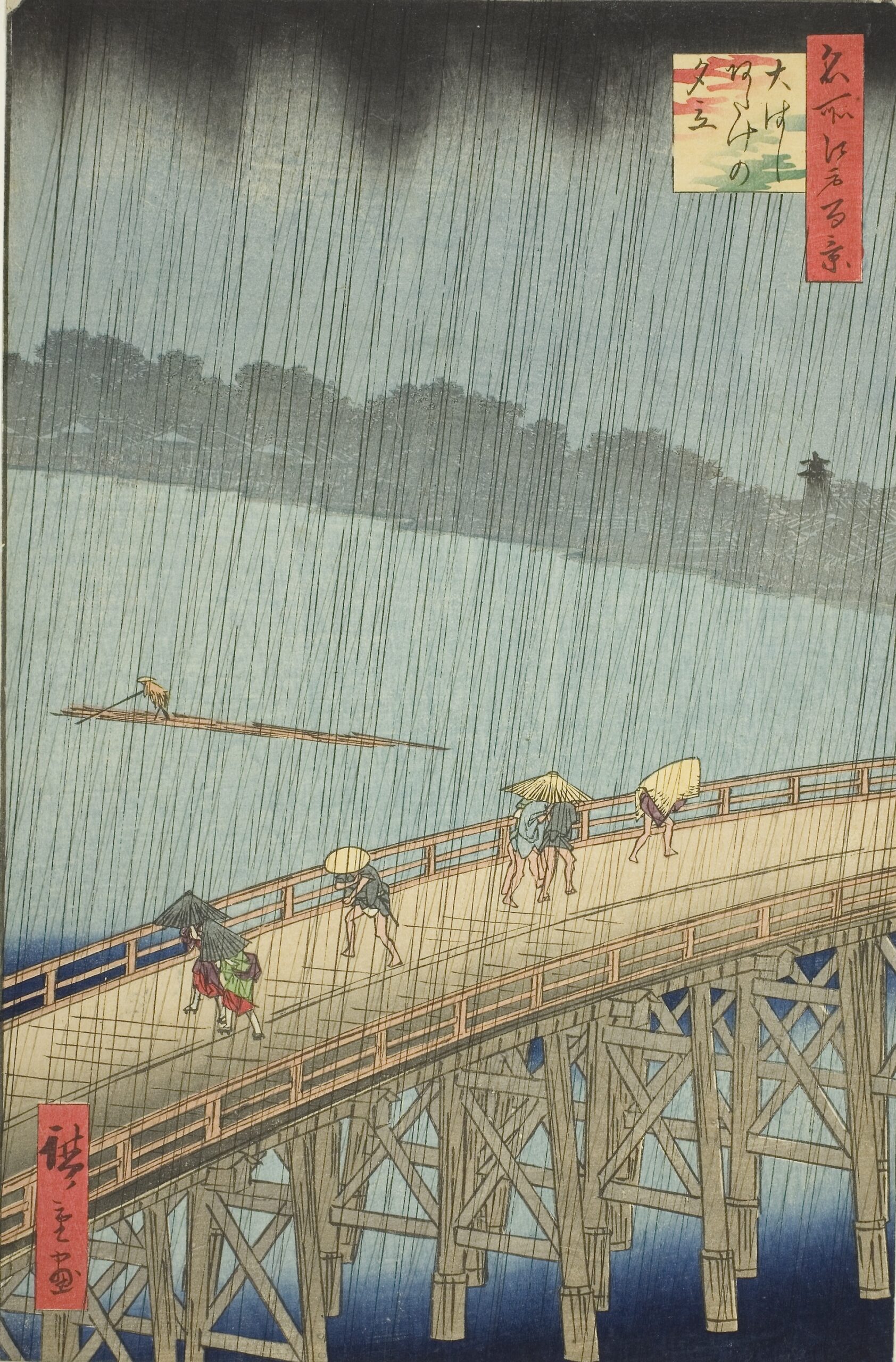
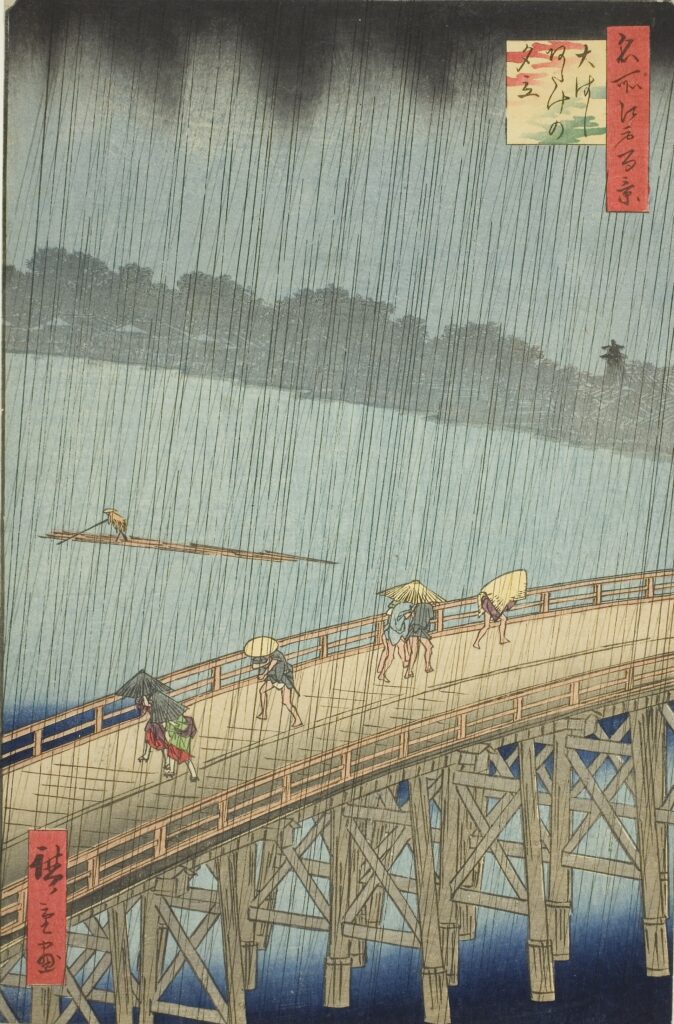
“Shower on the Great Bridge and Atake Bridge” depicts a sudden downpour.
The painting depicts people passing by on the bridge and boats crossing the Sumida River.
His innovative depiction of rain later had a major influence on Western painters such as Van Gogh.
Rain was not an uncommon occurrence for the common people of Edo; in fact, it was a part of everyday life.
<2> “Ohashi” and “Atake” refer to the large bridge over the Sumida River that was located near the current Kiyosubashi Bridge.
This bridge was a key transportation hub in Edo and a daily destination for people.
It was named “Ataka” after the Tokugawa family’s royal ship, the Atake Maru, was moored there.
“Thunderstorm over the Great Bridge and Atake” depicts the view from the bridge toward Ataka.
<3> Highlights of the Painting
The intensity of the sudden shower is expressed by drawing fine, parallel diagonal lines across the entire canvas.
This technique was extremely innovative for ukiyo-e of the time, and represented more than mere decoration; it was a “challenge to depict a natural phenomenon.”
It is particularly noteworthy that by varying the density of the diagonal lines of the rain, the artist can sense the perspective and even the intensity of the rain.
The painting depicts people surprised by the sudden shower, running while protecting themselves with hats and raincoats.
Though the figures on the bridge are small, their movements are vivid, conveying the lifestyle of ordinary Edo people.
The figure with an open umbrella in particular accentuates the intensity of the rain. Rain clouds cover the sky, casting a shadow over the river and the buildings in the distance.
However, a faint light lingers in the background, as if filtering in, hinting at the rain’s end.
Capturing this “fleeting passage of time” is its greatest allure.
This is the most famous image in the series.
Our eye is drawn to the bridge spanning the screen.
The Shin-Ohashi Bridge was built in 1693 downstream from Ryogoku Bridge on the Sumida River.
A heavy downpour suddenly breaks out of the pitch-black sky, depicted with shading, causing people crossing the bridge to hurry.
In the rain, the lone raft floating on the Sumida River appears all the more elegant.
The opposite bank is shrouded in smoke from the rain, and only the row of boat storehouses on the left and the fire watchtower on the right are faintly visible.
The diagonal composition of the bridge and the opposite bank creates a mysterious feeling that captivates the viewer.
<4> Walking along the modern-day “Ohashi Atake”
Today, bridges such as Kiyosubashi and Shin-Ohashi bridges span the Sumida River, allowing visitors to reminisce about the bridges of the past.
Although the surrounding area has undergone redevelopment and is lined with high-rise buildings, the wind blowing across the river and the passing of water buses still evoke memories of Edo.
Catching a sudden downpour is an experience truly reminiscent of an ukiyo-e.
<5> Tourist Guide
① Kiyosubashi Bridge (Nationally Designated Important Cultural Property)
A beautiful arched bridge spanning the Sumida River.
② Shin-Ohashi Monument
This stone monument marks the location of the Edo-period bridge. Experience the setting of ukiyo-e art.
It is located downstream from the current Shin-Ohashi Bridge.
③ Edo-Tokyo Museum (Ryogoku)
This museum displays a restored Edo townscape.
Hiroshige’s works, including “Shower over Ohashi Atake,” are also featured.
You can enjoy the historical context.