Utagawa Hiroshige – One Hundred Famous Views of Edo – 52 – Summer – Fukagawa Mannenbashi Bridge 歌川広重-名所江戸百景-52-夏-深川萬年橋 解説
Current Address: Mannenbashi Bridge, 1-chome, Tokiwabashi, Koto-ku
Latitude and Longitude: Latitude 35.6668: Longitude 139.7866
Published: July 1857 Age: 61
Explanation
<1> Introduction
“Fukagawa Mannenbashi Bridge” is a painting that symbolizes the atmosphere of Edo’s downtown area and the vitality of water transportation on the Sumida River.
The view of the Okawa River stretching out beyond the bridge and the sight of ordinary people crossing it convey the bustling lifestyle typical of Edo.
Mannenbashi Bridge was an important transportation route connecting Fukagawa and Honjo.
<2> About Fukagawa Mannenbashi Bridge
Mannenbashi Bridge is one of the bridges spanning the Sumida River.
It was constructed during the Kan’ei era.
Its name, “May it continue for a thousand or ten thousand years,” carries the auspicious meaning of “May it continue for a thousand or ten thousand years.”
For the common people of Edo, the Sumida River was a major artery of life, and its bridges were “bridges connecting Edo.”
Mannenbashi Bridge connected Fukagawa and Honjo.
Fukagawa is a fishing town filled with temples and shrines, and is full of downtown atmosphere.
Honjo developed as a town of samurai residences and artisans.
Mannenbashi Bridge connected these towns and was a place that fostered interaction between people.
<3> Highlights of the painting
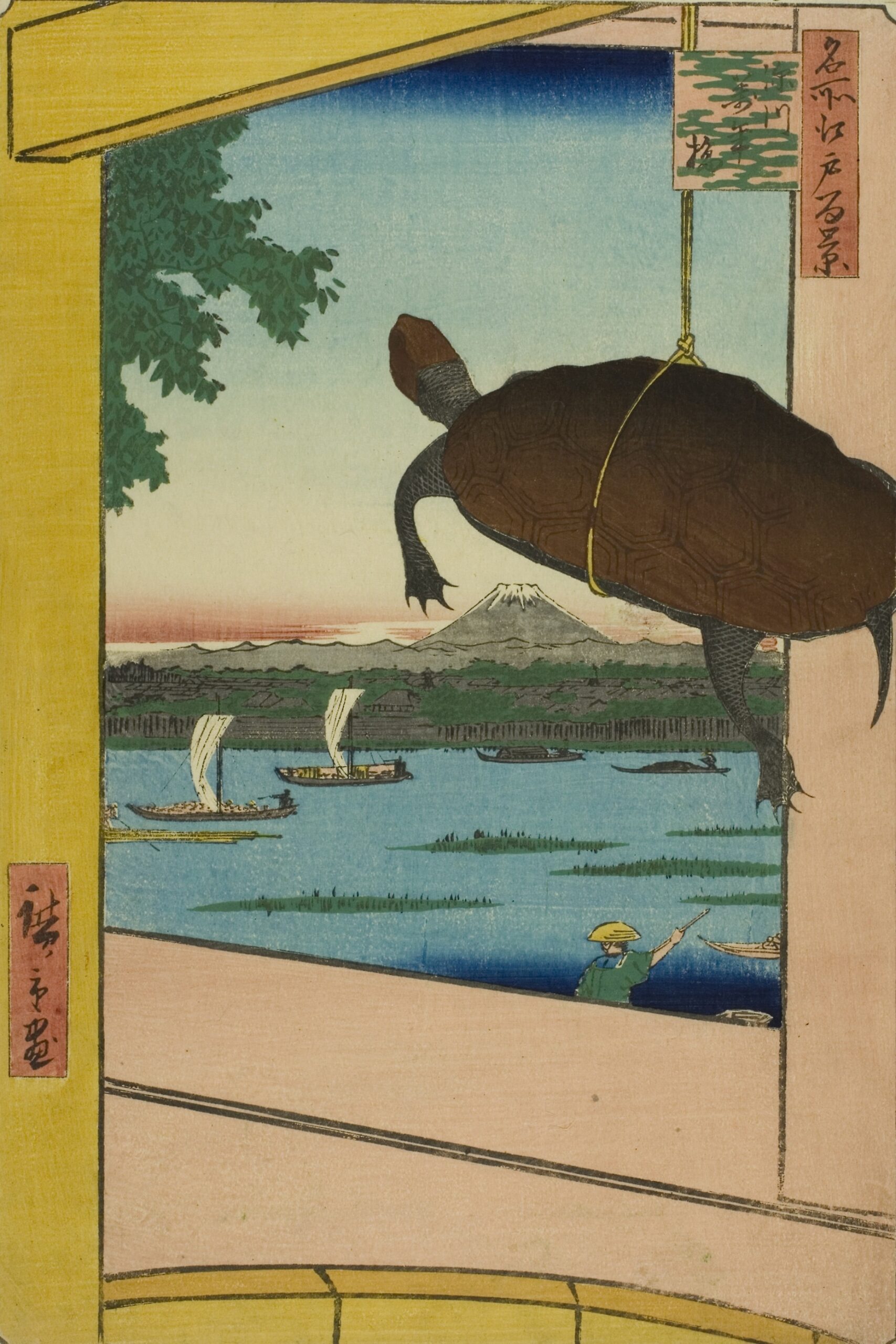
The bridge is positioned as a large arch in the composition.
The expansive river surface is boldly depicted.
Boats large and small passing under the bridge speak of the bustling water transport industry in Edo.
With boats carrying rice and lumber, and pleasure boats for outings, the river was truly “Edo’s highway.”
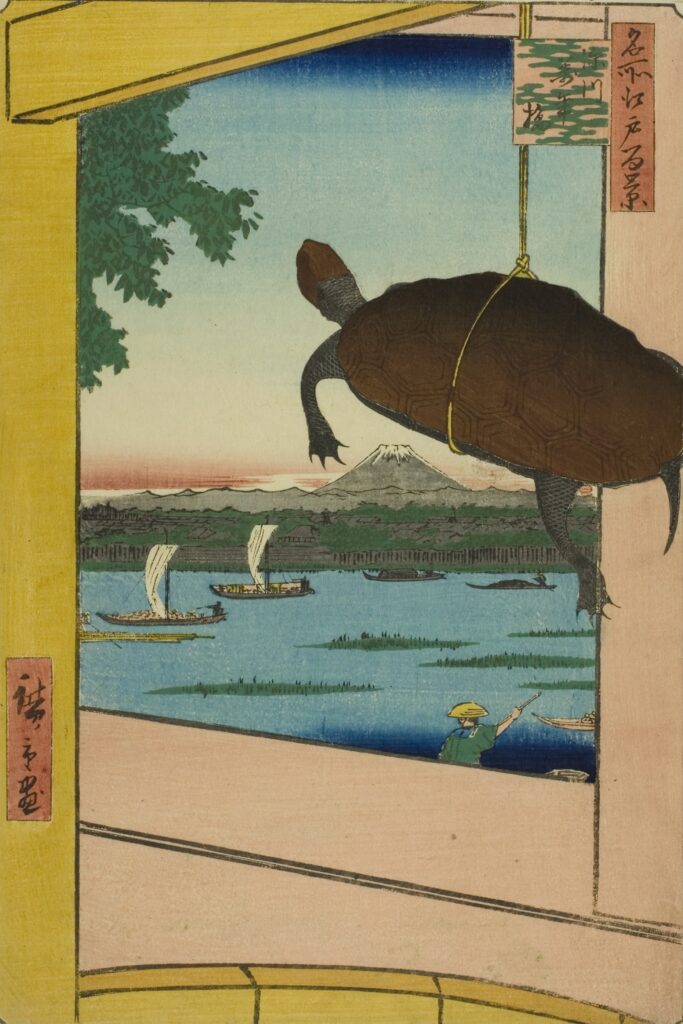
The large turtle depicted in the foreground is striking.
During the Edo period, on August 15th, shrines and temples would hold rites to release captured birds and fish into rivers and mountains, praying for the repose of the souls of the deceased and for the safety of the deceased.
Some people made a living by releasing turtles and birds.
Many bridge guards apparently had a side job.
It was a very laid-back business.
These turtles are being sold at Mannen Bridge, located just before the Onagi River and Sumida River join.
The bridge’s name comes from the turtle, which is said to live for 10,000 years.
The bridge’s railing and the bucket with the turtle hanging from it form a frame, creating a surprising composition with the turtle in the foreground and Mount Fuji in the background both in the center.
〈4〉 Walking across the modern-day Mannen Bridge
The current Mannen Bridge was rebuilt as an iron bridge.
It connects Tokiwa in Koto Ward and Yokokawa in Sumida Ward.
The view from the bridge has changed significantly since Hiroshige’s time. The mighty flow of the Sumida River remains unchanged to this day.
With the Skytree towering in the distance, the views of Edo and Tokyo overlap.
Spots around the bridge include the Fukagawa Edo Museum and Kiyosumi Garden, where you can experience Edo culture.
<5> Tourist Guide
1. Fukagawa Edo Museum
This popular facility features a life-size reconstruction of an Edo-period townscape.
You can experience the daily lives of ordinary people at the time Mannenbashi Bridge was painted.
2. Kiyosumi Garden
Retains traces of an Edo daimyo garden.
A tranquil Japanese garden.
It is within walking distance of Mannenbashi Bridge.
3. Tomioka Hachiman Shrine
This shrine represents Fukagawa.
It is also known for the Fukagawa Hachiman Festival, one of Edo’s three major festivals.
It was also a popular destination for people crossing the Mannenbashi Bridge.