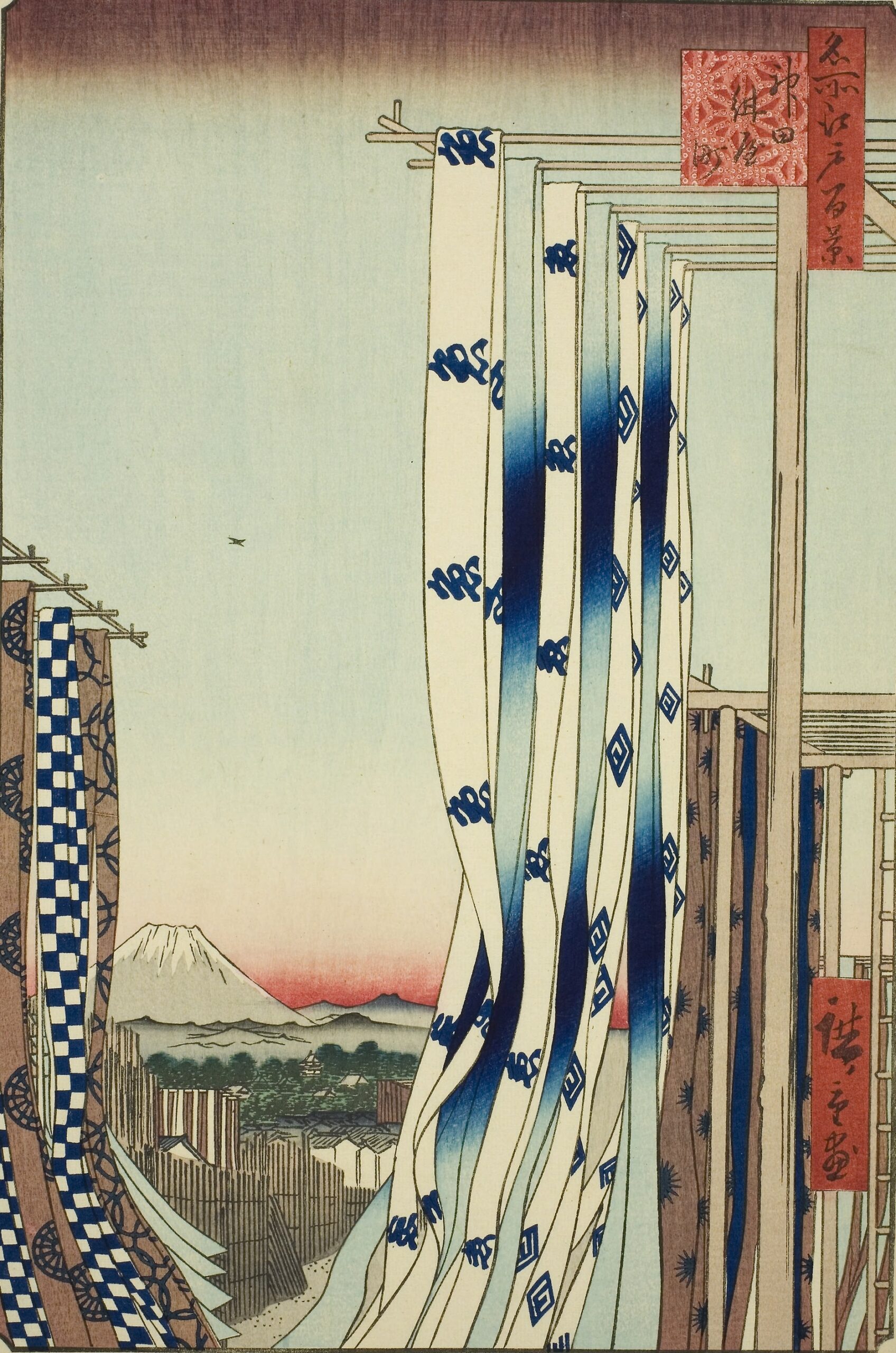
Utagawa Hiroshige – One Hundred Famous Views of Edo – 76 -automn- Kanda Kon’ya-cho 歌川広重-名所江戸百景-76-秋-神田紺屋町
Current Address: Kanda Kon’ya-cho, Chiyoda Ward
Latitude and Longitude: 35.6950, Longitude: 139.7740
Published: November 1857 Age: 61
Tourist Guide-Style Commentary: “Kanda Kon’ya-cho”
■ Introduction
Utagawa Hiroshige’s masterpiece series, “One Hundred Famous Views of Edo,” is a masterpiece of 119 prints depicting the faces of Edo throughout the four seasons.
Among these, “Kanda Kon’ya-cho” is one of the works that symbolizes Edo’s commerce and artisan culture.
Kanda was known as Edo’s leading merchant district, and Kon’ya-cho in particular was the center of the dyeing industry.
Here, Hiroshige vividly depicts the work of the artisans who supported the lives of the Edo people.
Hiroshige’s unique perspective is evident in his choice of subject matter, not nature or famous historical sites, but a town of artisans. This tourist-guide-style book introduces the charms of this “dyeing town,” which supported the clothing needs of Edo’s common people.
■ About Kanda Kon’ya-cho
Kanda is an area northeast of Edo Castle that flourished as a town filled with merchants and industrialists.
Kon’ya-cho, in particular, was an area lined with dye artisans, or “konya.”
Konya are artisans who dye fabric using techniques such as indigo dyeing and ink dyeing.
Edo residents wore cotton and linen kimonos on a daily basis, and re-dyeing and re-tailoring was common.
In addition to buying new kimonos, it was also common to enjoy trendy colors by “re-dying.”
Kon’ya-cho was an important town that met this demand.
The entire town became a workshop for artisans, and the sounds of washing cloth, the scent of dye, and the colorful sight of rolls of fabric drying in the sun made it a bustling town worthy of being called a “dye town.”
■ Highlights of the painting
Kanda was ruled by Tsuchiya Goroemon, who was authorized by Tokugawa Ieyasu to purchase indigo from the Kanto region and Izu.
Dye artisans gathered in this town, and the Aizome River flowed to the north.
Indigo-dyed fabric is hung one by one on a clothesline with a rafter.
It is drying, fluttering in the breeze.
The fabric bears a seal combining the character for “fish” (fish) of the publisher, Gyoei, and Hiroshige’s “hi” (fish) and “ro” (ro).
Similar fabric with wheel and checkered patterns is also drying on the left.
The landscape on the left depicts Edo Castle surrounded by greenery, with Mount Fuji in the distance.
■ Walking around Modern-Day Kanda Kon’ya-cho
Even today, the name “Kono’ya-cho” remains in the Chuo and Chiyoda wards.
While it is no longer the artisan district it was during the Edo period, the place name still speaks to its history.
Very few dyeing workshops remain in modern-day Kon’ya-cho.
Visiting long-established kimono shops in Nihonbashi and Kanda offers a chance to relive the dyeing culture of the Edo period.
Close to Kanda Myojin Shrine and Nihonbashi, this area is also recommended as a walking route to immerse yourself in the Edo atmosphere.
■ Tourist Guide Recommendations
- Ukiyo-e Viewing
You can see the real thing at the Edo-Tokyo Museum and the National Museum of Japan.
We recommend taking the time to appreciate the depiction of indigo-dyed fabric fluttering in the wind. - Kimono and Dyeing Culture Experience
There are also facilities in the Nihonbashi area that offer kimono rentals and indigo dyeing experiences.
Experience Hiroshige’s world for yourself and the allure of his paintings will only increase.
- Town Walking Route: Walking from Nihonbashi → Kanda Kon’yacho → Kanda Myojin Shrine is a historical walking course where you can enjoy Edo’s commerce, faith, and culture all at once.