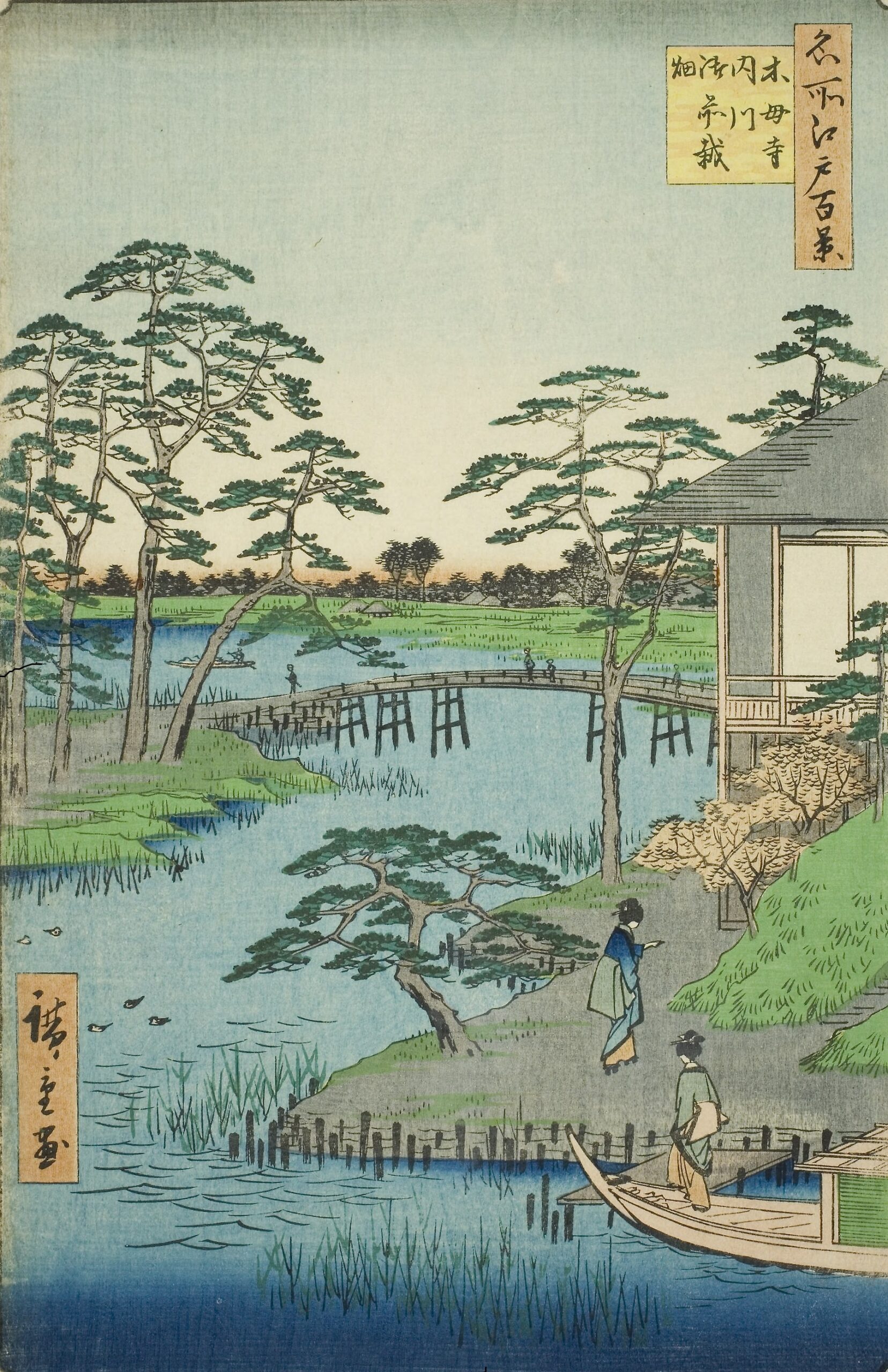
Utagawa Hiroshige-One Hundred Famous Views of Edo-93-Autumn-Mokuboji Uchikawa Gozensaibata 歌川広重-名所江戸百景-93-秋-木母寺内川御前栽畑
Current Address: Near Mokuboji Temple, Sumida Ward
Latitude and Longitude: Latitude: 35.6950, Longitude: 139.8160
Published: December 1857 Age: 61
Mokuboji Uchikawa Gozensaibata (Mokuboji Uchikawa Gozensaibata) Tourist Guide-Style Commentary: “Mokuboji Uchikawa Gozensaibata”
■ Introduction
Utagawa Hiroshige’s “One Hundred Famous Views of Edo” is a masterpiece consisting of 119 vivid illustrations depicting Edo’s landscapes and famous places.
One of the illustrations, “Mokuboji Uchikawa Gozensaibata,” is set at Mokuboji Temple, located on the east bank of the Sumida River (around Tsutsumi-dori in Sumida Ward, Tokyo).
This painting depicts the Uchikawa River that flows through the temple grounds and the landscape of the Shogun’s official fields (Gozenzaihata).
It vividly depicts the harmony between faith, agriculture, and the nature of Edo.
If you were introducing this area as a tourist guide, it would be a great spot to experience Edo’s faith, agriculture, and river scenery all in one place.
■ What is Mokuboji Temple?
Mokuboji Temple is an ancient temple said to have been built by order of Minamoto no Yoritomo.
The principal image is the Eleven-Headed Kannon Bodhisattva.
It is particularly known for the story known as the “Umewaka Legend.”
It is said that the temple was founded by Umewakamaru, a young boy separated from his mother, who died here and whose mother opened it to pray for his soul.
This moving story has also been the subject of the Kabuki and Noh plays “Sumida River.”
Mokuboji Temple was popular with the common people of Edo as the setting for the story.
During the Edo period, Mokuboji Temple was a popular tourist spot along the Sumida River, attracting many pilgrims and visitors for cherry blossom viewing and swimming in the river.
Mokuboji Temple was not simply a religious facility; it was a cultural hub that soothed people’s hearts.
■ What is the Gozenzaihata?
“Gozenzaihata” refers to fields where vegetables and grains were grown to feed the Shogun’s family.
The Edo Shogunate established such official fields in specific areas to ensure high-quality agricultural products.
The area around Mokuboji Temple is fertile and blessed with excellent water transportation along the Sumida River.
As a result, the Gozenzaihata was located here, where vegetables for the Shogun’s dinner table were grown.
The spacious fields depicted in the ukiyo-e are a symbolic representation of Edo’s agricultural landscape.
■ Highlights of the painting
Mokuboji Temple is located on the west bank of the upper Sumida River, about 200 meters downstream from its tributary, the Uchikawa River.
This temple is closely associated with the legend of Umewaka. The legend of Umewaka goes back to when he was kidnapped by human traffickers in Kyoto and brought to the Sumida River, where he died.
A mound was built for Umewaka’s burial, and a thatched hut was later built, forming Mokuboji Temple.
The image shown here is not of a temple, but of a restaurant on the temple grounds.
This Shijimi Restaurant served yamuimo (sea cucumber) and clam dishes.
A covered boat arrives on the right, with two geisha heading for the restaurant.
On the opposite bank of the Uchikawa River is Gozensaibatake, a field where vegetables were grown to be presented to the shogun.
■ Modern-day Kimoji Temple and a stroll around the surrounding area
Mokuboji Temple still exists today on Tsutsumi-dori in Sumida Ward, and enshrines the principal image, the Eleven-Headed Kannon.
Within the temple grounds, there are stone monuments and memorial towers that tell the legend of Umewakamaru, allowing you to feel the breath of history.
Gozensaibatake has since been lost.
■ Tourist Guide Recommendations
- Visit Mokuboji Temple and the Umewaka Legend
Visit the memorial tower associated with Umewakamaru within the temple grounds and imagine the story depicted in Noh and Kabuki plays. - Comparison with Ukiyo-e
By visiting the actual Mokuboji Temple with “One Hundred Famous Views of Edo” in hand, you can appreciate the contrast between Edo’s rural landscape and the modern urban landscape.